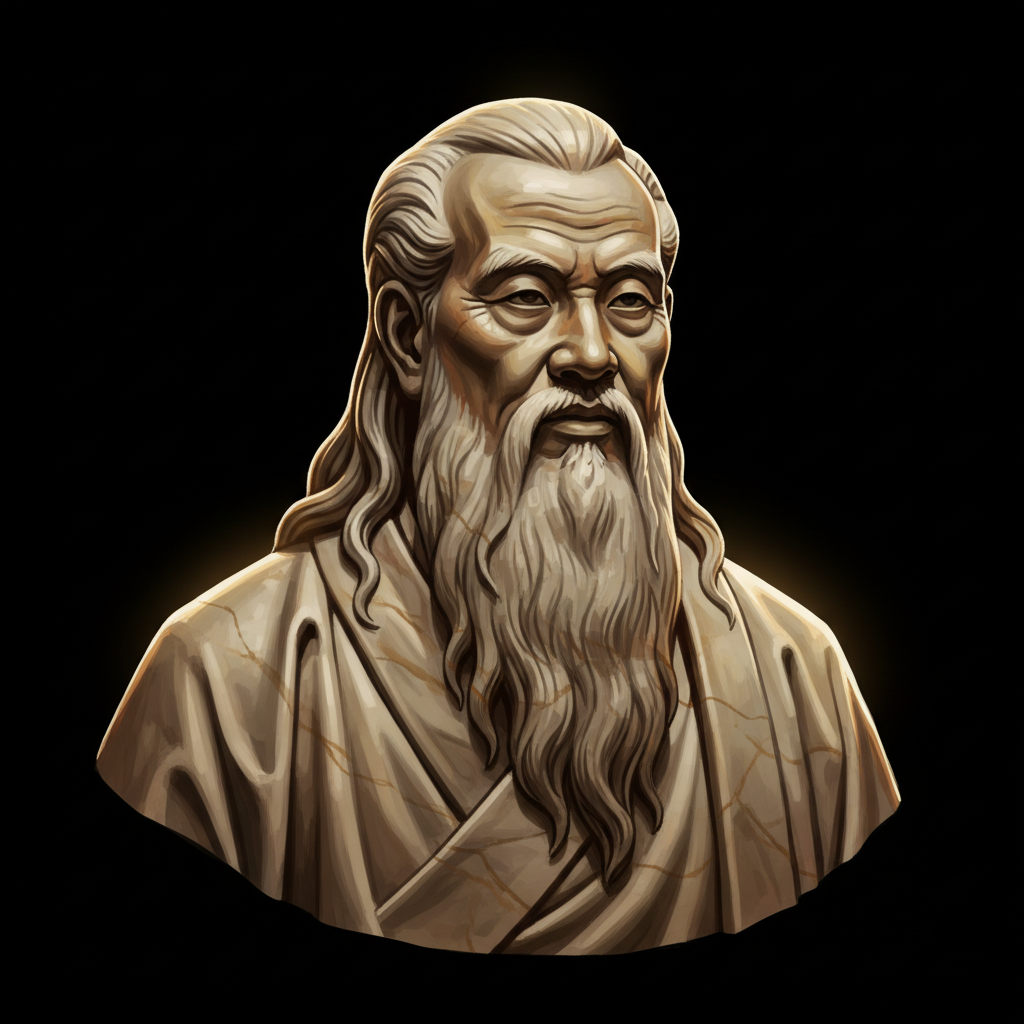
Laozi — "To yield is to be preserved whole."
To yield is to be preserved whole.
To yield is to be preserved whole.
Click any product to generate a realistic preview. Up to 3 at a time.
* Initial load can take up to 90 seconds — revising the preview in another color is nearly instant.
"The wise man's food is that which nourishes him; the fool's food is that which gratifies him."
"The sage is not attached to anything, and so he loses nothing."
"The sage is sharp but not cutting, pointed but not piercing, straightforward but not unrestrained, brilliant but not dazzling."
"Therefore it is because the sage never attempts to be great that he succeeds in becoming great."
"All things in the world come from being. And being comes from non-being."
Reputed founder of Taoism and author of the Tao Te Ching, whose wu wei (effortless action) shaped East Asian philosophy. Closely associated with Zhuangzi (later Taoist who extended Laozi's framework). For an intellectual contrast, see Confucius, near-contemporary Chinese sage of social ritual and duty — Confucius systematized social order through ritual and hierarchy; Laozi argued that all such systems were the disease, not the cure — the two founding poles of Chinese moral philosophy.
Found in 2 providers: grok,gemini
2 sources checked
Bending, giving way, or accepting a lower position keeps you intact. Resistance and rigidity invite breaking, while flexibility absorbs force and survives it. When you stop fighting every pressure, refuse to insist on winning, and let circumstances move through you, you come out of conflict undamaged. Softness outlasts hardness because it does not provide something solid for force to shatter, so the whole self stays together.
Laozi built Taoism around wu wei, effortless action that follows the grain of reality rather than forcing it. He repeatedly praised water, infants, and empty valleys as models of strength through yielding. Legend has him leaving society quietly rather than battling corruption, dictating the Tao Te Ching at a border pass and vanishing. This line distills his central conviction that the soft and low-placed endure while the rigid and proud break themselves.
Laozi lived during the late Zhou dynasty, an era sliding toward the Warring States period when feudal lords fought constantly and rulers demanded aggressive loyalty. Confucian thinkers answered the chaos with strict hierarchy, ritual, and active moral duty. Taoism offered the opposite medicine: retreat, humility, and non-contention as survival strategies amid political violence, purges, and short-lived courts. In a time when ambitious officials were regularly executed, counseling people to yield was practical, not merely poetic.
AI-generated insights based on extensive research and information for context. Factual errors? Email [email protected].
Your cart is empty