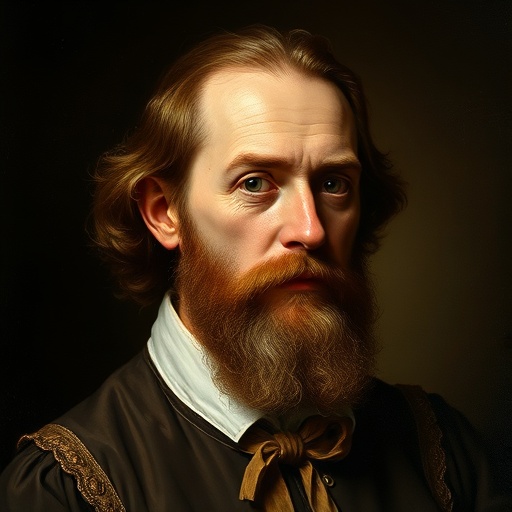
William Harvey — "Truth is the daughter of time, not of authority."
Truth is the daughter of time, not of authority.
Truth is the daughter of time, not of authority.
Click any product to generate a realistic preview. Up to 3 at a time.
* Initial load can take up to 90 seconds — revising the preview in another color is nearly instant.
"I have seen, and by my own experiments, demonstrated the truth of what I assert."
"The whole world is a theatre, and all the men and women merely players."
"We are taught by nature to begin with the simple and proceed to the complex."
"The blood, therefore, returns by the veins to the heart."
"The heart is the beginning of life; the sun of the microcosm."
English physician whose On the Motion of the Heart and Blood in Animals (1628) demonstrated blood circulation, overturning 1,400 years of Galenic medicine. Closely associated with Francis Bacon (his contemporary in the new English empiricism). For an intellectual contrast, see Galenic medicine, the 2nd-century Greek medical tradition (humors, blood-as-consumed-fuel) — Harvey calculated that the heart pumps more blood per hour than the body could possibly produce as fuel — a single quantitative observation that demolished the entire Galenic-Aristotelian medical worldview. The cleanest example in medical history of arithmetic disproving 14 centuries of authority.
A powerful statement on the nature of scientific truth, emphasizing empirical discovery over deference to established views.
Date: 17th Century (widely attributed, reflecting his scientific ethos)
PhilosophicalFound in 1 providers: gemini
1 source checked
Truth emerges gradually through observation, experimentation, and the passage of time — not because someone powerful declares it so. No authority figure, institution, or tradition can make something true by decree. Genuine knowledge requires patience, evidence, and honest inquiry. What seems uncertain today may become established fact tomorrow, but only through disciplined investigation rather than submission to conventional wisdom or hierarchical pronouncements.
Harvey spent decades meticulously observing dissected hearts and living animals before publishing his revolutionary theory of blood circulation in 1628. His peers and the medical establishment fiercely resisted his findings, clinging to Galen's 1,400-year-old authority. Harvey trusted empirical evidence over inherited doctrine, embodying this principle personally — his truth about circulation was vindicated not by acceptance from authorities but by time and reproducible observation.
The early modern period was a battleground between scholastic authority and empirical science. Galenic medicine dominated European universities for over a millennium through institutional power, not evidence. Harvey worked amid the Scientific Revolution alongside Galileo and Bacon, when challenging Aristotelian and Church-sanctioned knowledge risked professional ruin. The printing press had recently democratized ideas, and empiricism was slowly displacing reverence for ancient texts as the arbiter of natural truth.
AI-generated insights based on extensive research and information for context. Factual errors? Email [email protected].
Your cart is empty