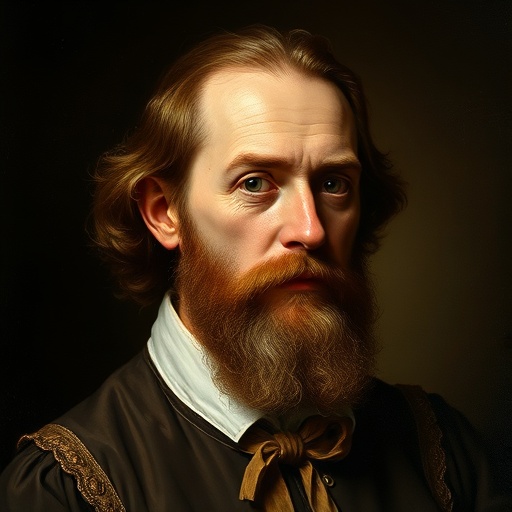
William Harvey — "The blood, therefore, returns by the veins to the heart."
The blood, therefore, returns by the veins to the heart.
The blood, therefore, returns by the veins to the heart.
Click any product to generate a realistic preview. Up to 3 at a time.
* Initial load can take up to 90 seconds — revising the preview in another color is nearly instant.
"The physician must be a man of experience."
"The greatest happiness is to be able to understand the works of God."
"I appeal to the evidence of my senses, and to the testimony of dissections."
"Only by understanding the wisdom of natural foods and their effects on the body, shall we attain mastery of disease and pain, which shall enable us to relieve the burden of mankind."
"It is better to know a little perfectly than to know much imperfectly."
English physician whose On the Motion of the Heart and Blood in Animals (1628) demonstrated blood circulation, overturning 1,400 years of Galenic medicine. Closely associated with Francis Bacon (his contemporary in the new English empiricism). For an intellectual contrast, see Galenic medicine, the 2nd-century Greek medical tradition (humors, blood-as-consumed-fuel) — Harvey calculated that the heart pumps more blood per hour than the body could possibly produce as fuel — a single quantitative observation that demolished the entire Galenic-Aristotelian medical worldview. The cleanest example in medical history of arithmetic disproving 14 centuries of authority.
Found in 1 providers: grok
1 source checked
Blood does not simply disperse throughout the body and disappear — it moves in a continuous loop, flowing outward through arteries and returning through veins back to the heart. The body's fluid is recycled, not consumed. This describes a closed circulatory system where the heart acts as a pump, and blood completes a circuit rather than being produced and absorbed endlessly.
Harvey spent decades dissecting animals and measuring cardiac output to prove blood circulates rather than being continuously generated by the liver, as Galen taught. This sentence is the empirical conclusion of his 1628 masterwork De Motu Cordis, the result of quantitative reasoning showing the heart pumps far more blood per hour than the body could possibly produce.
In early modern Europe, Galenic medicine — nearly 1,500 years old — held that the liver constantly produced new blood consumed by tissues. Harvey's claim contradicted church-endorsed ancient authority during an era when challenging classical knowledge was professionally and sometimes physically dangerous. His mechanistic, observation-based proof helped establish empirical science over inherited dogma during the Scientific Revolution.
AI-generated insights based on extensive research and information for context. Factual errors? Email [email protected].
Your cart is empty