Laozi — "Use justice to rule a country. Use surprise to wage war. Use non-action to gover…"
Use justice to rule a country. Use surprise to wage war. Use non-action to govern the world.
Use justice to rule a country. Use surprise to wage war. Use non-action to govern the world.
Click any product to generate a realistic preview. Up to 3 at a time.
* Initial load can take up to 90 seconds — revising the preview in another color is nearly instant.
"He who boasts of his own achievements will not endure."
"A man with outward courage dares to die; a man with inward courage dares to live."
"Deal with it before it happens. Set things in order before there is confusion."
"To know yet to think that one does not know is the highest [attainment]. Not to know yet to think that one knows is a disease."
"The journey of a thousand miles begins with a single step."
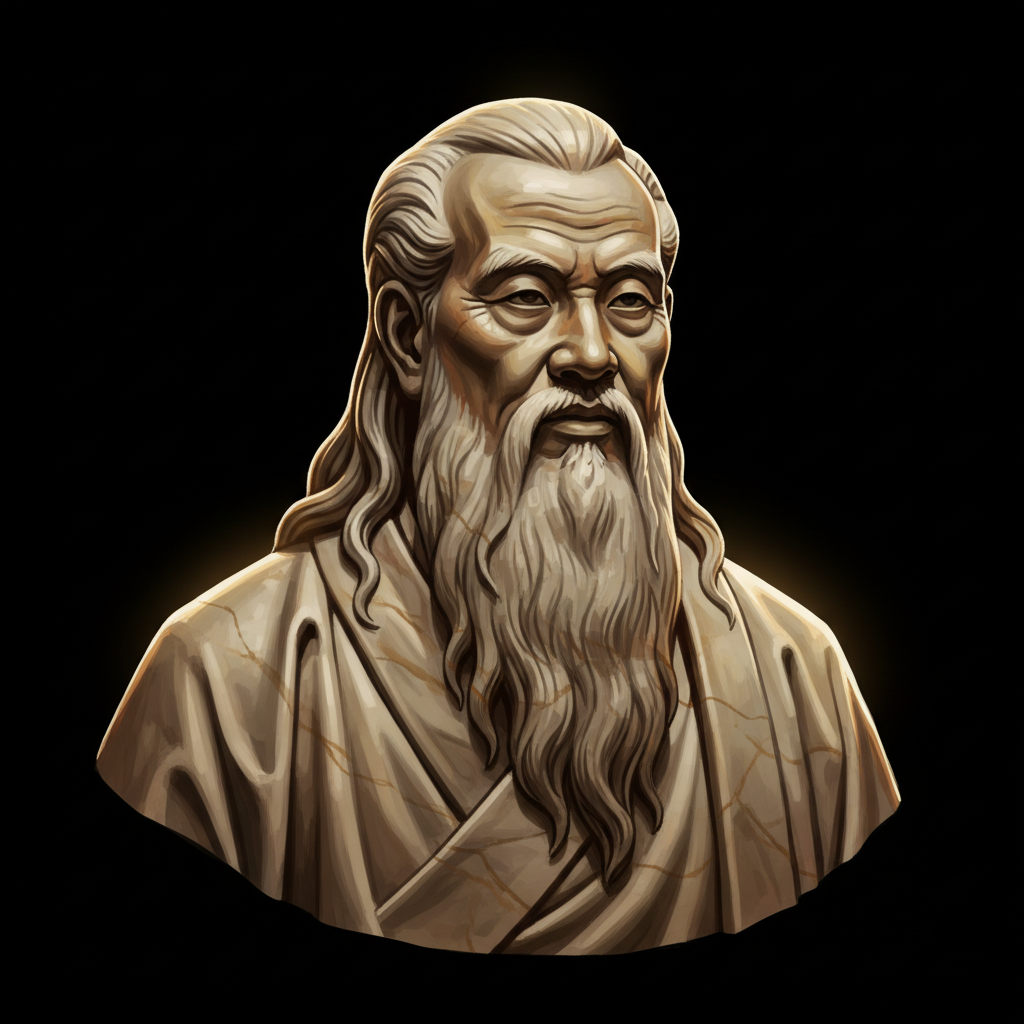
Reputed founder of Taoism and author of the Tao Te Ching, whose wu wei (effortless action) shaped East Asian philosophy. Closely associated with Zhuangzi (later Taoist who extended Laozi's framework). For an intellectual contrast, see Confucius, near-contemporary Chinese sage of social ritual and duty — Confucius systematized social order through ritual and hierarchy; Laozi argued that all such systems were the disease, not the cure — the two founding poles of Chinese moral philosophy.
Found in 1 providers: gemini
1 source checked
Different situations demand different methods. Running a country well requires fairness and predictable rules so people know what to expect. Winning a war requires the opposite, since enemies prepare for expected moves, so unpredictability wins battles. But governing the world at the deepest level requires neither force nor cleverness, only stepping back and letting things unfold naturally without interference, allowing people and events to find their own balance.
Laozi served as an archivist in the Zhou royal court, observing rulers closely before withdrawing from public life in disillusionment. This layered advice reflects his signature method of contrasting worldly tactics with deeper Taoist wisdom. He accepts that laws and strategy have their place, but places wu wei, effortless non-action, above both. The progression mirrors his teaching that the highest path transcends the clever tools humans normally rely on.
Laozi lived during the late Zhou dynasty, when central authority was collapsing and regional states fought constant wars, a period leading into the Warring States era. Rulers obsessed over legal codes, military strategy, and harsh Legalist control to survive. Against this backdrop of manipulation and violence, Laozi's suggestion that the world is best governed by doing nothing was a radical rebuke of the scheming statecraft consuming Chinese civilization around him.
AI-generated insights based on extensive research and information for context. Factual errors? Email [email protected].
Your cart is empty