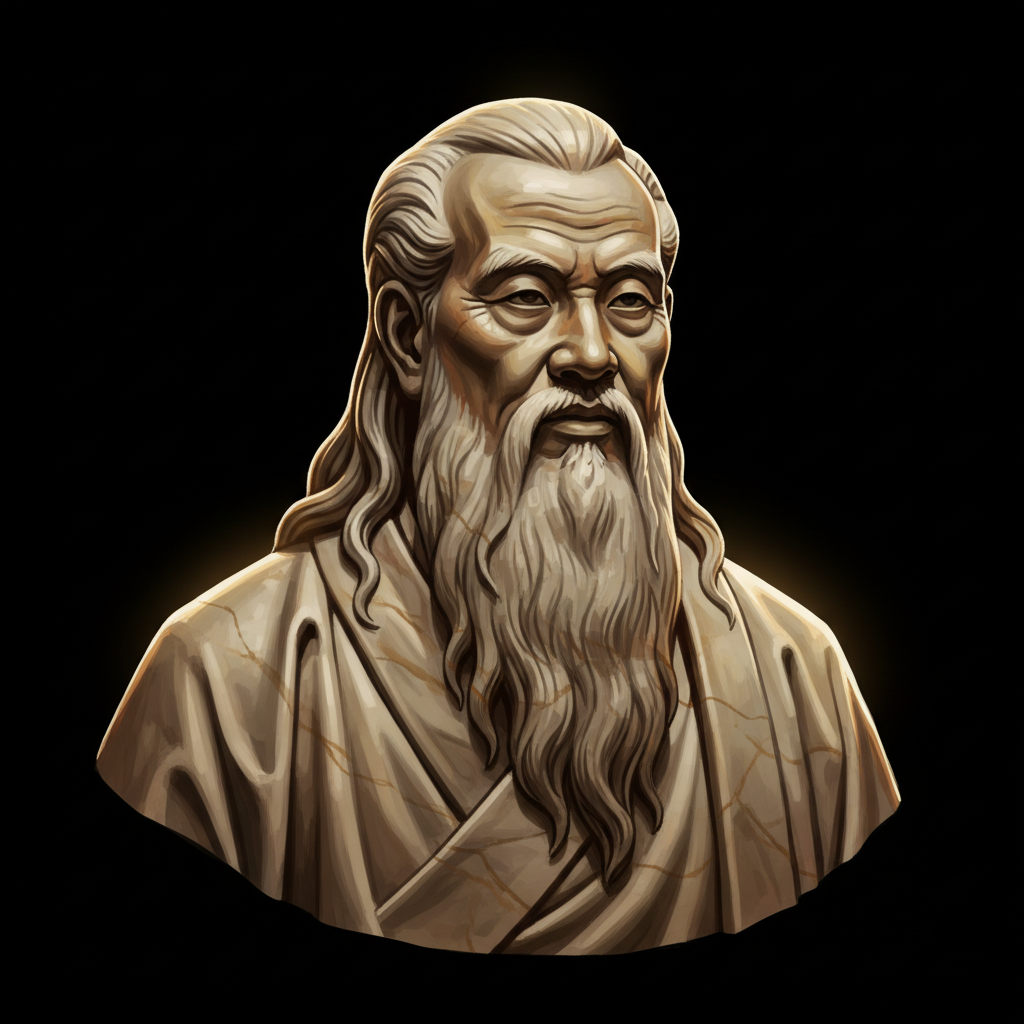
Laozi — "The journey of a thousand miles begins with a single step."
The journey of a thousand miles begins with a single step.
The journey of a thousand miles begins with a single step.
Click any product to generate a realistic preview. Up to 3 at a time.
* Initial load can take up to 90 seconds — revising the preview in another color is nearly instant.
"Therefore it is because the sage never attempts to be great that he succeeds in becoming great."
"The greatest paradox of life is that death is the ultimate goal."
"Knowing others is intelligence; knowing yourself is true wisdom. Mastering others is strength; mastering yourself is true power."
"To attain knowledge, add things everyday. To attain wisdom, remove things every day."
"Governing a large country is like frying a small fish."
Reputed founder of Taoism and author of the Tao Te Ching, whose wu wei (effortless action) shaped East Asian philosophy. Closely associated with Zhuangzi (later Taoist who extended Laozi's framework). For an intellectual contrast, see Confucius, near-contemporary Chinese sage of social ritual and duty — Confucius systematized social order through ritual and hierarchy; Laozi argued that all such systems were the disease, not the cure — the two founding poles of Chinese moral philosophy.
Found in 1 providers: grok
1 source checked
Any large goal or long undertaking, no matter how daunting, has to start with one small action. Progress is not made by staring at the finish line but by taking the first concrete move, and then another. Size and distance become manageable when broken down into the immediate next step you can actually take right now. Waiting for perfect conditions guarantees you never begin at all.
Laozi taught wu wei, effortless action aligned with the natural flow of the Tao rather than forced striving. As the semi-legendary founder of Taoism and reputed keeper of the Zhou royal archives, he favored humility, patience, and yielding over ambition. This saying captures his conviction that vast transformations unfold from small, unforced beginnings, mirroring how water carves stone slowly and how sages accomplish much by starting modestly.
Laozi is traditionally placed in the 6th century BCE, late Zhou dynasty China, an era of collapsing feudal order leading toward the Warring States period. Rival lords waged constant war, and philosophers of the Hundred Schools competed to prescribe cures. Against Confucian emphasis on ritual and ambitious statecraft, Taoism offered a counter-philosophy of simplicity, patience, and small beginnings, a pointed message to rulers and reformers overwhelmed by the scale of restoring a fractured realm.
AI-generated insights based on extensive research and information for context. Factual errors? Email [email protected].
Your cart is empty