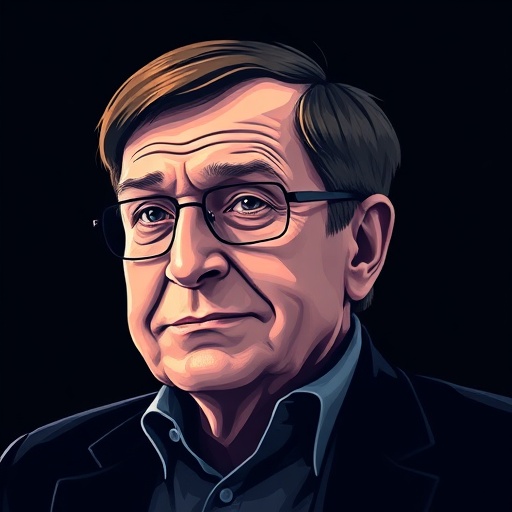
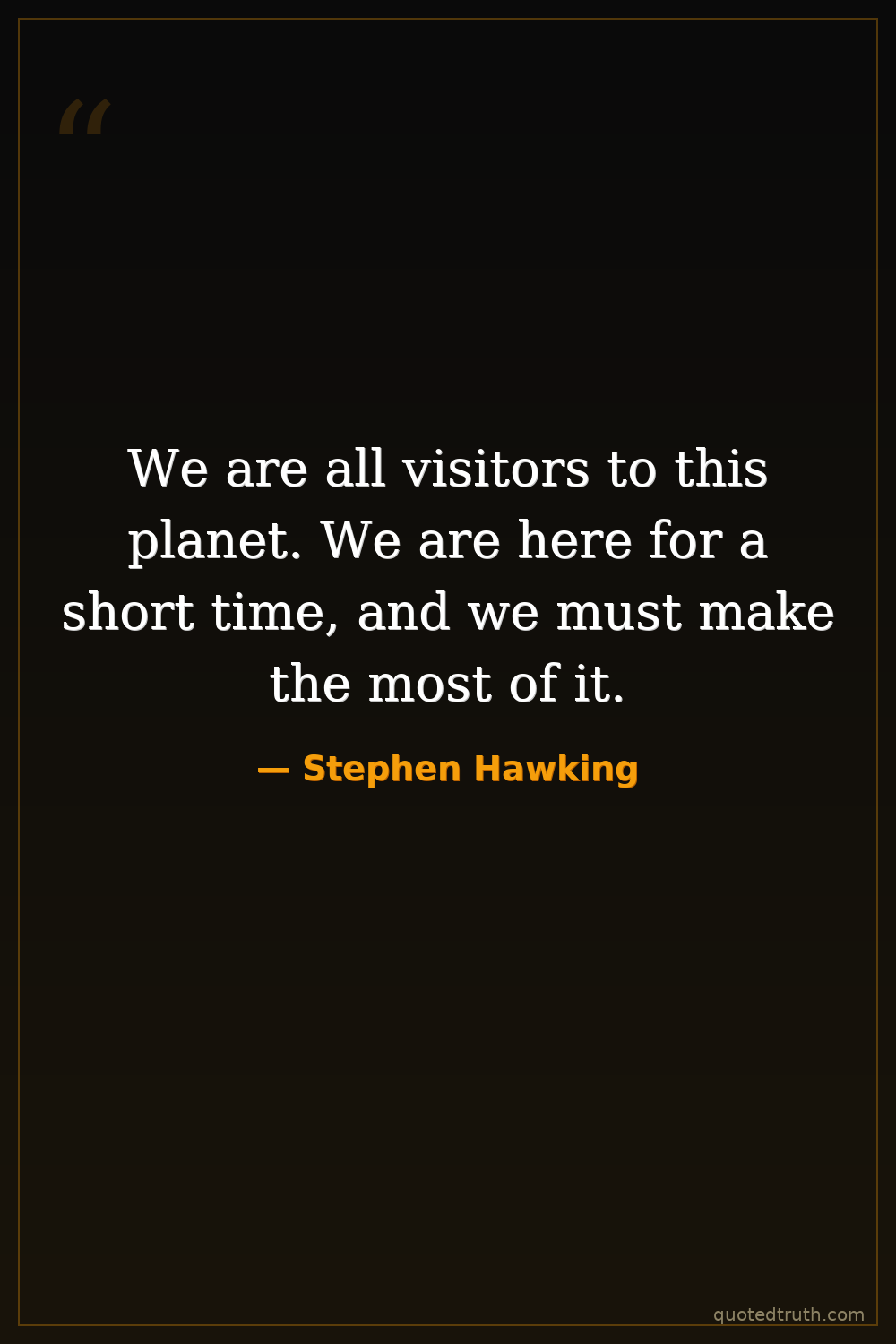
Stephen Hawking — "We are all visitors to this planet. We are here for a short time, and we must ma…"
We are all visitors to this planet. We are here for a short time, and we must make the most of it.
We are all visitors to this planet. We are here for a short time, and we must make the most of it.
Click any product to generate a realistic preview. Up to 3 at a time.
* Initial load can take up to 90 seconds — revising the preview in another color is nearly instant.
"I tell my kids: Don't spend all your time at the computer. But then I realize, I do that myself all day."
"In the proof stage, I nearly cut that last sentence of the book. Had I done so, the sales might have been halved."
"I have always been very optimistic about the future of the human race."
"The universe is a beautiful and dangerous place, and I'm glad to be a part of it."
"I am an optimist, but I am a realist who understands that science is a slow process."
British theoretical physicist whose Hawking radiation work and A Brief History of Time (1988) brought black-hole physics to a mass audience while he lived with ALS for 55 years. Closely associated with Roger Penrose (his collaborator on singularity theorems) and Carl Sagan (fellow popularizer who wrote Brief History's foreword). For an intellectual contrast, see William Lane Craig, American philosopher of religion — Craig's Kalam cosmological argument depends on the Big Bang requiring a divine first cause; Hawking's no-boundary proposal was specifically designed to remove the moment that would require one — the cleanest cosmology-vs-natural-theology contrast in modern thought.
Found in 1 providers: grok
1 source checked
We don't permanently belong to Earth — we're temporary inhabitants passing through. Life is finite, so wasting it on trivial pursuits is a mistake. The point isn't simply to exist but to engage fully, contribute meaningfully, and extract maximum value from the time given. Urgency matters: knowing time is limited should sharpen your focus on what genuinely counts.
Hawking lived this philosophy under extraordinary pressure. Diagnosed with ALS at 21 and given two years, he survived decades while almost completely paralyzed, communicating through a single cheek muscle. Rather than retreating, he revolutionized theoretical physics, wrote bestselling popular science, and lectured globally. His entire career was a demonstration that constrained time demands maximum effort.
Hawking worked through the Cold War space race, the dawn of computing, and the information age — eras when humanity simultaneously grasped its cosmic insignificance and technological power. Climate awareness was also rising during his later decades; he publicly warned about existential threats. The tension between human fragility and human potential made his visitor-on-a-pale-blue-dot framing especially resonant.
AI-generated insights based on extensive research and information for context. Factual errors? Email [email protected].
Your cart is empty