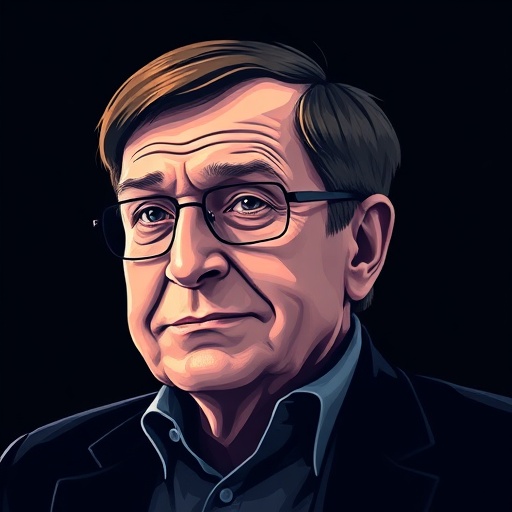
Stephen Hawking — "The universe is a beautiful and dangerous place, and I'm glad to be a part of it…"
The universe is a beautiful and dangerous place, and I'm glad to be a part of it.
The universe is a beautiful and dangerous place, and I'm glad to be a part of it.
Click any product to generate a realistic preview. Up to 3 at a time.
* Initial load can take up to 90 seconds — revising the preview in another color is nearly instant.
"It is a waste of time to be angry about my disability. One has to get on with life and I haven't done badly. People won't have time for you if you are always angry or complaining."
"There are no boundaries to human endeavor. We are all different. However bad life may seem, there is always something you can do and succeed at. While there's life, there is hope."
"We are all different, but we share the same human spirit. Perhaps it's human nature that we adapt and survive."
"The universe is a mystery, and I'm trying to solve it."
"I think that the human race has a future, but it's going to be a challenging one."
British theoretical physicist whose Hawking radiation work and A Brief History of Time (1988) brought black-hole physics to a mass audience while he lived with ALS for 55 years. Closely associated with Roger Penrose (his collaborator on singularity theorems) and Carl Sagan (fellow popularizer who wrote Brief History's foreword). For an intellectual contrast, see William Lane Craig, American philosopher of religion — Craig's Kalam cosmological argument depends on the Big Bang requiring a divine first cause; Hawking's no-boundary proposal was specifically designed to remove the moment that would require one — the cleanest cosmology-vs-natural-theology contrast in modern thought.
Found in 1 providers: grok
1 source checked
The universe contains wonders — galaxies, nebulae, the architecture of spacetime — alongside forces that annihilate without mercy: black holes, gamma-ray bursts, colliding stars. This quote holds both truths simultaneously. Rather than letting danger breed despair, the speaker finds gratitude in simply existing within something so vast and extraordinary. It's a mature acceptance: reality is neither safe nor comfortable, but participation in it — consciousness witnessing the cosmos — is itself a remarkable gift.
Hawking spent decades mapping the universe's most violent extremes — black holes where time stops, the Big Bang's explosive origin. Yet he also lived under perpetual physical danger: ALS diagnosed at 21 left him almost fully paralyzed for over 50 years. He defied every medical timeline while producing foundational physics. His famous wit and refusal to be defined by illness directly mirrors this quote's spirit — finding gladness in existence despite its ruthless constraints.
Hawking's active career spanning the 1960s through 2010s coincided with humanity's deepest cosmic reckoning. The Cold War normalized existential threat; nuclear arsenals made Earth genuinely fragile. Simultaneously, space telescopes and radio astronomy revealed staggering cosmic beauty — pulsars, quasars, the cosmic microwave background. His 1988 bestseller A Brief History of Time captured this duality globally. The era forced humanity to confront both its smallness in an indifferent universe and the privilege of being conscious within it.
AI-generated insights based on extensive research and information for context. Factual errors? Email [email protected].
Your cart is empty