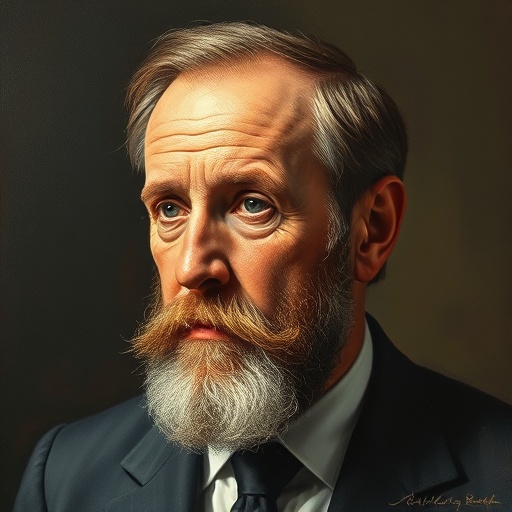
Niels Bohr — "We are here in a position to be able to understand that the human spirit cannot …"
We are here in a position to be able to understand that the human spirit cannot be completely satisfied by science alone.
We are here in a position to be able to understand that the human spirit cannot be completely satisfied by science alone.
Click any product to generate a realistic preview. Up to 3 at a time.
* Initial load can take up to 90 seconds — revising the preview in another color is nearly instant.
"When we speak of the electron, we are not speaking of something that really exists, but of something that we have imagined."
"The scientist's greatest reward is the joy of discovery."
"There are some things so serious that you have to laugh at them."
"Never express yourself more clearly than you are able to think."
"The atom is not a mechanical system, but a system of relationships."
Found in 1 providers: grok
1 source checked
Science, for all its power to explain how the physical world works, cannot fully answer every question humans care about. People also seek meaning, beauty, morality, purpose, and emotional connection, which lie beyond measurement and equations. A purely scientific worldview leaves important parts of human experience untouched. To live a complete life, we need more than facts and formulas; we also need art, ethics, relationships, and reflection on what matters.
Bohr revolutionized physics with his atomic model and helped found quantum mechanics, yet he was deeply philosophical, drawn to complementarity, Eastern thought, and the limits of knowledge. He wrestled with the ethical fallout of nuclear weapons, advocating openness among nations. Friendships with Einstein, artists, and writers shaped him, and his own motto cited opposites as complementary truths. This quote captures his conviction that rigorous science must coexist with humanistic and spiritual insight.
Bohr lived through two world wars, the rise of quantum theory, and the atomic bomb's creation and aftermath. Early twentieth-century Europe was shaken by collapsing certainties in physics, politics, and religion, while positivism claimed science could answer everything. After Hiroshima, many scientists, including Bohr, questioned unchecked technical progress. Existentialism, theology, and Eastern philosophy surged in popular thought. In that climate, his insistence on a broader human spirit pushed back against narrow scientism and called for wisdom alongside discovery.
AI-generated insights based on extensive research and information for context. Factual errors? Email [email protected].
Your cart is empty