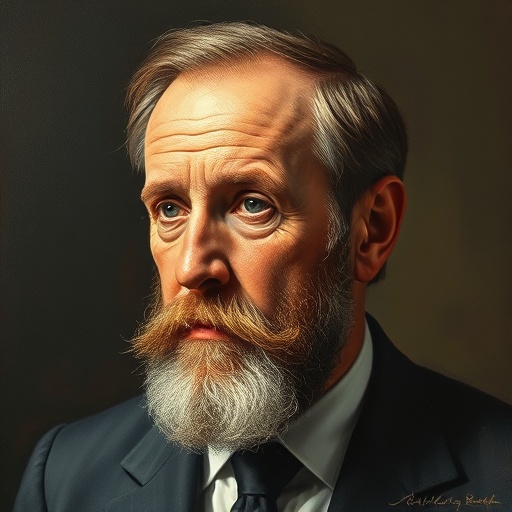
Niels Bohr — "Never express yourself more clearly than you are able to think."
Never express yourself more clearly than you are able to think.
Never express yourself more clearly than you are able to think.
Click any product to generate a realistic preview. Up to 3 at a time.
* Initial load can take up to 90 seconds — revising the preview in another color is nearly instant.
"No, no, you're not thinking; you're just being logical."
"The goal of science is to understand the world, and the goal of life is to live it."
"Only a fool is certain of anything. A wise man is always open to doubt."
"Physics is an attempt to describe the world, and it is impossible to describe the world without describing ourselves."
"It is wrong to think that the task of physics is to find out how nature is. Physics concerns what we can say about nature."
Found in 3 providers: grok,deepseek,gemini
3 sources checked
Don't dress up half-formed ideas in polished language. Clear words can fool you and your audience into believing the underlying thinking is equally clear, when in reality the concept is still fuzzy, incomplete, or contradictory. Match the precision of your expression to the precision of your actual understanding. If a notion is tentative, speak tentatively. Premature certainty in phrasing locks in confusion, hides gaps, and stops you from doing the harder work of actually figuring out what you mean.
Bohr built quantum theory on concepts that stretched language past its breaking point: complementarity, wave-particle duality, observer-dependent reality. He famously rewrote drafts endlessly, dictating sentences dozens of times, because he refused to say more than he genuinely grasped. His lectures were notoriously groping and hesitant, frustrating listeners who wanted crispness. That hesitation was principled: for Bohr, atomic reality was so strange that any fluent, confident description was almost certainly wrong. Ambiguity honored the physics.
Bohr worked through the 1920s-30s quantum revolution, when classical intuitions collapsed and physicists like Einstein, Heisenberg, and Schrödinger fought over what equations actually meant. Popular science writing was exploding, and journalists demanded tidy explanations of relativity and atoms. Meanwhile logical positivists in Vienna were insisting every meaningful statement be precisely verifiable. Bohr pushed back against both pressures, arguing that forcing clean language onto genuinely unfinished ideas, whether in physics or philosophy, was intellectually dishonest and scientifically dangerous.
AI-generated insights based on extensive research and information for context. Factual errors? Email [email protected].
Your cart is empty