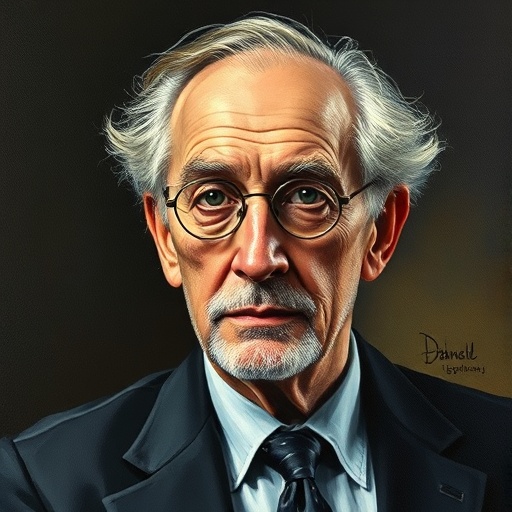
Francis Crick — "We are just a collection of molecules."
We are just a collection of molecules.
We are just a collection of molecules.
Click any product to generate a realistic preview. Up to 3 at a time.
* Initial load can take up to 90 seconds — revising the preview in another color is nearly instant.
"The origin of life is a scientific problem."
"The truth is rarely pure and never simple."
"The scientific method is a powerful tool, but it is not the only way to understand the world."
"Science is a game."
"You, your joys and your sorrows, your memories and your ambitions, your sense of personal identity and free will, are in fact no more than the behavior of a vast assembly of nerve cells and their asso…"
Found in 1 providers: grok
1 source checked
The statement claims that human beings, despite our sense of self, emotion, and consciousness, are ultimately nothing more than physical matter organized in complex ways. There is no soul, spirit, or supernatural ingredient added on top. Everything we experience, think, or feel arises from chemistry and physics operating among atoms and molecules. It is a strict materialist view that reduces life and mind to molecular interactions governed entirely by natural laws.
Crick spent his career proving life's machinery is molecular. After co-discovering DNA's double helix with Watson in 1953, he helped crack the genetic code, showing heredity is chemistry. Later he turned to consciousness, arguing in The Astonishing Hypothesis that the self is just neurons firing. A lifelong atheist who left a research post over a proposed chapel, Crick consistently insisted biology needs no mysticism—molecules suffice to explain us.
Crick worked during the molecular biology revolution of the mid-to-late 20th century, when DNA, proteins, and neurons were rapidly demystifying life. Postwar science increasingly challenged religious and vitalist explanations of humanity, while the Human Genome Project and neuroscience boom of the 1990s pushed reductionism into public debate. His era wrestled with bioethics, cloning fears, and questions about free will, making blunt materialist claims like this both scientifically mainstream and culturally provocative.
AI-generated insights based on extensive research and information for context. Factual errors? Email [email protected].
Your cart is empty