What it means
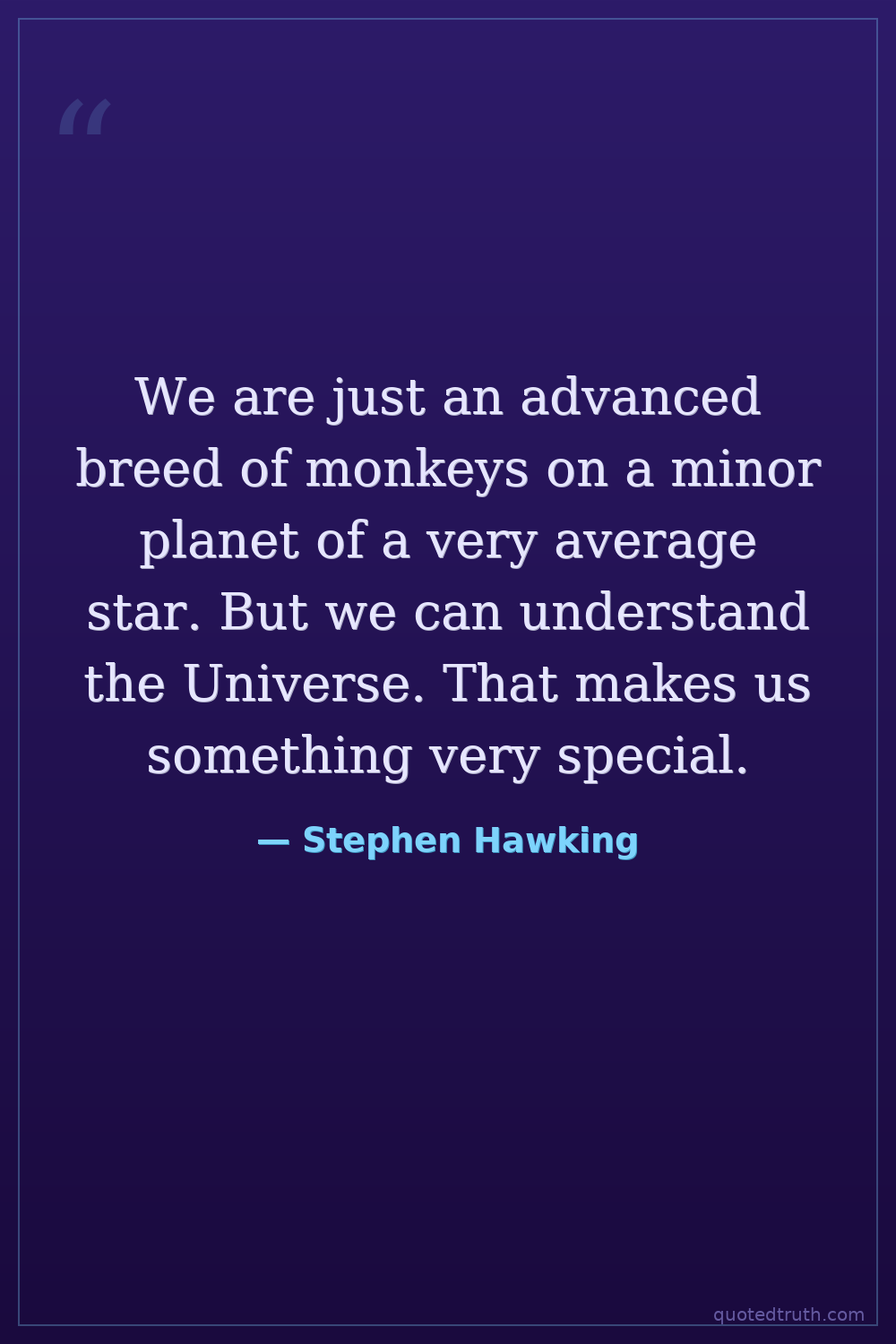
Humans occupy a physically insignificant position in the cosmos — primates on an ordinary rock around a mediocre star. Yet despite this cosmic smallness, we possess the rare ability to comprehend the universe itself. The quote's power lies in that pivot: not what we are materially, but what we can grasp mentally. Understanding the cosmos — its scale, laws, and history — is what elevates humanity above mere biology and gives existence genuine meaning.
Relevance to Stephen Hawking
Hawking spent his career mapping the universe's most extreme phenomena — black holes, the Big Bang, quantum gravity. He was physically confined by ALS from age 21, almost entirely paralyzed, while his mind ranged across cosmic scales. This tension mirrors the quote perfectly. He championed public science through A Brief History of Time, believing ordinary people could grasp deep cosmic truths. His life proved intellect transcends physical limitation — the ultimate expression of something very special.
The era
During Hawking's lifetime (1942–2018), humanity confronted its cosmic insignificance at an accelerating pace. The Hubble Space Telescope revealed billions of galaxies; Voyager's 1990 pale blue dot image showed Earth as a speck; exoplanet surveys found billions of potentially habitable worlds. Cold War nuclear anxiety, climate science, and evolutionary biology were eroding anthropocentric worldviews. Hawking's claim that comprehension itself is humanity's distinguishing achievement offered intellectual pride without requiring religious or political exceptionalism.
AI-generated insights based on extensive research and information for context. Factual errors? Email [email protected].