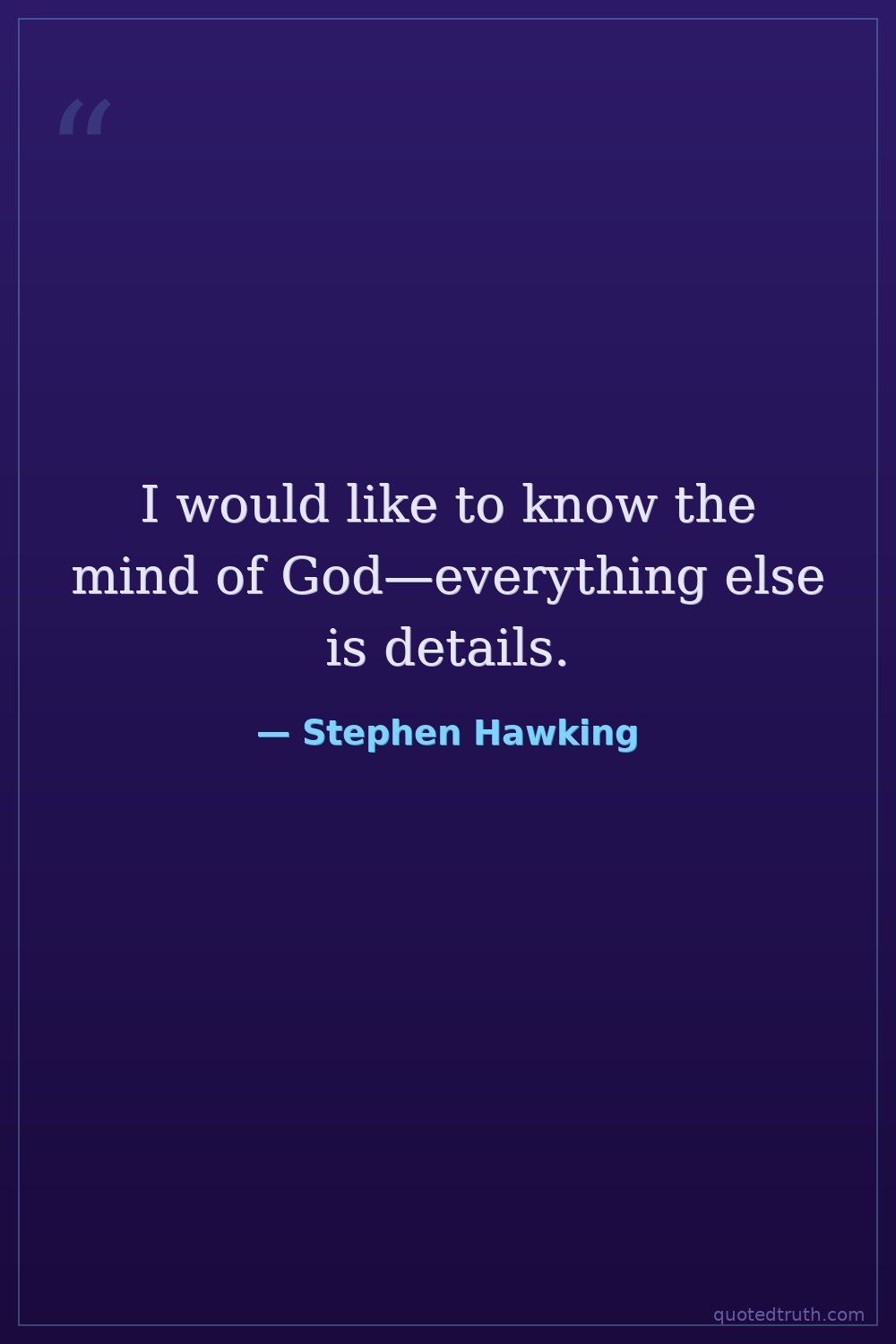
Stephen Hawking — "I would like to know the mind of God—everything else is details."
I would like to know the mind of God—everything else is details.
I would like to know the mind of God—everything else is details.
Click any product to generate a realistic preview. Up to 3 at a time.
* Initial load can take up to 90 seconds — revising the preview in another color is nearly instant.
"I believe that the simplest explanation is that there is no God who created the universe and directed our fate. This leads me to a profound realization: there is probably no heaven and afterlife eithe…"
"I believe that we are alone in the universe, but I hope we are not."
"There is a fundamental difference between religion, which is based on authority, and science, which is based on observation and reason. Science will win because it works."
"I believe that we are alone in the universe, or that we are the only intelligent life."
"The development of full artificial intelligence could spell the end of the human race."
British theoretical physicist whose Hawking radiation work and A Brief History of Time (1988) brought black-hole physics to a mass audience while he lived with ALS for 55 years. Closely associated with Roger Penrose (his collaborator on singularity theorems) and Carl Sagan (fellow popularizer who wrote Brief History's foreword). For an intellectual contrast, see William Lane Craig, American philosopher of religion — Craig's Kalam cosmological argument depends on the Big Bang requiring a divine first cause; Hawking's no-boundary proposal was specifically designed to remove the moment that would require one — the cleanest cosmology-vs-natural-theology contrast in modern thought.
Found in 1 providers: grok
1 source checked
The quote declares an ambition to fully understand the universe's fundamental laws — the complete, unified framework governing all of existence. 'Mind of God' is metaphorical shorthand for the ultimate theory of everything: a single coherent set of principles explaining why the universe exists and behaves as it does. Everything else — technology, politics, daily life — becomes secondary noise once you've oriented your entire existence toward that singular, all-explaining truth.
Hawking spent his career seeking exactly this — a Theory of Everything uniting general relativity and quantum mechanics. Paralyzed by ALS from age 21, he continued pursuing the deepest questions physics could ask. His bestseller A Brief History of Time (1988) literally ends with a version of this sentiment. As an atheist, he used 'God' as a stand-in for nature's ultimate logic, not religion — a distinction he repeatedly clarified.
Hawking's era — roughly 1960s to 2010s — saw physicists closer than ever to a Theory of Everything. The Standard Model unified three fundamental forces by the 1970s. String theory emerged in the 1980s promising full unification. The Higgs boson was confirmed in 2012. Yet gravity stubbornly resisted integration. This pursuit defined an era when scientists genuinely believed final answers were reachable, making Hawking's ambition widely shared and culturally resonant.
AI-generated insights based on extensive research and information for context. Factual errors? Email [email protected].
Your cart is empty