What it means
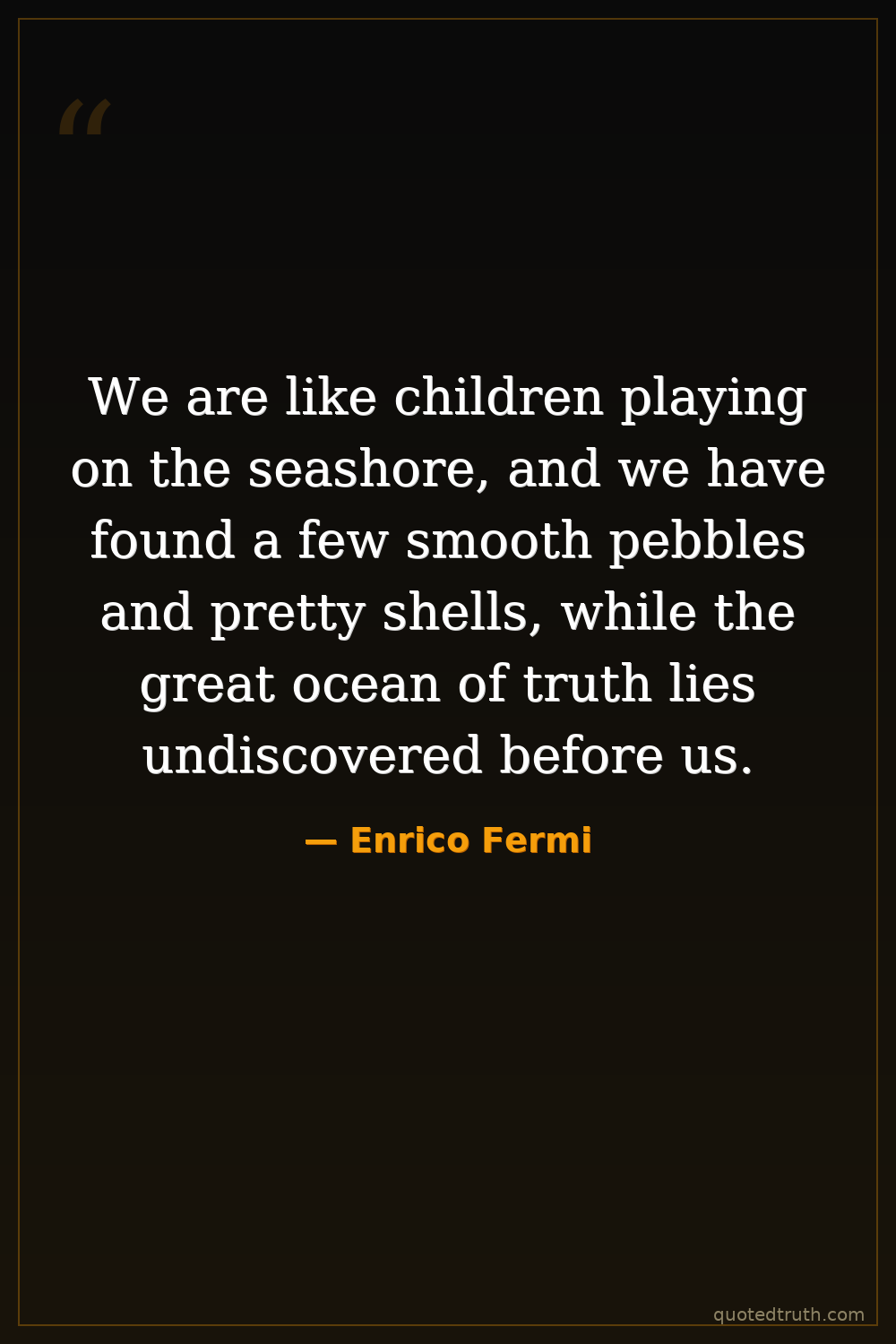
Despite remarkable discoveries, human knowledge remains a tiny fraction of what exists to be known. The image captures intellectual humility: we find a few beautiful fragments on the edge of an immense, undiscovered reality. Scientific breakthroughs, however impressive, reveal more mystery than they resolve. What we understand is a shoreline curio; what awaits understanding is an ocean vast beyond measure. Progress should inspire wonder, not complacency.
Relevance to Enrico Fermi
Fermi built the world's first nuclear reactor in 1942 beneath a Chicago football stadium, splitting atoms to release energy previously locked inside matter itself. Yet he was famously humble, known for Fermi estimation — reasoning carefully from limited data toward vast unknowns. His work in particle physics and statistical mechanics constantly revealed deeper layers of reality. The ocean metaphor fits a man whose every discovery opened three new questions.
The era
Fermi lived through a scientific revolution that fundamentally transformed understanding of matter, energy, and the universe — from relativity and quantum mechanics in the 1920s–30s to nuclear physics in the 1940s. The Manhattan Project demonstrated that theoretical physics could reshape civilization overnight. Yet mid-century physicists recognized their knowledge was provisional; particle accelerators kept revealing unexpected particles and forces. Breakthroughs accelerated but so did awareness of how much remained beyond current tools.
AI-generated insights based on extensive research and information for context. Factual errors? Email [email protected].