Max Planck — "We cannot rest content with an explanation of natural phenomena which does not c…"
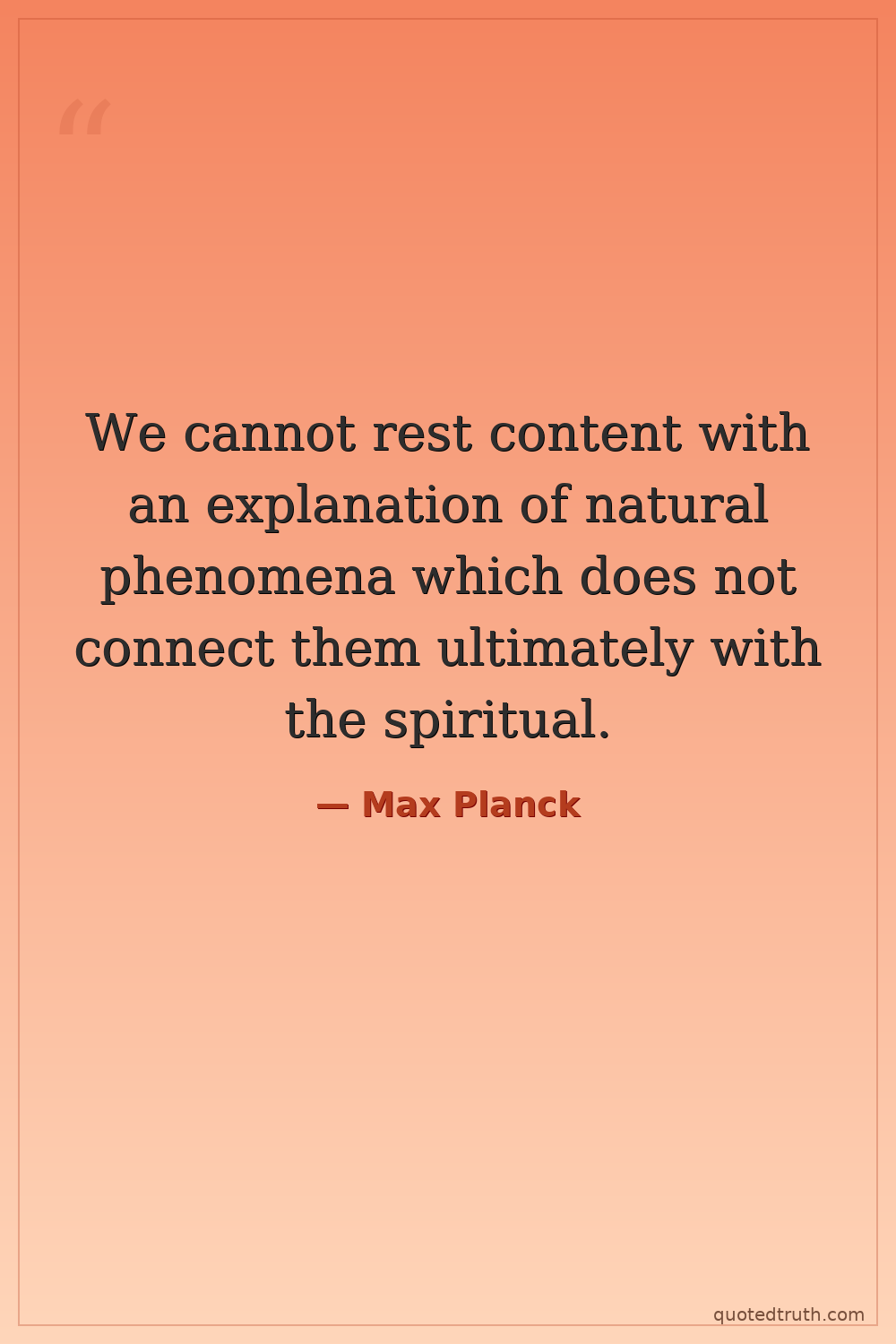
We cannot rest content with an explanation of natural phenomena which does not connect them ultimately with the spiritual.
We cannot rest content with an explanation of natural phenomena which does not connect them ultimately with the spiritual.
Click any product to generate a realistic preview. Up to 3 at a time.
* Initial load can take up to 90 seconds — revising the preview in another color is nearly instant.
"The ultimate goal of all science is to understand the universe."
"Science advances one funeral at a time."
"The human mind, no matter how highly trained, cannot grasp the universe. We are in the position of a little child, entering a huge library whose walls are covered to the ceiling with books in many dif…"
"The pioneer in a new field of knowledge is never a popular man."
"The highest court is in the end one's own conscience and conviction—that goes for you and for Einstein and every other physicist—and before any science there is first of all belief. For me, it is beli…"
Found in 1 providers: grok
1 source checked
Planck argues that science alone cannot fully satisfy our understanding of nature. Explanations that reduce reality to matter and measurement leave something unaccounted for. A complete account of the physical world must eventually link it to something beyond the physical—consciousness, mind, or spirit. Until we make that connection, our grasp of reality remains incomplete, no matter how precise our equations or experiments become.
Planck was a devout Lutheran who insisted throughout his career that science and religion were compatible pursuits of truth. Though he founded quantum mechanics by discovering energy quanta in 1900, he resisted purely materialist interpretations of physics. In his 1944 Florence lecture, he declared that behind matter stands a conscious intelligent Mind. This quote reflects his lifelong conviction that the deeper physicists probed nature, the more they encountered mystery pointing beyond measurement.
Planck lived through physics' greatest upheaval (1858-1947), when Newtonian certainty collapsed into quantum uncertainty and relativity. Materialism and positivism dominated intellectual life, while two world wars devastated Europe and his own family—his son was executed for plotting against Hitler. Amid this scientific revolution and moral catastrophe, many thinkers wrestled with whether pure rationalism could anchor meaning. Planck's insistence on the spiritual dimension pushed back against the mechanistic worldview gaining ground in his era.
AI-generated insights based on extensive research and information for context. Factual errors? Email [email protected].
Your cart is empty