What it means
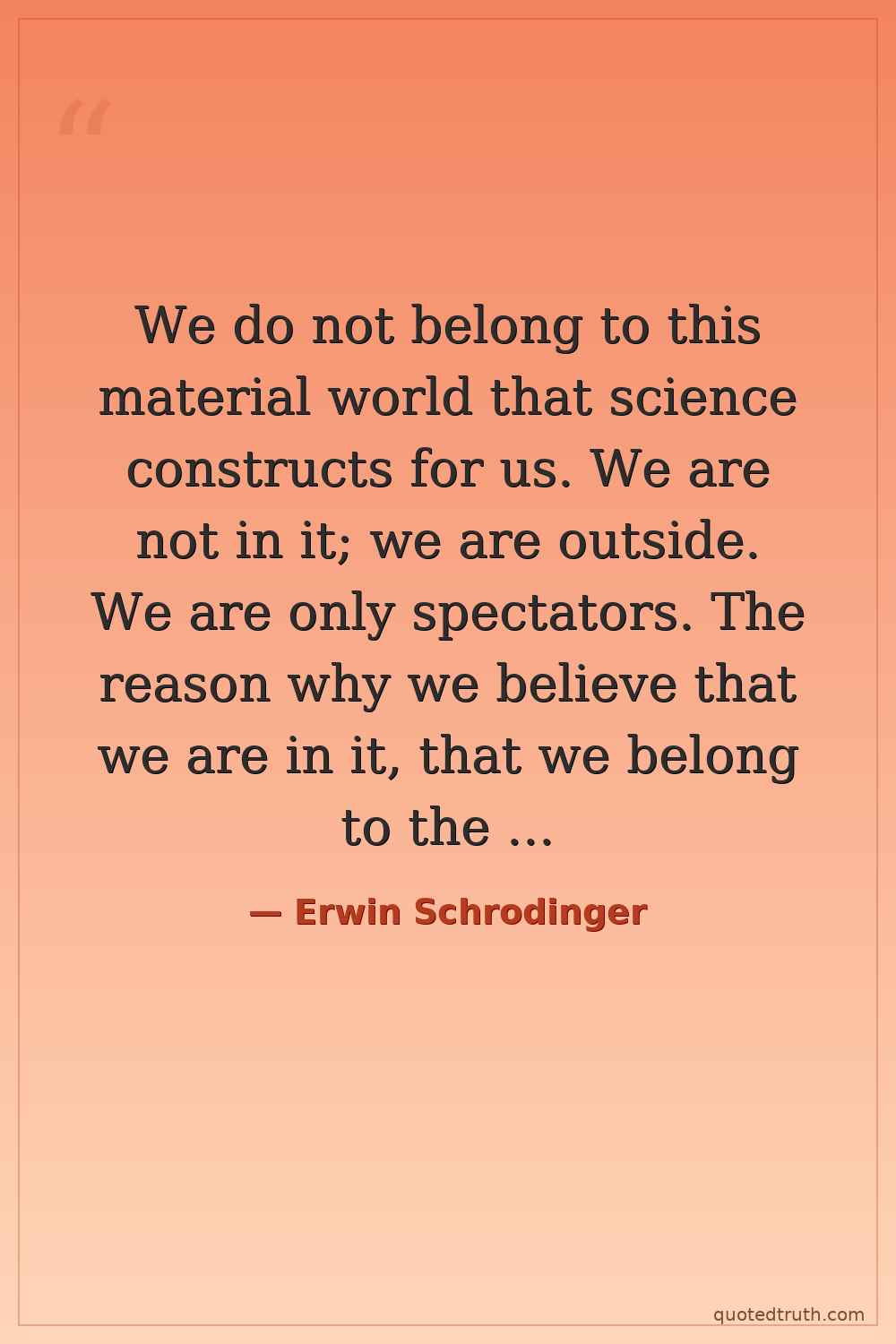
We are not truly part of the physical universe that science describes and measures. Our consciousness exists outside the material picture — we observe reality rather than inhabit it. Our sense of being embedded in the world is an illusion created because our bodies appear in that physical picture, but our experiencing self remains fundamentally separate from the matter-and-energy world science maps.
Relevance to Erwin Schrodinger
Schrödinger, who formulated wave mechanics and the famous cat thought experiment, spent his career probing the boundary between observer and observed. His work in quantum mechanics forced confrontation with the measurement problem — how observation collapses wave functions — leading him naturally to philosophical questions about consciousness. His book 'What is Life?' and essays on mind reveal a lifelong conviction that consciousness lies outside physics entirely.
The era
Writing in the mid-20th century, Schrödinger witnessed quantum mechanics demolish classical determinism, revealing an observer-dependent reality that unsettled scientific materialism. The Copenhagen interpretation made the observer central to physics for the first time. Simultaneously, logical positivism dominated philosophy, reducing mind to brain. Schrödinger pushed back, drawing on Vedantic philosophy to argue consciousness could never be fully captured by the scientific world-picture it paradoxically creates.
AI-generated insights based on extensive research and information for context. Factual errors? Email [email protected].