Wright Brothers (Orville & Wilbur) — "We do not intend to make a fortune out of this, but to make a machine that will …"
We do not intend to make a fortune out of this, but to make a machine that will fly.
We do not intend to make a fortune out of this, but to make a machine that will fly.
Click any product to generate a realistic preview. Up to 3 at a time.
* Initial load can take up to 90 seconds — revising the preview in another color is nearly instant.
"We have been making daily flights, and the machine is working perfectly."
"Learning the secret of flight from a bird was a good deal like learning the secret of magic from a magician—something the magician won't tell, and the bird can't tell."
"We were not discouraged by our failures, but rather stimulated to renewed effort."
"The desire for flight is the expression of a deep-seated human instinct."
"It was impossible to convince the people generally that we were not a pair of lunatics."
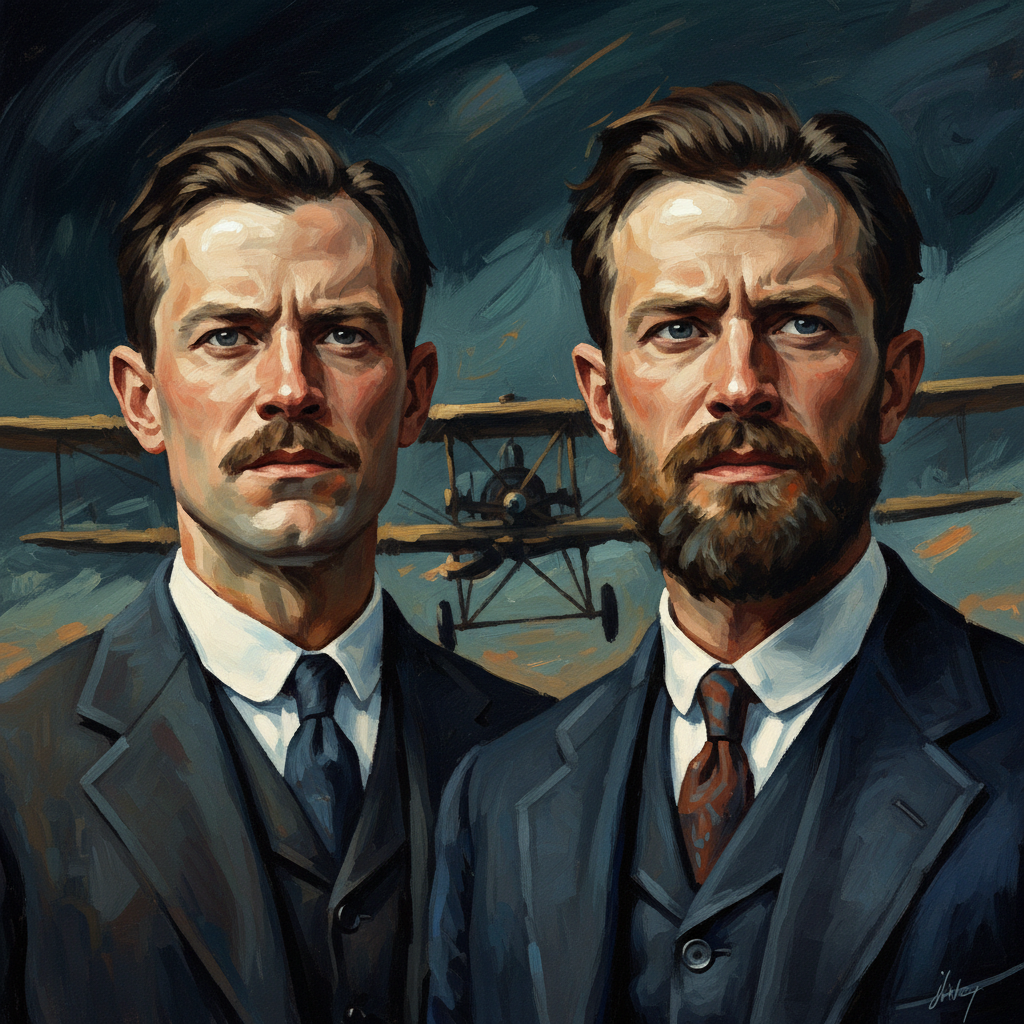
American aviation pioneers who achieved the first sustained powered controlled airplane flight at Kitty Hawk, NC, on December 17, 1903. Closely associated with Octave Chanute (their gliding mentor and aeronautical correspondent). For an intellectual contrast, see Samuel Pierpont Langley, Smithsonian Institution Secretary and government-funded aviation researcher — Langley's Aerodrome crashed twice into the Potomac in October-December 1903 with $50,000 of War Department funding; the Wright Brothers' bicycle-shop empiricism beat Langley's institutional Big Science by 9 days. The most-cited example in engineering history of empirical-tinkerer beating institution-funded credentialism.
Found in 1 providers: grok
1 source checked
The speakers are saying their goal is not wealth or profit but actually achieving a working invention. They care about solving the technical problem and proving the thing can be built, not about getting rich off it. Success is defined by the machine functioning as intended, not by what it earns. Money is a byproduct at best, never the point of the work itself.
The Wrights ran a modest Dayton bicycle shop that funded their aeronautical experiments without outside investors. They spent years on wind-tunnel tests, glider trials at Kitty Hawk, and a custom engine, chasing controlled flight when most thought it impossible. Even after their 1903 success, they guarded patents to protect the invention itself, not to chase riches. The quote captures their engineer-craftsman mindset: solve the problem first, commerce second.
In the early 1900s, inventors like Edison and backers like Langley poured public money into flight and failed spectacularly. The press mocked aviation as a crank pursuit, and newspapers demanded spectacle and profit from every new machine. Industrial America equated progress with fortunes built on steel, oil, and rail. Two self-funded bicycle mechanics declaring they wanted a working aircraft rather than a payday cut against that Gilded Age assumption that invention existed to generate wealth.
AI-generated insights based on extensive research and information for context. Factual errors? Email [email protected].
Your cart is empty