Wright Brothers (Orville & Wilbur) — "We have been very busy with the demonstrations of our machine."
We have been very busy with the demonstrations of our machine.
We have been very busy with the demonstrations of our machine.
Click any product to generate a realistic preview. Up to 3 at a time.
* Initial load can take up to 90 seconds — revising the preview in another color is nearly instant.
"We have not been able to get any very good pictures, as the camera was not very good."
"It was impossible to convince the people generally that we were not a pair of lunatics."
"The public is very enthusiastic about our machine."
"Learning the secret of flight from a bird was a good deal like learning the secret of magic from a magician—something the magician won't tell, and the bird can't tell."
"The machine itself was nothing; the method was everything."
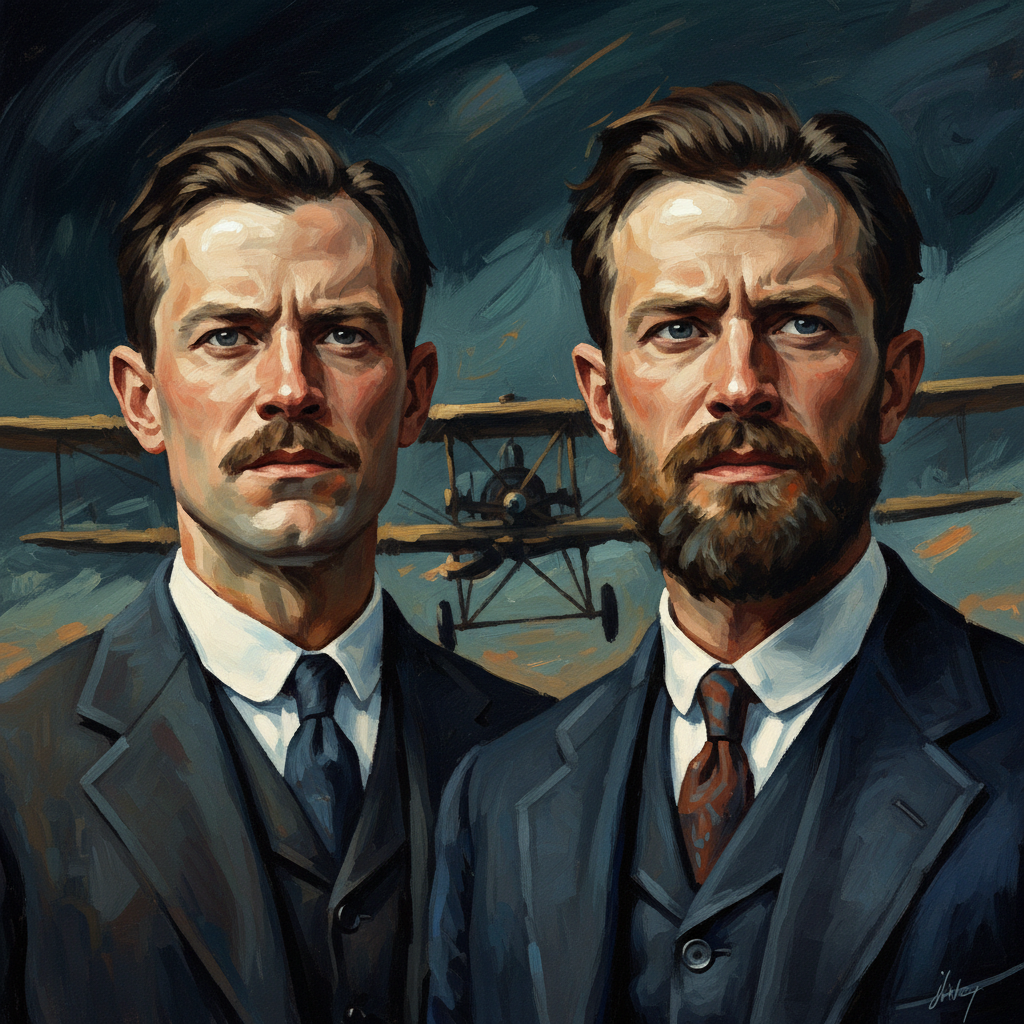
American aviation pioneers who achieved the first sustained powered controlled airplane flight at Kitty Hawk, NC, on December 17, 1903. Closely associated with Octave Chanute (their gliding mentor and aeronautical correspondent). For an intellectual contrast, see Samuel Pierpont Langley, Smithsonian Institution Secretary and government-funded aviation researcher — Langley's Aerodrome crashed twice into the Potomac in October-December 1903 with $50,000 of War Department funding; the Wright Brothers' bicycle-shop empiricism beat Langley's institutional Big Science by 9 days. The most-cited example in engineering history of empirical-tinkerer beating institution-funded credentialism.
Found in 1 providers: grok
1 source checked
The quote simply states they were consumed with publicly proving their airplane works. Beyond quiet understatement, it captures the exhausting repetition required to convince skeptics that powered flight was real. Rather than theoretical claims, the brothers believed in showing, not telling — letting their machine's performance answer doubters. It reflects a methodical, evidence-first mindset: truth demonstrated beats truth declared. Work, not words, was their argument.
After Kitty Hawk's 1903 success, the brothers spent years improving their design before going public. In 1908, they split continents — Wilbur dazzled crowds at Le Mans, France, while Orville demonstrated for the U.S. Army at Fort Myer, Virginia. Self-taught bicycle mechanics, they trusted engineering proof over press releases. Their terse, practical language — 'the machine,' never 'our miracle' — perfectly captures their no-ego, results-driven character throughout their careers.
In the early 1900s, powered flight was widely dismissed as fantasy even after Kitty Hawk, with newspapers largely ignoring early reports. By 1908, European military powers were racing to harness aviation, and nationalist competition intensified. The Wright Brothers' demonstrations became geopolitical events — France felt embarrassed that Americans had achieved what many Europeans claimed impossible — reshaping how governments imagined future warfare, mail delivery, and the collapse of geographic distance.
AI-generated insights based on extensive research and information for context. Factual errors? Email [email protected].
Your cart is empty