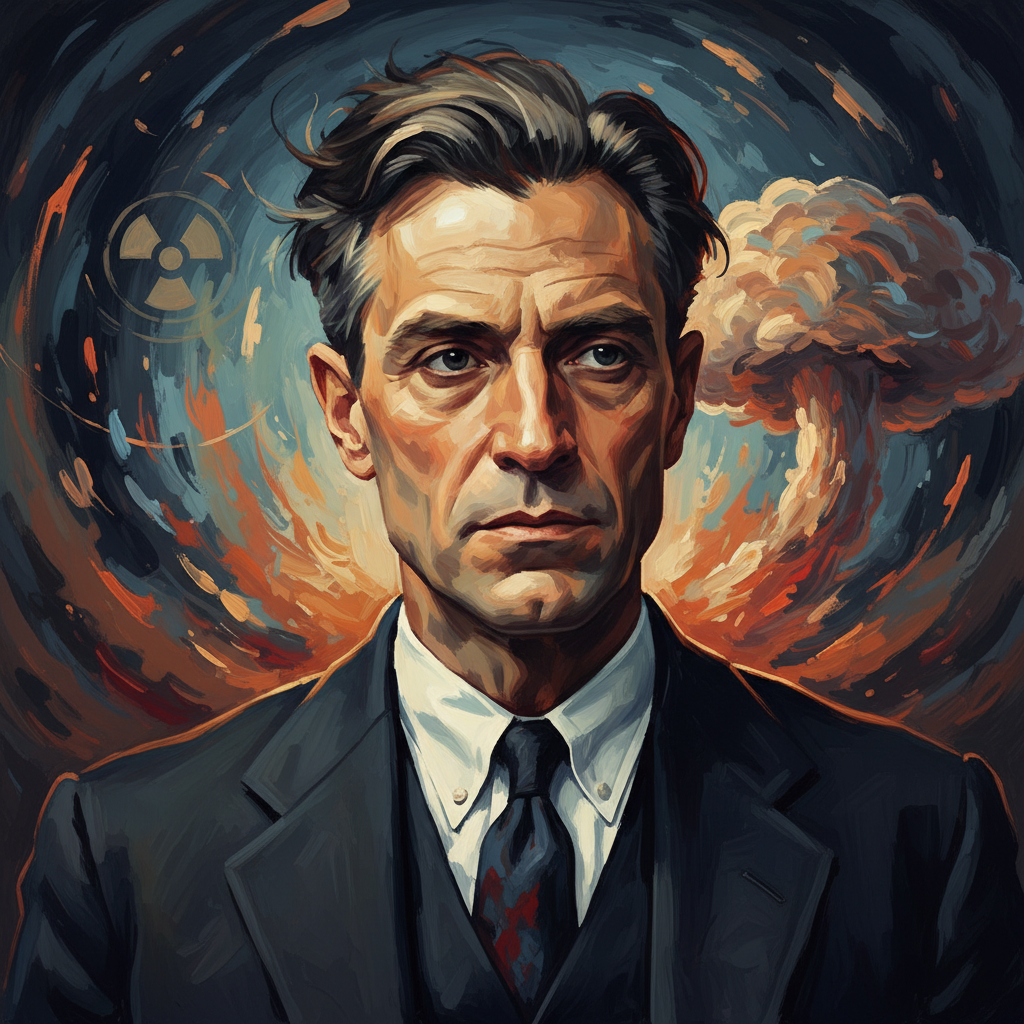
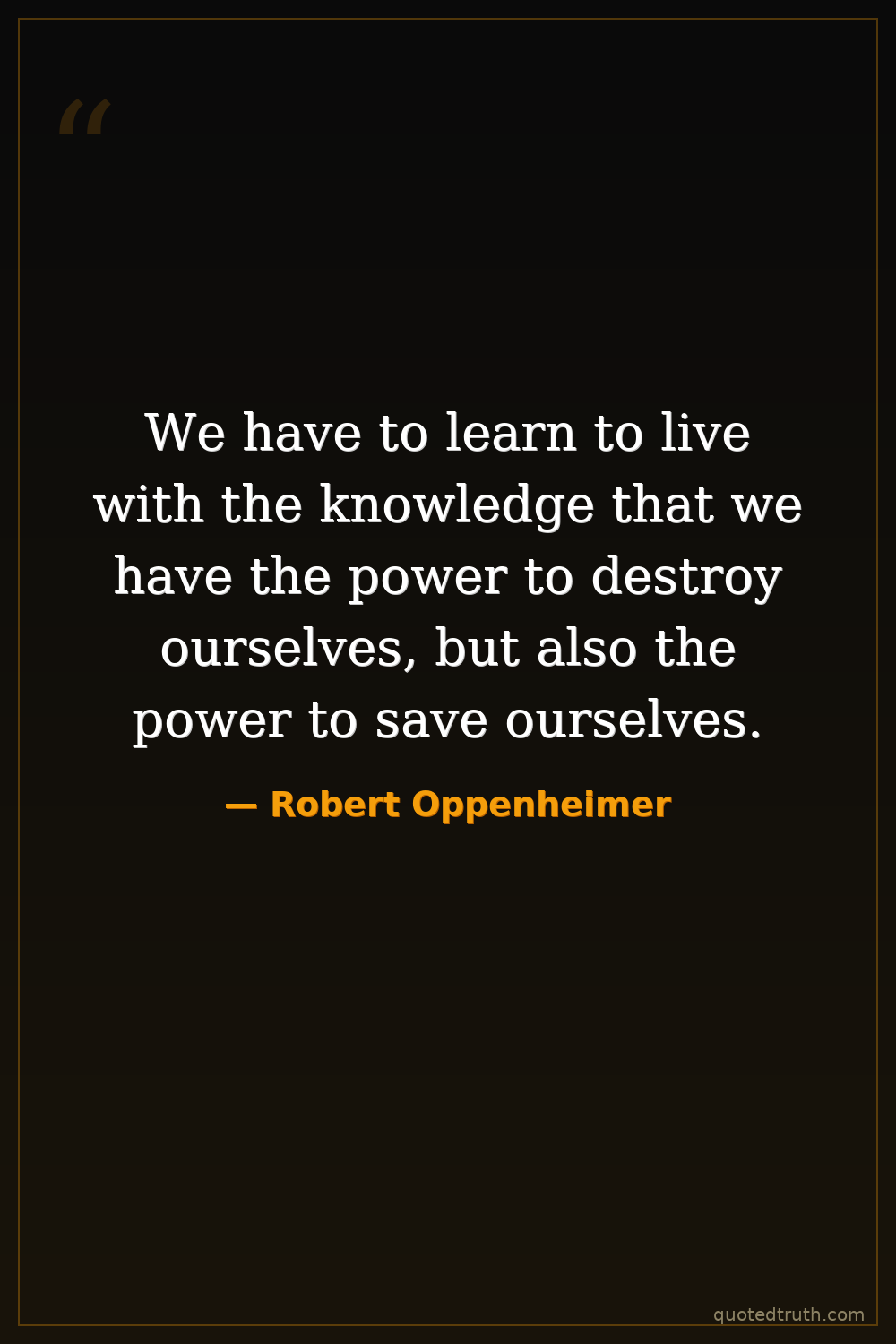
Robert Oppenheimer — "We have to learn to live with the knowledge that we have the power to destroy ou…"
We have to learn to live with the knowledge that we have the power to destroy ourselves, but also the power to save ourselves.
We have to learn to live with the knowledge that we have the power to destroy ourselves, but also the power to save ourselves.
Click any product to generate a realistic preview. Up to 3 at a time.
* Initial load can take up to 90 seconds — revising the preview in another color is nearly instant.
"The people of this world must unite or they will perish."
"We are not here to curse the darkness, but to light the candle that can guide us through it."
"The atomic bomb is a symbol of the power of science. It is a symbol of the power of man to control nature. And it is a symbol of the responsibility that comes with that power."
"Knowledge cannot be pursued without morality."
"In an important sense, the atomic bomb was made in Germany."
American theoretical physicist who directed the Manhattan Project's Los Alamos Laboratory and oversaw the atomic bombs; lost his security clearance in 1954. Closely associated with Niels Bohr (Manhattan Project consultant and atomic-policy advisor) and Hans Bethe (Los Alamos theoretical-division chief). For an intellectual contrast, see Edward Teller, Hungarian-American physicist and 'father of the H-bomb' — Teller pushed the H-bomb against Oppenheimer's objections and testified against him at his 1954 security hearing — the precise moment that ended Oppenheimer's career. The canonical 'physicist-of-conscience vs physicist-of-state' pairing in nuclear-age ethics; Christopher Nolan's Oppenheimer (2023) dramatized this rivalry for a mass audience.
Found in 1 providers: grok
1 source checked
Humanity now possesses knowledge it cannot unknow: the ability to annihilate itself through war, environmental collapse, or technological catastrophe—but equally the intelligence and will to avert those outcomes. The quote demands psychological acceptance of this dual reality. Rather than paralysis or denial, it calls for living consciously with both the threat and the possibility, channeling scientific and moral capacity toward survival rather than destruction.
Oppenheimer directed the Manhattan Project, birthing the weapon that killed over 200,000 people in Hiroshima and Nagasaki. Witnessing the Trinity test, he quoted the Bhagavad Gita: 'Now I am become Death.' Afterward, he opposed the hydrogen bomb and championed international nuclear controls, accepting professional ruin—losing his security clearance in 1954—rather than abandon his conscience. His entire post-war life was a struggle to reconcile his creation with his belief in human reason.
Oppenheimer worked during the atomic age's dawn—a period defined by Hiroshima (1945), the Soviet bomb (1949), hydrogen bomb tests (1952), and the Cuban Missile Crisis (1962). For the first time in history, humanity held genuine civilizational self-destruction within reach. The Cold War arms race institutionalized apocalyptic threat. Scientists, politicians, and citizens struggled to build moral frameworks—arms control treaties, deterrence doctrines—for coexisting with unprecedented, self-made existential danger.
AI-generated insights based on extensive research and information for context. Factual errors? Email [email protected].
Your cart is empty