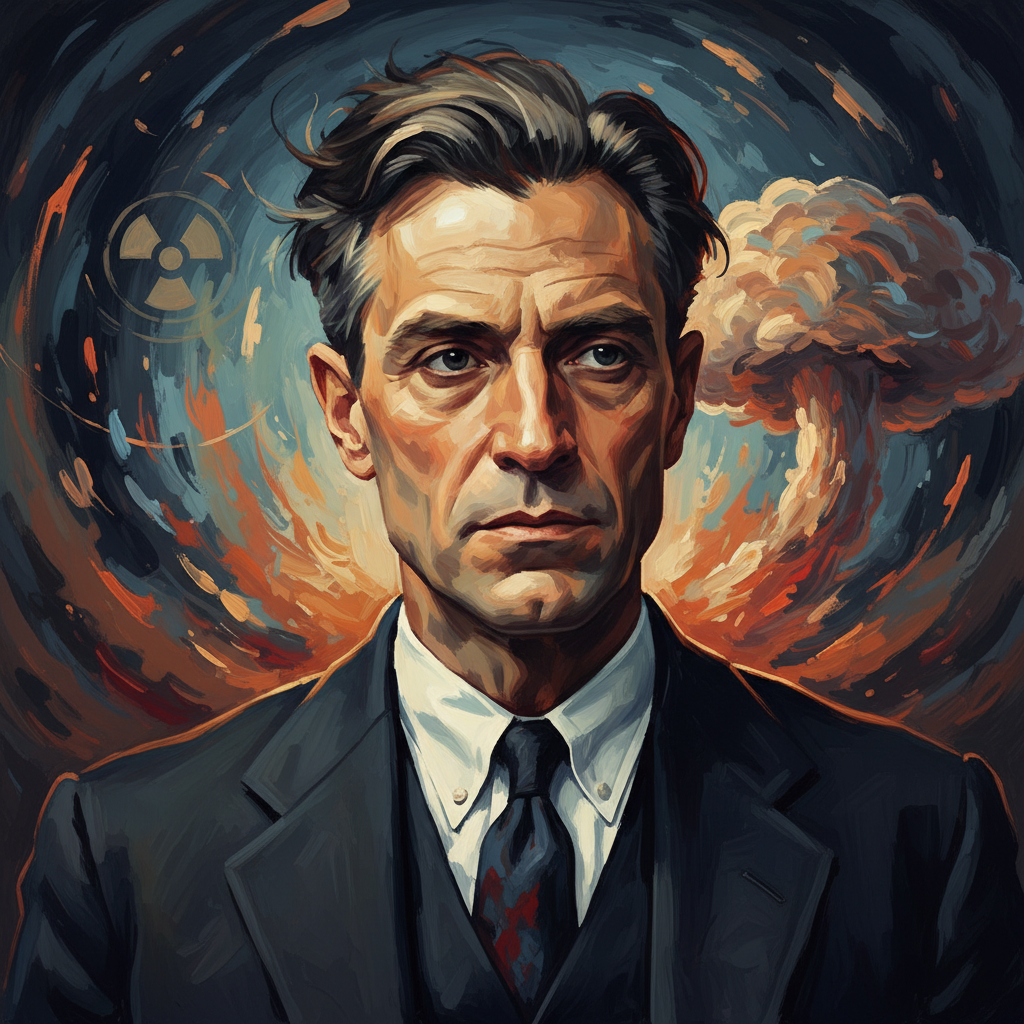
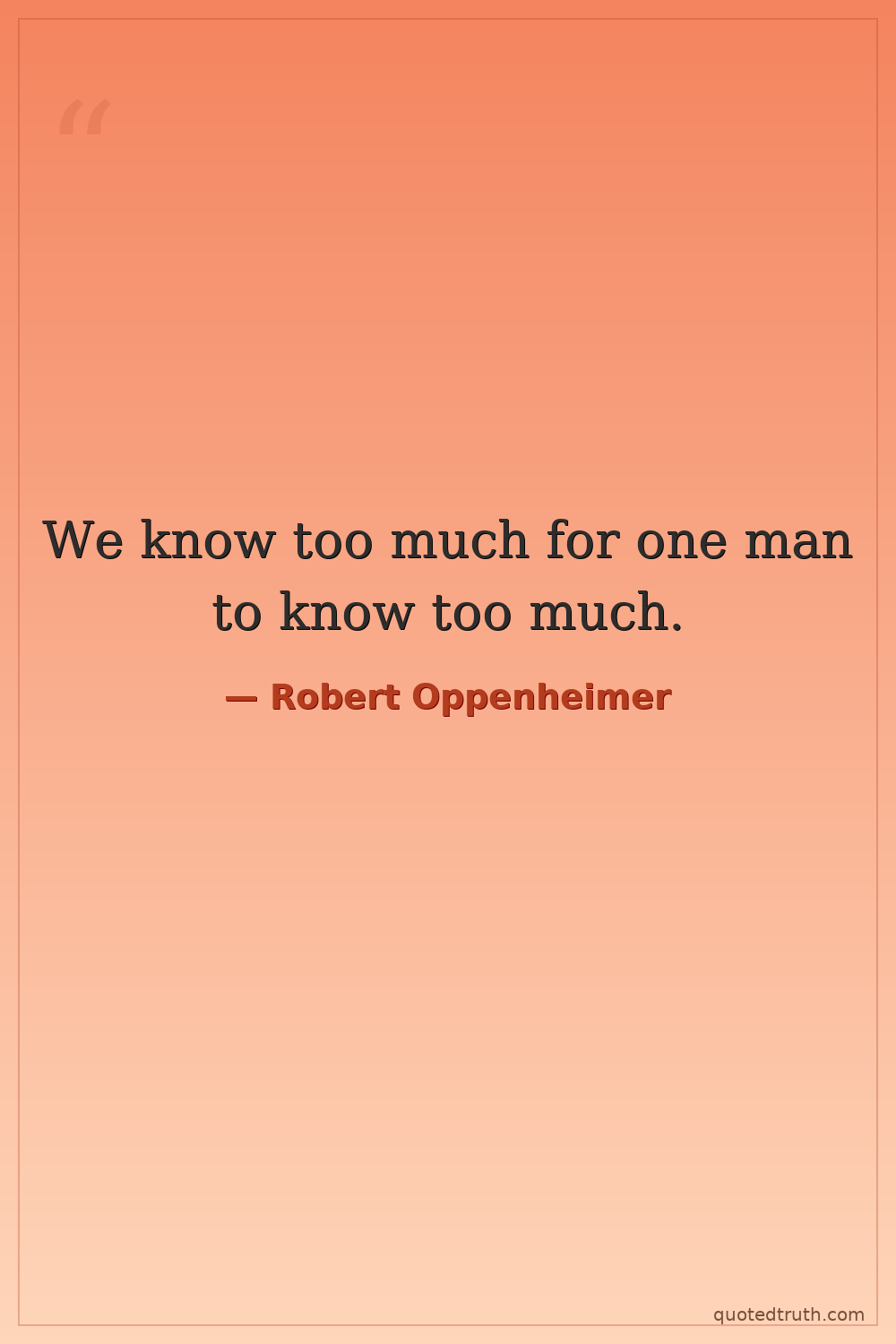
Robert Oppenheimer — "We know too much for one man to know too much."
We know too much for one man to know too much.
We know too much for one man to know too much.
Click any product to generate a realistic preview. Up to 3 at a time.
* Initial load can take up to 90 seconds — revising the preview in another color is nearly instant.
"Both the man of science and the man of action live always at the edge of mystery, surrounded by it."
"The only way to do great work is to love what you do."
"It is a matter of profound gravity that the world has changed, and we must change with it."
"We have opened a new age, an age of atomic energy, an age of atomic weapons."
"The atomic bomb is a symbol of the power of science. It is a symbol of the power of man to control nature. And it is a symbol of the responsibility that comes with that power."
American theoretical physicist who directed the Manhattan Project's Los Alamos Laboratory and oversaw the atomic bombs; lost his security clearance in 1954. Closely associated with Niels Bohr (Manhattan Project consultant and atomic-policy advisor) and Hans Bethe (Los Alamos theoretical-division chief). For an intellectual contrast, see Edward Teller, Hungarian-American physicist and 'father of the H-bomb' — Teller pushed the H-bomb against Oppenheimer's objections and testified against him at his 1954 security hearing — the precise moment that ended Oppenheimer's career. The canonical 'physicist-of-conscience vs physicist-of-state' pairing in nuclear-age ethics; Christopher Nolan's Oppenheimer (2023) dramatized this rivalry for a mass audience.
Found in 1 providers: gemini
1 source checked
Collective human knowledge has grown so vast that no single person can master even a meaningful fraction of it. What sounds paradoxical resolves simply: because humanity knows so much, any individual's knowledge is necessarily partial, however deep. Where Renaissance polymaths could genuinely command most human learning, modern science's explosive growth makes that impossible. Mastery and humility are now inseparable — expertise in one domain means ignorance of dozens of others.
Oppenheimer embodied this tension directly. Trained in theoretical physics yet fluent in Sanskrit, philosophy, and literature, he was among the last genuine polymaths — yet he led a project requiring thousands of specialists across nuclear physics, engineering, metallurgy, and chemistry simultaneously. The Manhattan Project's complexity forced him to trust experts far beyond his own mastery. His later opposition to the hydrogen bomb reflected his awareness that scientific power had outgrown any individual's capacity for moral comprehension.
The mid-20th century witnessed an unprecedented explosion in scientific specialization. World War II accelerated it simultaneously across nuclear physics, computing, radar, and medicine — each demanding dedicated expert communities. The post-war era birthed national laboratories, massive federal research programs, and institutional big science. The lone-genius model of Newton or Einstein was giving way to vast collaborative teams with compartmentalized knowledge. No individual could track the whole; collective discovery had permanently outpaced individual mastery.
AI-generated insights based on extensive research and information for context. Factual errors? Email [email protected].
Your cart is empty