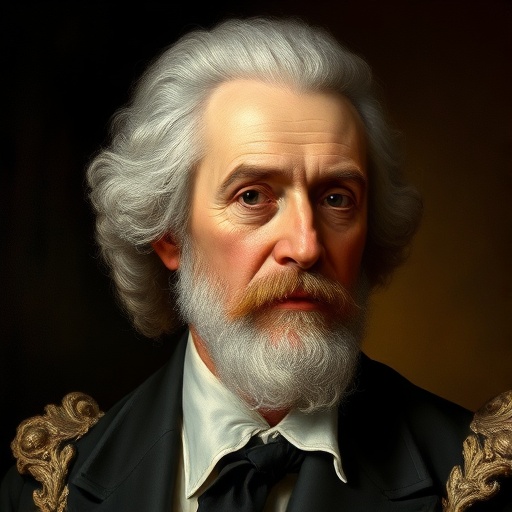
Antoine Lavoisier — "We must dare to know, and to speak what we know."
We must dare to know, and to speak what we know.
We must dare to know, and to speak what we know.
Click any product to generate a realistic preview. Up to 3 at a time.
* Initial load can take up to 90 seconds — revising the preview in another color is nearly instant.
"It took them only an instant to cut off that head, but France may not produce another like it in a century."
"I have lived long enough to be certain that the world will not be ready for my discoveries until at least a hundred years after my death."
"The more I study, the more I am convinced of the existence of a superior intelligence."
"The progress of science is like the ascent of a mountain, where every step brings new horizons into view."
"We must trust to nothing but facts: these are presented to us by nature and cannot deceive."
Found in 1 providers: grok
1 source checked
Acquiring knowledge is not enough — you have an obligation to state it openly, even when doing so is risky or unpopular. The word 'dare' signals that both truth-seeking and truth-telling require courage. Staying silent to preserve comfort or status is a form of intellectual cowardice. Real understanding demands the rigor to discover what is true and the honesty to say it plainly.
Lavoisier did not quietly doubt the phlogiston theory dominating chemistry — he demolished it publicly through controlled experiments and published his results in his landmark 1789 Traite Elementaire de Chimie. He named oxygen and hydrogen, rewrote chemical nomenclature, and insisted on quantitative measurement over inherited dogma. Speaking what he knew against entrenched consensus reshaped science and ultimately cost him his life: he was guillotined in 1794.
Lavoisier worked at the height of the Enlightenment, whose motto 'Sapere Aude' — dare to be wise — made intellectual courage a moral imperative. Eighteenth-century scientific institutions were deeply entrenched; overturning phlogiston required publicly challenging respected authorities. France's revolutionary upheaval made speaking plainly literally dangerous: the same era that celebrated reason guillotined thinkers like Lavoisier for ties to the old regime, giving this quote tragic weight.
AI-generated insights based on extensive research and information for context. Factual errors? Email [email protected].
Your cart is empty