Antoine Lavoisier — "It took them only an instant to cut off that head, but France may not produce an…"
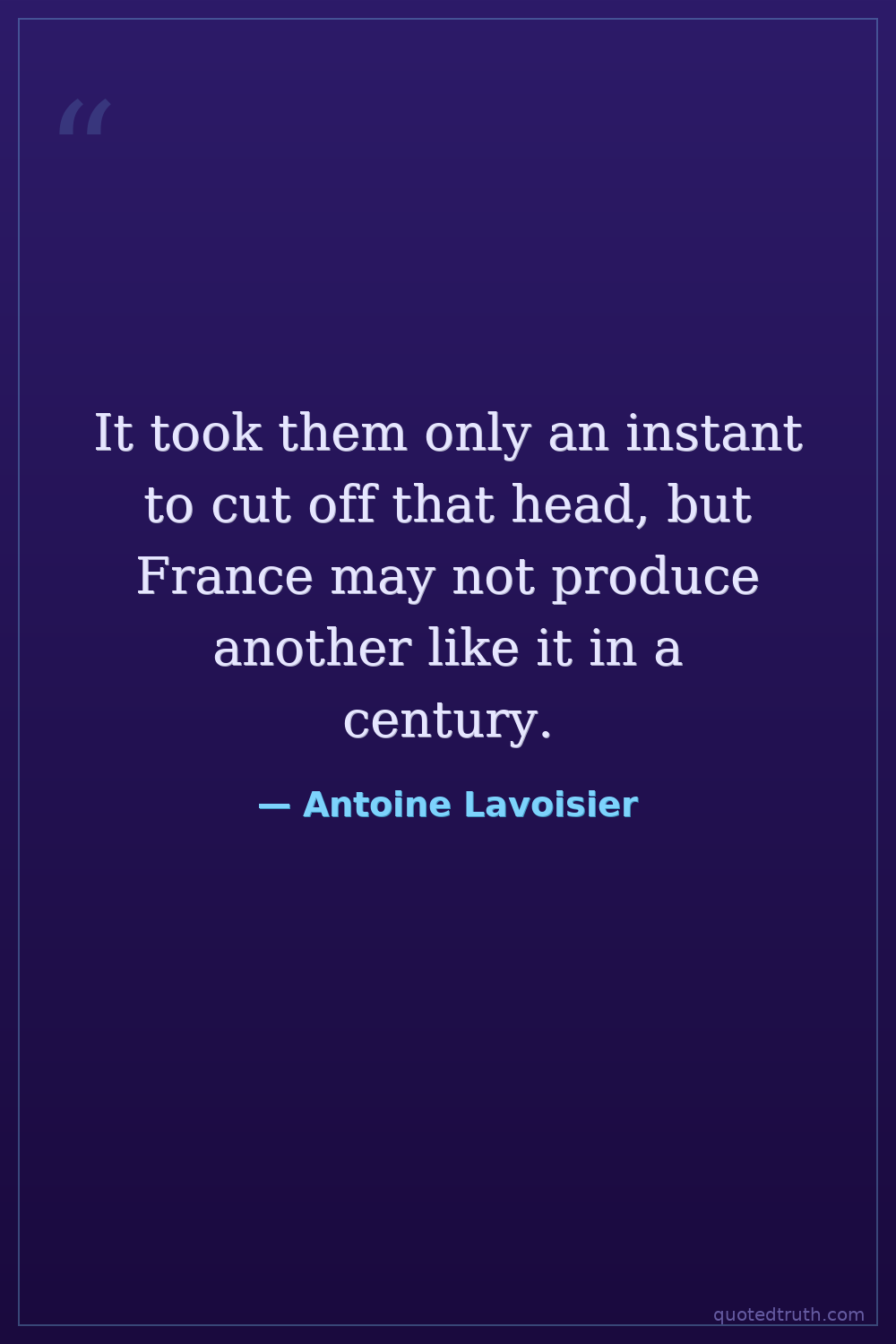
It took them only an instant to cut off that head, but France may not produce another like it in a century.
It took them only an instant to cut off that head, but France may not produce another like it in a century.
Click any product to generate a realistic preview. Up to 3 at a time.
* Initial load can take up to 90 seconds — revising the preview in another color is nearly instant.
"Languages are true analytical methods; algebra, which is adapted to its purpose in every species of expression, in the most simple, most exact, and best manner possible, is at the same time a language…"
"As ideas are preserved and communicated by means of words, it necessarily follows that we cannot improve the language of any science, without at the same time improving the science itself; neither can…"
"Chemistry is a science of facts and experiments, and not of opinions."
"It is almost possible to predict one or two days in advance, within a rather broad range of probability, what the weather is going to be; it is even thought that it will not be impossible to publish d…"
"The true wealth of a nation is its knowledge and its industry."
Found in 1 providers: deepseek
1 source checked
The speaker laments how quickly a brilliant mind can be destroyed compared to how long it takes for one to emerge. A single moment of violence wipes out what took decades of learning, talent, and dedication to build. It warns that societies can casually discard their greatest thinkers in brief acts of brutality, while replacing them requires generations of rare circumstances.
Ironically, this remark was made about Lavoisier himself after his execution by guillotine in 1794. As the chemist who overturned phlogiston theory, named oxygen, and established conservation of mass, he embodied the intellectual loss described. Despite his scientific stature, revolutionary tribunals condemned him for his role as a tax collector, proving talent offered no shield against political fury during the Terror.
The early modern period ended with the French Revolution's Reign of Terror (1793-1794), when guillotines claimed thousands, including scientists, aristocrats, and former tax farmers. Enlightenment ideals of reason collided violently with revolutionary politics. The judge reportedly declared the Republic had no need of savants. Lavoisier's death crystallized Europe's horror at the Revolution devouring its own brightest minds during this upheaval.
AI-generated insights based on extensive research and information for context. Factual errors? Email [email protected].
Your cart is empty