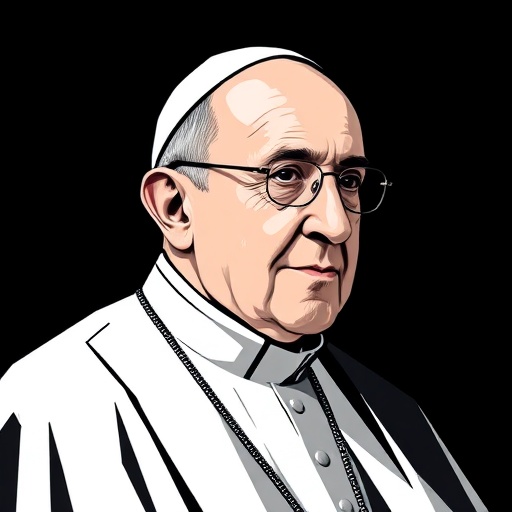
Pope Francis — "We must not be afraid of dialogue."
We must not be afraid of dialogue.
We must not be afraid of dialogue.
Click any product to generate a realistic preview. Up to 3 at a time.
* Initial load can take up to 90 seconds — revising the preview in another color is nearly instant.
"The globalization of indifference has taken from us the ability to weep."
"A little bit of humor helps us to carry on."
"A pastor who does not pray is a pastor who is in danger."
"This economy kills."
"The Church is not a customs office."
First Latin American and Jesuit pope (2013-), who has steered the Catholic Church toward pastoral inclusion on LGBTQ pastoral care, divorced Catholics, and climate. Closely associated with Pope John XXIII (the Vatican II reformer pope) and Cardinal Walter Kasper (his theological ally on pastoral reform). For an intellectual contrast, see Cardinal Raymond Burke, American traditionalist cardinal, former head of the Vatican Apostolic Signatura — Burke is the public face of Catholic traditionalism that views Francis's pastoral approach as doctrinally dangerous — he has formally challenged Amoris Laetitia and other Francis reforms.
Found in 1 providers: grok
1 source checked
Fear of conversation with those who differ from us closes minds and hardens divisions. Genuine dialogue requires courage — the willingness to listen, to be changed, and to engage honestly with people whose beliefs, cultures, or experiences challenge our own. It is not weakness but an act of trust that truth can survive and even strengthen through open, honest exchange between people of goodwill.
Jorge Mario Bergoglio built his papacy on outreach — meeting with atheists, Muslims, divorced Catholics, and LGBTQ individuals many predecessors avoided. As the first Jesuit pope, he inherited an order historically devoted to intellectual engagement and cross-cultural mission. His 2013 interview with La Civiltà Cattolica modeled radical openness, and Laudato Si engaged secular scientists and policymakers directly.
Francis became pope in 2013 amid deepening global polarization — culture wars, religious nationalism, and the rise of social media echo chambers. The Catholic Church itself faced internal fractures over doctrine, clerical abuse scandals, and declining Western attendance. His call for dialogue pushed back against fortress-Church conservatism and secular tribalism alike, urging encounter over condemnation.
AI-generated insights based on extensive research and information for context. Factual errors? Email [email protected].
Your cart is empty