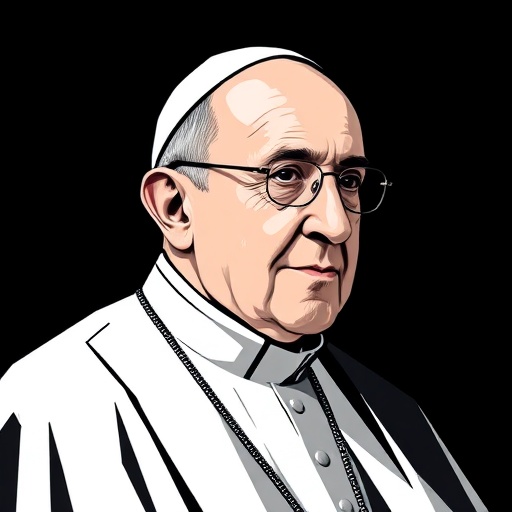
Pope Francis — "We must not be afraid to be a Church that is poor and for the poor."
We must not be afraid to be a Church that is poor and for the poor.
We must not be afraid to be a Church that is poor and for the poor.
Click any product to generate a realistic preview. Up to 3 at a time.
* Initial load can take up to 90 seconds — revising the preview in another color is nearly instant.
"The true power is service. The Pope must be a servant of servants."
"A little bit of humor helps us to carry on."
"We have to state, without mincing words, that there is an inseparable bond between our faith and the poor."
"If someone is gay and he searches for the Lord and has good will, who am I to judge? We shouldn’t marginalize people for this. They must be integrated into society."
"The Lord makes us see that there is no true joy without love."
First Latin American and Jesuit pope (2013-), who has steered the Catholic Church toward pastoral inclusion on LGBTQ pastoral care, divorced Catholics, and climate. Closely associated with Pope John XXIII (the Vatican II reformer pope) and Cardinal Walter Kasper (his theological ally on pastoral reform). For an intellectual contrast, see Cardinal Raymond Burke, American traditionalist cardinal, former head of the Vatican Apostolic Signatura — Burke is the public face of Catholic traditionalism that views Francis's pastoral approach as doctrinally dangerous — he has formally challenged Amoris Laetitia and other Francis reforms.
Found in 1 providers: grok
1 source checked
The quote calls the Catholic Church to embrace simplicity and make serving economically disadvantaged people its central mission. It challenges institutional wealth, prestige, and comfort, arguing Christianity's authentic purpose demands solidarity with those in poverty. The word 'afraid' is deliberate—it acknowledges real resistance inside the Church to abandoning power and resources. This is a call to overcome that fear and return to the radical servant-church model Jesus originally embodied.
Jorge Bergoglio chose the name 'Francis' honoring St. Francis of Assisi's embrace of radical poverty. As Archbishop of Buenos Aires, he rode public buses, cooked his own meals, and rejected chauffeured transport. As Pope, he chose a simple Vatican guesthouse over the Apostolic Palace. A Jesuit trained in service to the marginalized, he grew up in Argentina amid stark economic inequality—making poverty not an abstraction but a lived pastoral reality.
Francis became pope in 2013, years after the 2008 financial crisis deepened global inequality and inspired movements like Occupy Wall Street. The Catholic Church simultaneously faced credibility crises from clerical abuse scandals and perceptions of institutional wealth insulated from ordinary believers. Worldwide, the wealthiest 1% continued accumulating while billions in the Global South lived in poverty. His statement directly challenged Vatican opulence and reoriented the Church toward social justice at a pivotal moment.
AI-generated insights based on extensive research and information for context. Factual errors? Email [email protected].
Your cart is empty