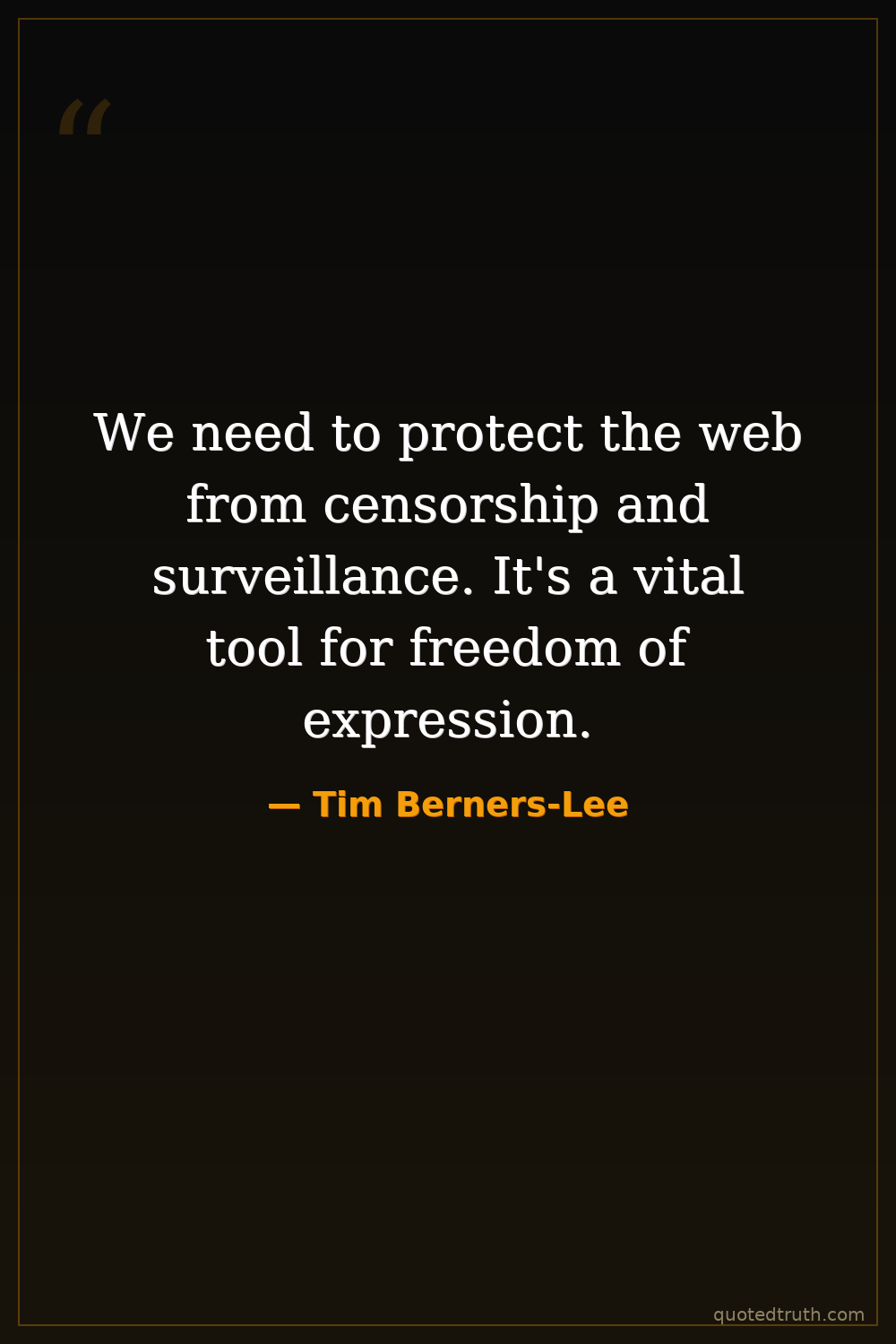
Tim Berners-Lee — "We need to protect the web from censorship and surveillance. It's a vital tool f…"
We need to protect the web from censorship and surveillance. It's a vital tool for freedom of expression.
We need to protect the web from censorship and surveillance. It's a vital tool for freedom of expression.
Click any product to generate a realistic preview. Up to 3 at a time.
* Initial load can take up to 90 seconds — revising the preview in another color is nearly instant.
"The web should be a place where people can be themselves, not just perform for others."
"The web is a public resource, and it needs to be protected."
"The web is a mirror of humanity. It reflects our best and our worst."
"The web should be a place where everyone can share their ideas and connect with each other."
"The web is not just for looking up information. It's for connecting people, collaborating, and creating new things."
British computer scientist who invented the World Wide Web at CERN in 1989 and founded the W3C, championing open web standards. Closely associated with Vint Cerf (TCP/IP co-creator and 'father of the internet') and Marc Andreessen (Mosaic browser creator and Netscape co-founder). For an intellectual contrast, see Mark Zuckerberg, Facebook (Meta) founder — Zuckerberg's walled-garden Facebook is the canonical contemporary opposite of Berners-Lee's open-web vision; Berners-Lee's Solid project and 'recapture the web' essays are explicitly written as a rebuttal to the platform-monopoly model Facebook pioneered.
Found in 1 providers: grok
1 source checked
The web gives everyone a voice — but only if nobody can silence you or watch what you say. Censorship kills dissent by blocking information outright; surveillance kills it quietly, making people afraid to speak. Keeping the web open means protecting it as a space where power can be questioned, minorities can organize, and truth can circulate without a government or corporation deciding what is allowed.
Berners-Lee invented the web at CERN in 1989 and immediately released it royalty-free — a deliberate choice to prevent any single entity from controlling it. He co-founded the World Wide Web Consortium to maintain open standards, then launched the Web Foundation campaigning against surveillance and shutdowns. His 2019 Contract for the Web was a direct response to governments and corporations weaponizing the very technology he built and gave away.
Snowden's 2013 revelations exposed NSA mass surveillance programs harvesting global internet traffic. Simultaneously, China's Great Firewall refined state censorship; Russia and Turkey began systematic blocking. Social media platforms faced mounting pressure to remove political content. The Arab Spring had just demonstrated the web's power for democratic organizing — and authoritarian crackdowns that followed proved how quickly governments could weaponize or shut down that same infrastructure. Digital rights became urgent geopolitical terrain.
AI-generated insights based on extensive research and information for context. Factual errors? Email [email protected].
Your cart is empty