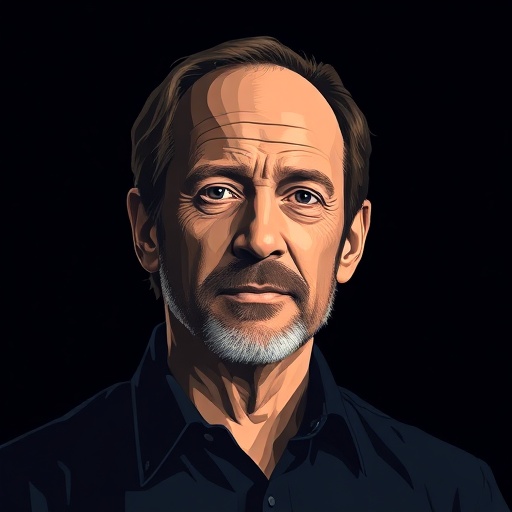
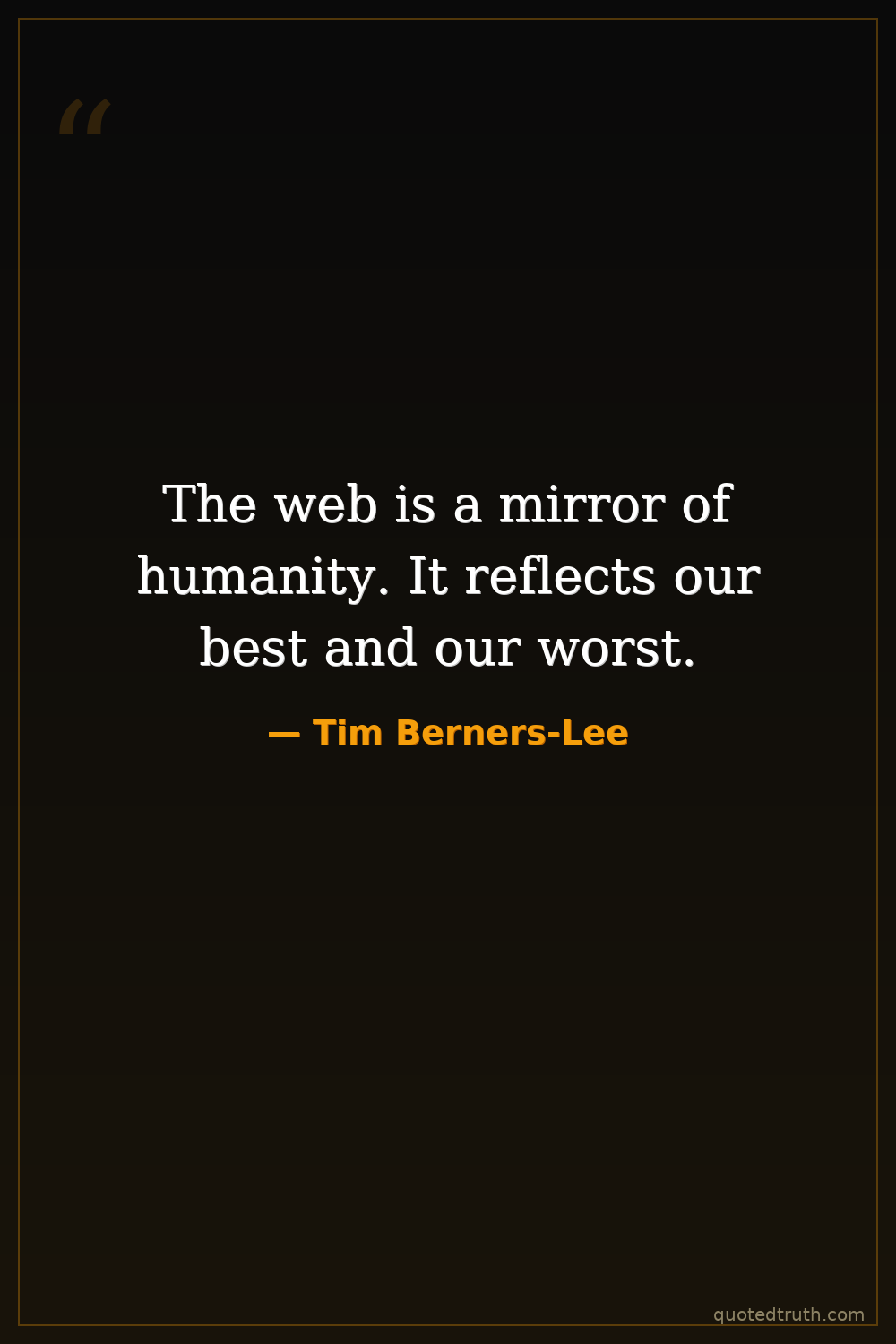
Tim Berners-Lee — "The web is a mirror of humanity. It reflects our best and our worst."
The web is a mirror of humanity. It reflects our best and our worst.
The web is a mirror of humanity. It reflects our best and our worst.
Click any product to generate a realistic preview. Up to 3 at a time.
* Initial load can take up to 90 seconds — revising the preview in another color is nearly instant.
"I'm optimistic that Solid can help to fix the web and make it a better place for everyone."
"I want the web to be a place where everyone can thrive, where everyone can learn, and where everyone can contribute."
"The web is not a neutral platform anymore. It's being manipulated by powerful interests."
"The web is a mirror of society."
"I regret that I put two slashes in the URL. It was unnecessary."
British computer scientist who invented the World Wide Web at CERN in 1989 and founded the W3C, championing open web standards. Closely associated with Vint Cerf (TCP/IP co-creator and 'father of the internet') and Marc Andreessen (Mosaic browser creator and Netscape co-founder). For an intellectual contrast, see Mark Zuckerberg, Facebook (Meta) founder — Zuckerberg's walled-garden Facebook is the canonical contemporary opposite of Berners-Lee's open-web vision; Berners-Lee's Solid project and 'recapture the web' essays are explicitly written as a rebuttal to the platform-monopoly model Facebook pioneered.
Found in 1 providers: grok
1 source checked
The web has no moral character of its own — it amplifies whatever humans bring to it. Generosity, knowledge-sharing, and creativity exist alongside harassment, misinformation, and exploitation. The internet is neither utopia nor dystopia but a faithful amplification of human nature in all its complexity. What we encounter online is an accurate reflection of who we collectively are, the inspiring and the ugly alike.
Berners-Lee invented the World Wide Web in 1989 at CERN and deliberately made it royalty-free, believing open access would democratize knowledge. He founded the W3C and the Web Foundation to fight for an open web. Watching it increasingly weaponized for surveillance, propaganda, and abuse, he became a vocal advocate for digital rights and governance, speaking from the specific grief and moral weight of its creator.
Berners-Lee's observation hardened as the web's early utopian promise collided with dark realities. The 2010s brought social media radicalization, state-sponsored disinformation, and mass surveillance revelations via Snowden in 2013. The Arab Spring showed its liberatory power; Brexit and the 2016 US election exposed its capacity for manipulation. By the 2020s, debates over hate speech, misinformation, and Big Tech dominance made the web's dual nature an urgent geopolitical crisis.
AI-generated insights based on extensive research and information for context. Factual errors? Email [email protected].
Your cart is empty