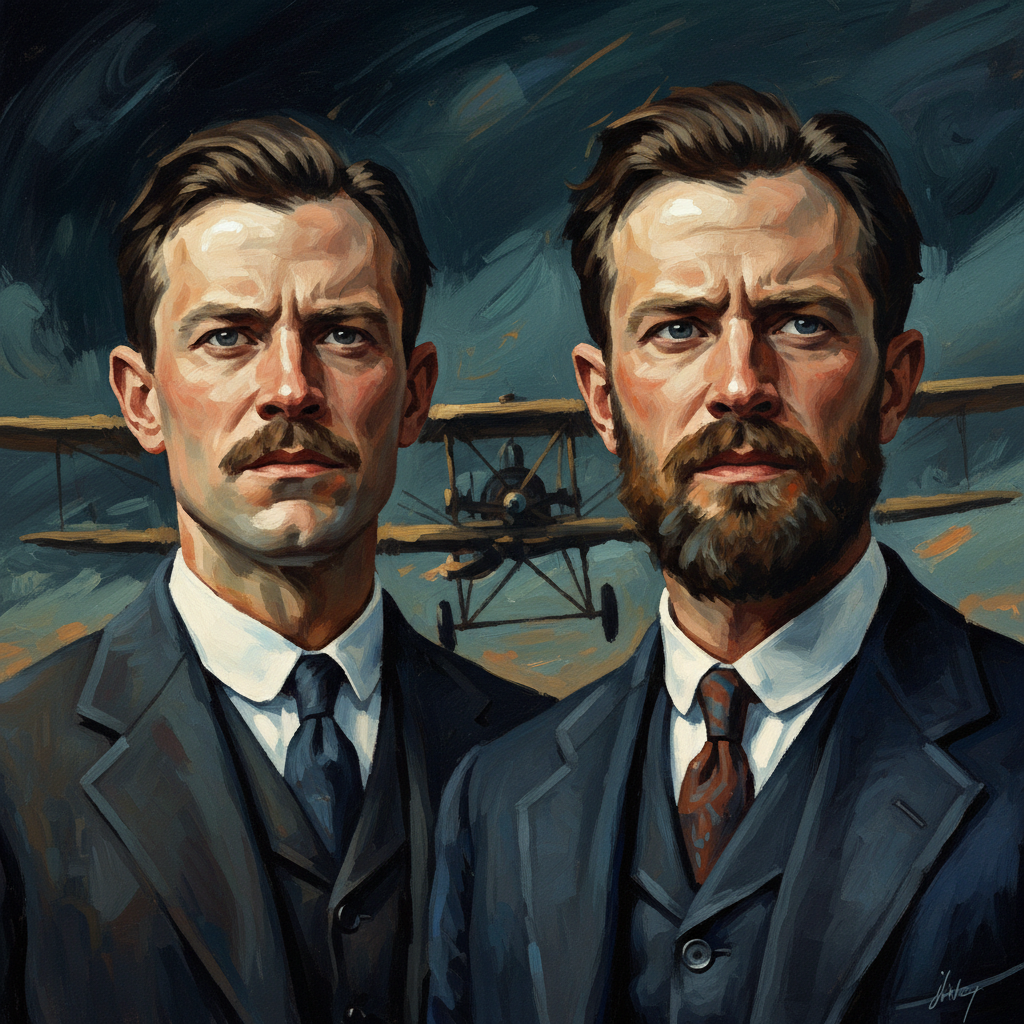
Wright Brothers (Orville & Wilbur) — "We were not as a matter of fact in the habit of thinking of the future. We were …"
We were not as a matter of fact in the habit of thinking of the future. We were too busy with the present.
We were not as a matter of fact in the habit of thinking of the future. We were too busy with the present.
Click any product to generate a realistic preview. Up to 3 at a time.
* Initial load can take up to 90 seconds — revising the preview in another color is nearly instant.
"We do not believe that the difficulties are insurmountable, and we are confident that we shall yet succeed."
"For some years I have been afflicted with the belief that flight is possible to man. My disease has progressed to an incurable stage."
"We have been out almost every day experimenting, and have made about 100 flights."
"We were very much surprised at the ease with which the machine was controlled."
"We are trying to arrange a demonstration in Europe."
American aviation pioneers who achieved the first sustained powered controlled airplane flight at Kitty Hawk, NC, on December 17, 1903. Closely associated with Octave Chanute (their gliding mentor and aeronautical correspondent). For an intellectual contrast, see Samuel Pierpont Langley, Smithsonian Institution Secretary and government-funded aviation researcher — Langley's Aerodrome crashed twice into the Potomac in October-December 1903 with $50,000 of War Department funding; the Wright Brothers' bicycle-shop empiricism beat Langley's institutional Big Science by 9 days. The most-cited example in engineering history of empirical-tinkerer beating institution-funded credentialism.
Found in 1 providers: grok
1 source checked
The speaker admits they rarely speculated about what was coming next. Their attention was consumed by immediate tasks, problems, and experiments right in front of them. Long-range planning and daydreaming about outcomes took a back seat to hands-on work. In short, they lived and labored in the moment because the work itself demanded full focus, leaving little room for predicting or worrying about tomorrow.
The Wright Brothers ran a modest bicycle shop in Dayton while methodically solving the puzzle of controlled flight. They built their own wind tunnel, hand-carved propellers, and tested gliders at Kitty Hawk season after season. Each problem—lift, control, power—demanded immediate attention. They weren't visionaries chasing fame; they were tinkerers absorbed in today's broken wing warp or miscalculated airfoil. Fame, patents, and aviation's future came later, almost incidentally to the daily grind.
In the late 1890s and early 1900s, powered flight was widely mocked as impossible or decades away. Samuel Langley's government-funded attempts failed publicly in 1903, just days before Kitty Hawk. The era celebrated tangible craftsmanship—bicycle makers, machinists, and self-taught inventors like Edison. Without universities pushing aeronautics or venture capital chasing moonshots, progress came from workshop experimentation. The Wrights' present-focused tinkering fit a world where practical problem-solving, not grand forecasting, produced breakthroughs.
AI-generated insights based on extensive research and information for context. Factual errors? Email [email protected].
Your cart is empty