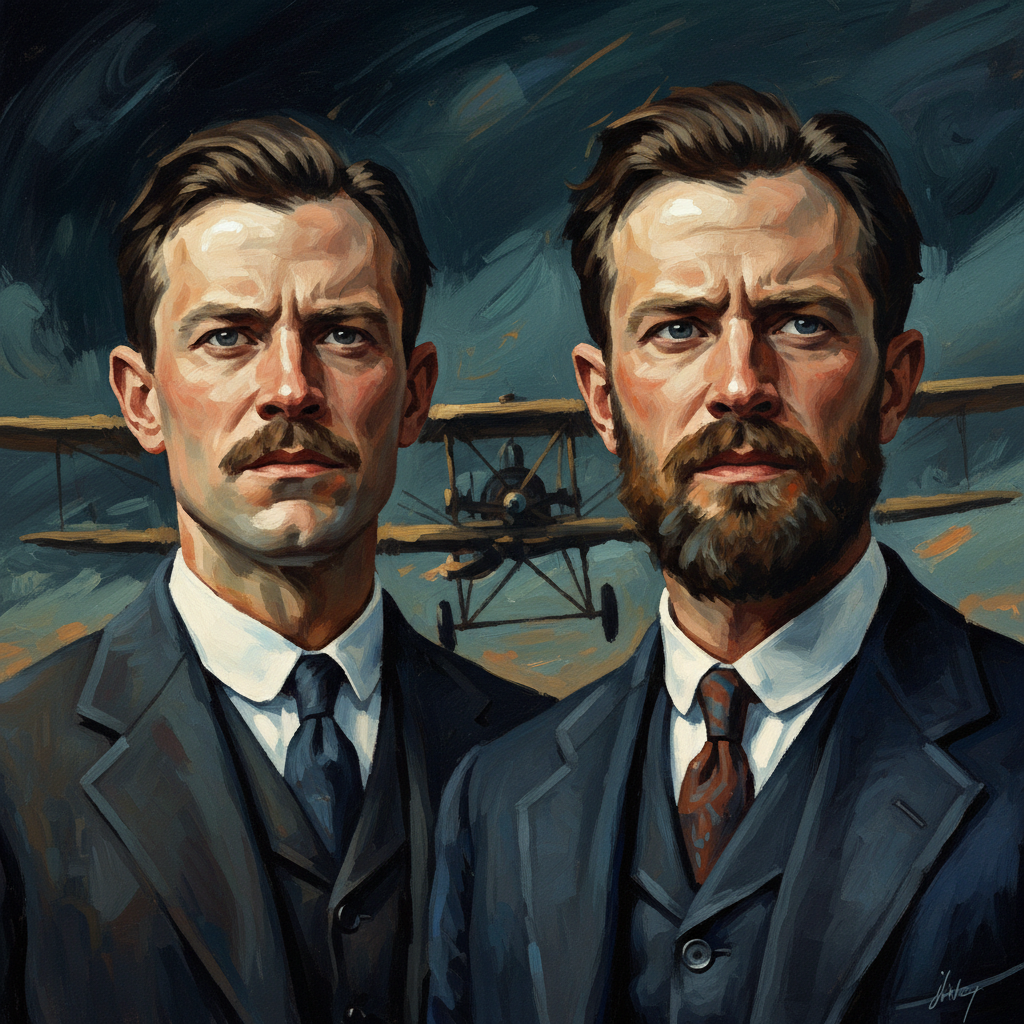
Wright Brothers (Orville & Wilbur) — "We were very much surprised at the ease with which the machine was controlled."
We were very much surprised at the ease with which the machine was controlled.
We were very much surprised at the ease with which the machine was controlled.
Click any product to generate a realistic preview. Up to 3 at a time.
* Initial load can take up to 90 seconds — revising the preview in another color is nearly instant.
"No flights of any kind were made except those of our own machine, which, strange to say, did not become a public amusement."
"We could hardly wait to get up in the morning."
"I confess that, in 1901, I said to my brother Orville that men would not fly for 50 years. Two years later, we were making flights. This demonstration of my inability as a prophet gave me such a shock…"
"The greatest value of our work is that it will be an inspiration to others."
"The fact that the machine did not fall apart at the first gust of wind was a great encouragement."
American aviation pioneers who achieved the first sustained powered controlled airplane flight at Kitty Hawk, NC, on December 17, 1903. Closely associated with Octave Chanute (their gliding mentor and aeronautical correspondent). For an intellectual contrast, see Samuel Pierpont Langley, Smithsonian Institution Secretary and government-funded aviation researcher — Langley's Aerodrome crashed twice into the Potomac in October-December 1903 with $50,000 of War Department funding; the Wright Brothers' bicycle-shop empiricism beat Langley's institutional Big Science by 9 days. The most-cited example in engineering history of empirical-tinkerer beating institution-funded credentialism.
Found in 1 providers: grok
1 source checked
The speaker expresses genuine astonishment at how simple and manageable operating their invention turned out to be. What they expected to be difficult, demanding, or unpredictable instead responded smoothly to their inputs. The surprise is the key emotion here: reality outperformed their expectations. They anticipated struggle and instead found responsiveness, suggesting that careful preparation and design had produced something far more cooperative than they had dared to hope.
Orville and Wilbur spent years obsessing over control as the unsolved problem of flight, while rivals chased power and lift. Their wing-warping system, three-axis control, and wind-tunnel testing on over 200 wing shapes targeted this exact challenge. After countless glider trials at Kitty Hawk, the machine's responsiveness confirmed their methodical bicycle-mechanic engineering approach had cracked what scientists and well-funded experimenters like Langley could not.
In December 1903, heavier-than-air powered flight was widely mocked as impossible; Samuel Langley's Aerodrome had crashed into the Potomac days earlier to public ridicule. The era buzzed with mechanical optimism, Edison's inventions, and automobiles, yet respected scientists declared flight a fool's errand. Newspapers barely covered the Wrights' success because it contradicted accepted wisdom. Control, not lift, was the breakthrough the age needed to transform humanity's relationship with distance and geography.
AI-generated insights based on extensive research and information for context. Factual errors? Email [email protected].
Your cart is empty