What it means
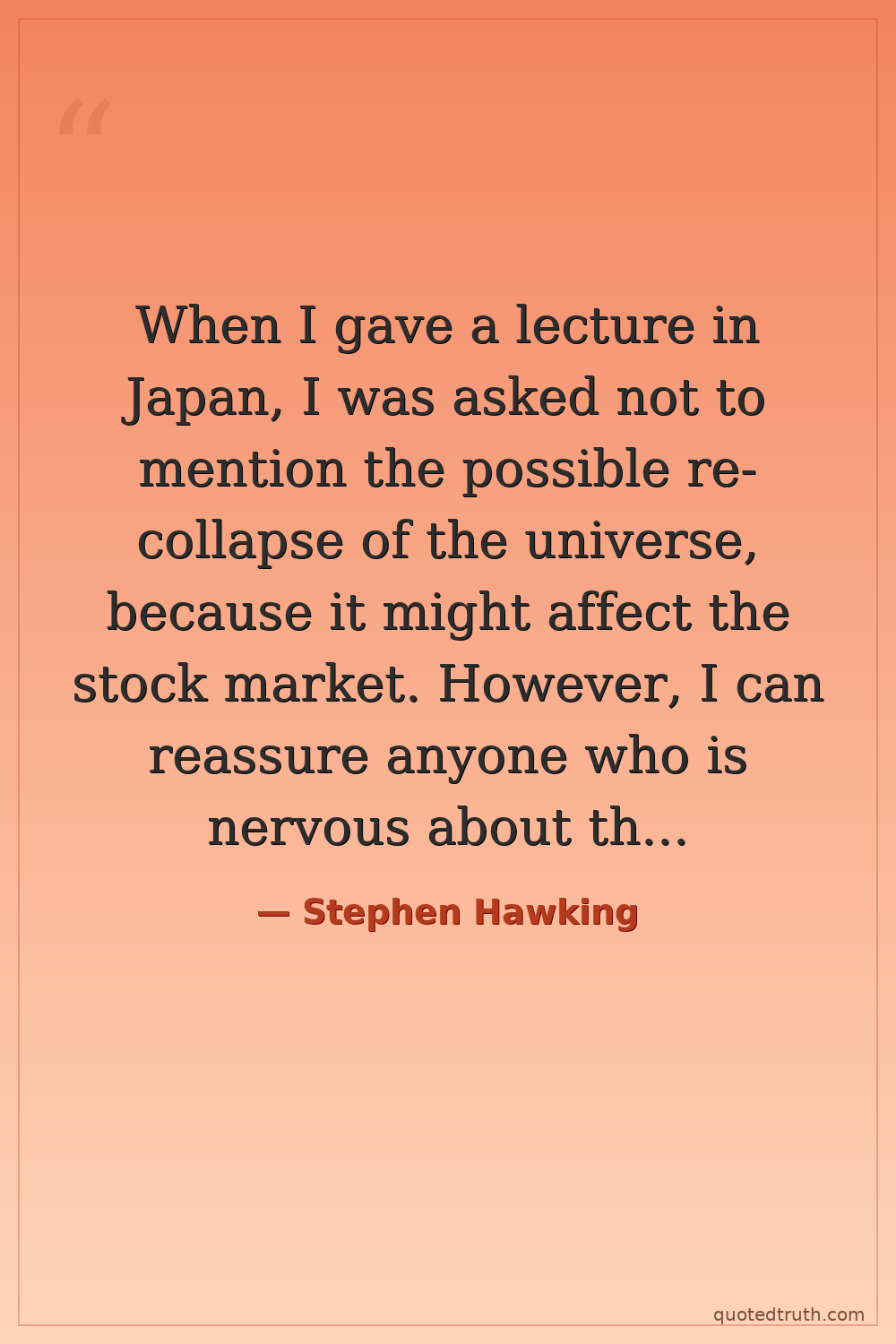
Science affects real-world anxieties, even irrational ones. Hawking uses dry wit to expose how humans project short-term economic fears onto cosmic timescales. The universe's eventual end, billions of years away, is utterly irrelevant to today's financial decisions. He gently mocks the absurdity of letting astronomical speculation influence markets while reassuring that existential cosmic dread is thoroughly premature.
Relevance to Stephen Hawking
Hawking's entire career balanced rigorous cosmology with public accessibility and sharp humor. His work on the Big Bang, black holes, and universe expansion made him uniquely qualified to discuss cosmic endpoints. His wit was legendary — he used comedy to disarm intimidating physics concepts, and this anecdote perfectly captures his ability to make cosmology both approachable and amusing without sacrificing scientific precision.
The era
Hawking delivered lectures like this during the 1980s-90s, when Japan's economic bubble and global financial anxiety were prominent. Simultaneously, theoretical cosmology was entering public consciousness through his 1988 bestseller A Brief History of Time. The tension between Wall Street volatility and cosmic timescales reflected a broader cultural moment when science was becoming mainstream entertainment yet still triggered irrational public fears.
AI-generated insights based on extensive research and information for context. Factual errors? Email [email protected].