What it means
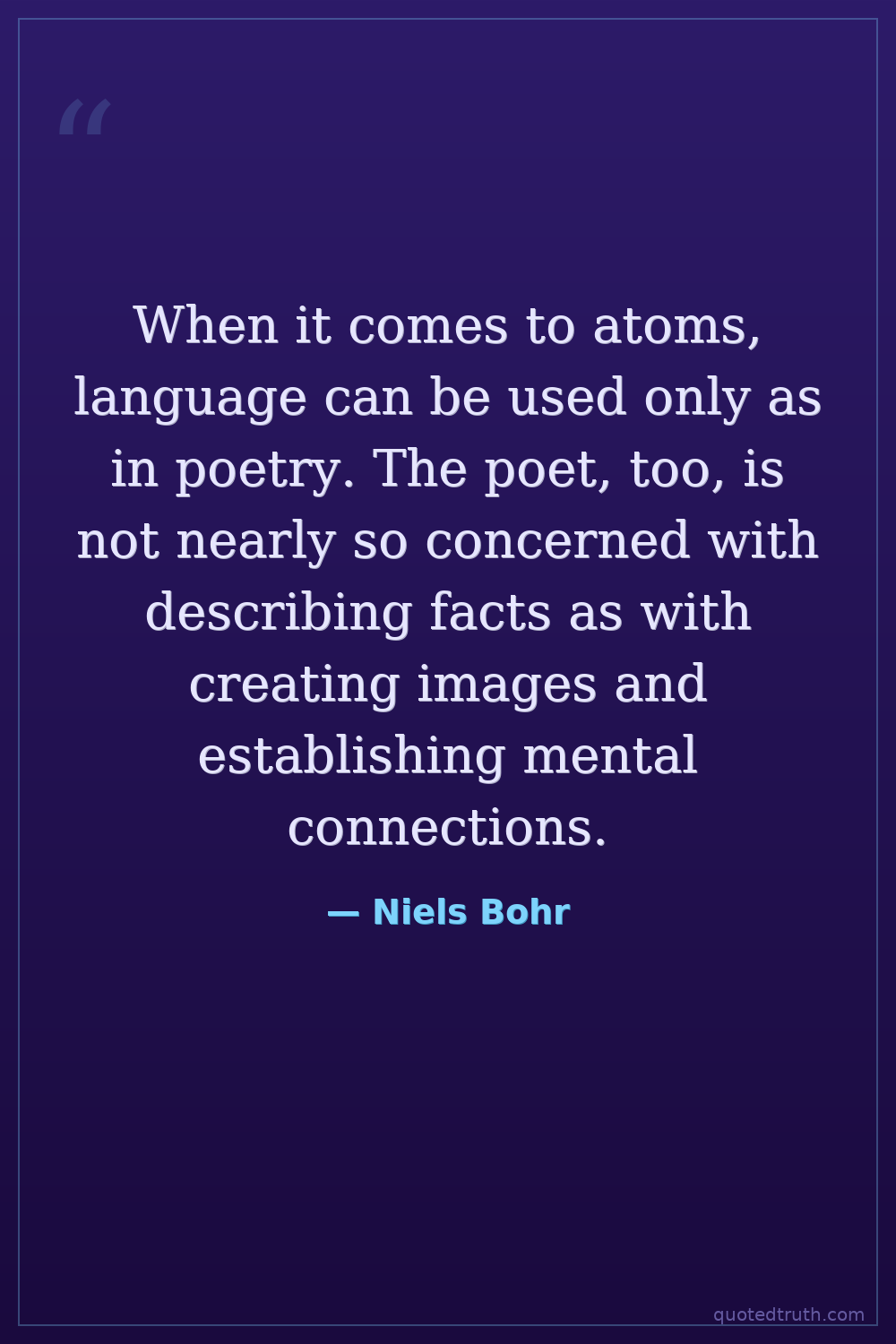
Describing the atomic world is not like reporting on everyday objects. Atoms behave in ways ordinary words cannot capture, so physicists must rely on metaphors, analogies, and suggestive images rather than literal description. In this sense, speaking about atoms resembles poetry: the goal is not a precise photograph of reality but evoking understanding and forging mental links that let the mind grasp something fundamentally strange and invisible.
Relevance to Niels Bohr
Bohr built his career wrestling with phenomena that defied classical description. His atomic model required abandoning intuitive pictures, and his complementarity principle argued wave and particle were two necessary images of one reality. He insisted physicists could never describe quantum events directly, only through limited classical language. This quote distills that philosophical stance, reflecting his lifelong belief that understanding nature at its deepest level requires creative, symbolic thinking rather than literal depiction.
The era
Bohr worked through the early twentieth-century revolution that overturned Newtonian certainty. Between 1913 and the 1930s, quantum mechanics, relativity, and the Copenhagen interpretation forced scientists to question whether reality could be pictured at all. Heisenberg's uncertainty and wave-particle duality shattered classical intuitions. Meanwhile, modernist poets like Eliot and Rilke were similarly breaking language to capture fractured experience, making Bohr's comparison between physics and poetry a genuine reflection of his intellectual moment.
AI-generated insights based on extensive research and information for context. Factual errors? Email [email protected].