What it means
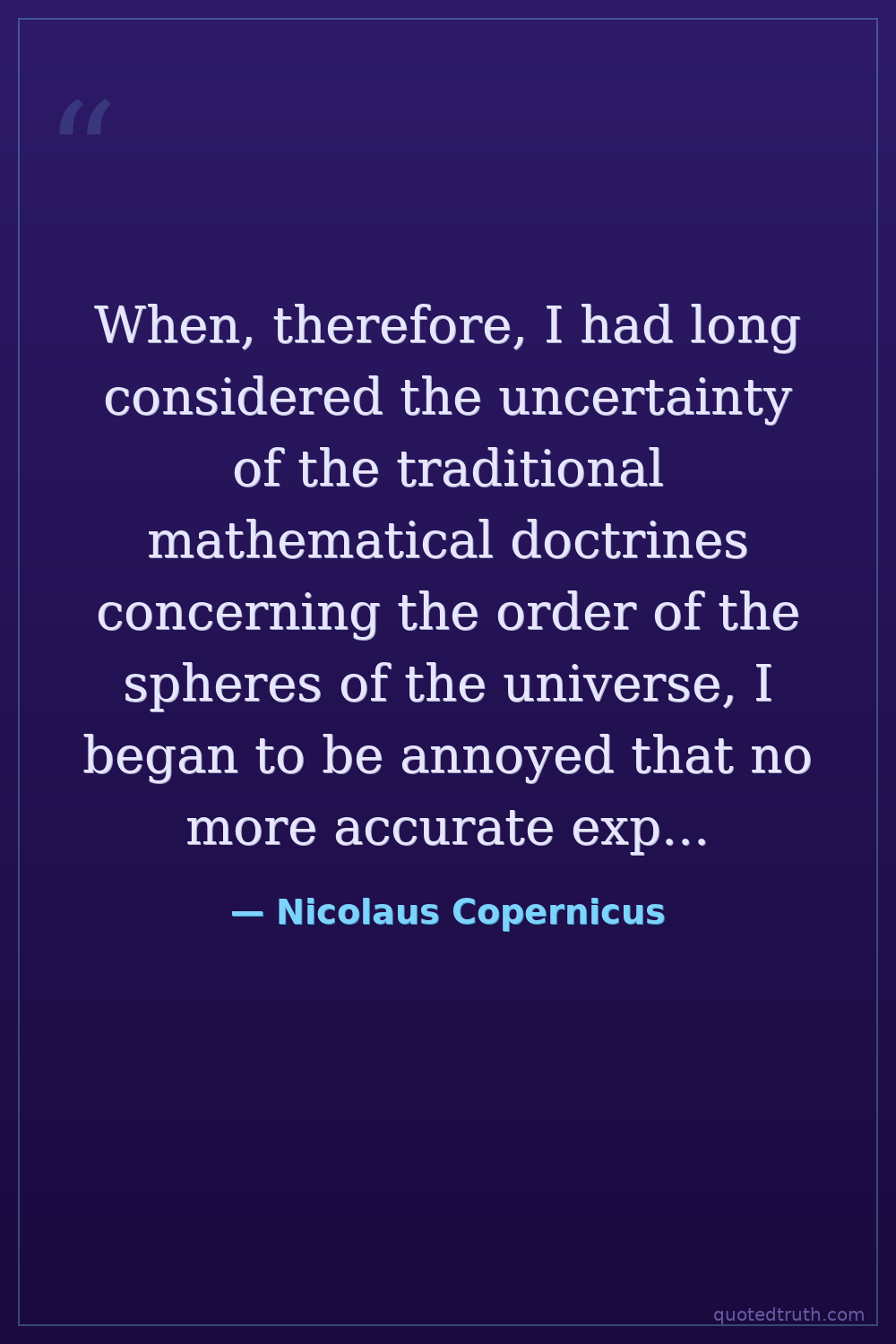
Copernicus expresses frustration that ancient and medieval astronomical systems produced conflicting, imprecise accounts of how celestial bodies move. Despite centuries of mathematical effort, no consensus existed on something as fundamental as the arrangement of planets. This inconsistency bothered him deeply, implying that a perfect, rationally ordered cosmos deserved a correspondingly precise and unified scientific description.
Relevance to Nicolaus Copernicus
Copernicus was a meticulous canon and physician trained in mathematics and astronomy at Kraków, Bologna, and Padua. His frustration here is characteristically his own: a conservative, deeply religious man who believed God's creation must be orderly, driving him to spend decades privately developing heliocentrism before finally publishing De Revolutionibus in 1543, the year he died.
The era
In the early sixteenth century, European astronomy still rested on Ptolemy's geocentric system from the second century AD, patched with increasingly complex epicycles. Renaissance humanism was driving scholars back to original Greek texts, revealing contradictions. Meanwhile, navigational demands from the Age of Exploration made accurate celestial tables urgent, exposing how badly existing models disagreed with actual observation.
AI-generated insights based on extensive research and information for context. Factual errors? Email [email protected].