Nicolaus Copernicus — "I am aware that I have made myself liable to be laughed at by those who consider…"
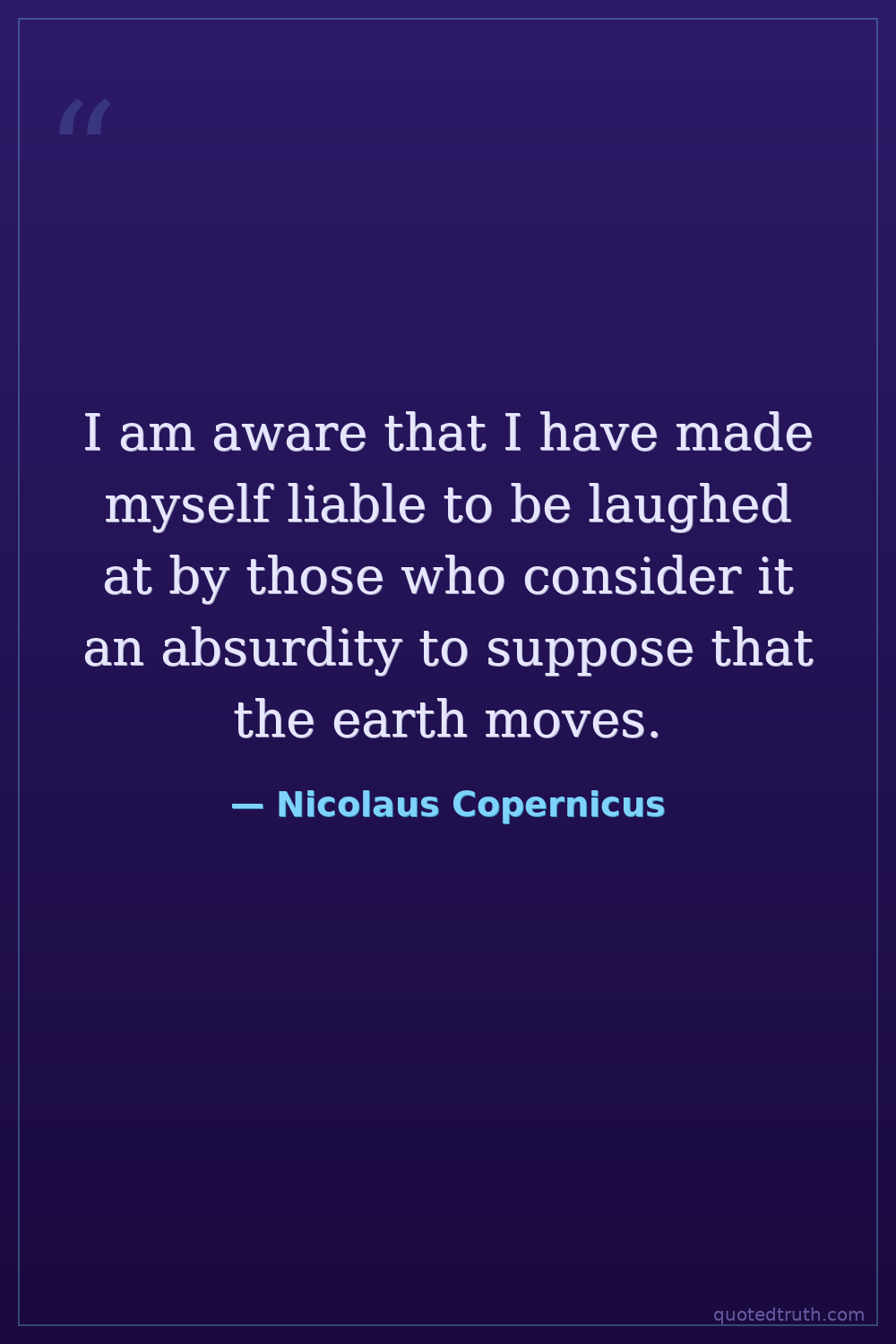
I am aware that I have made myself liable to be laughed at by those who consider it an absurdity to suppose that the earth moves.
I am aware that I have made myself liable to be laughed at by those who consider it an absurdity to suppose that the earth moves.
Click any product to generate a realistic preview. Up to 3 at a time.
* Initial load can take up to 90 seconds — revising the preview in another color is nearly instant.
"It is not incredible that the earth moves, but that it stands still, that is incredible."
"The earth has a spherical shape, for it is bounded on all sides by the circumference of a circle."
"For the world is spherical, and is bounded by a spherical surface."
"There may be babblers, wholly ignorant of mathematics, who dare to condemn my hypothesis, upon the authority of some part of the Bible twisted to suit their purpose. I value them not, and scorn their …"
"When, therefore, I had long considered the uncertainty of the traditional mathematical doctrines concerning the order of the spheres of the universe, I began to be annoyed that no more accurate explan…"
Preface to De revolutionibus orbium coelestium (sentiment, not direct quote)
Date: 1543
Nature & WorldFound in 1 providers: grok
1 source checked
The speaker acknowledges that claiming the Earth moves will invite ridicule and mockery from contemporaries. He understands this idea defies common sense and established belief, yet he stands by it regardless. It captures the lonely courage required to assert an uncomfortable truth — accepting that you will be seen as absurd by most people, while remaining convinced by evidence and reason over social acceptance.
Copernicus spent decades developing his heliocentric model, finally publishing De Revolutionibus in 1543, the year he died — reportedly receiving his printed copy on his deathbed. He deliberately delayed publication for years, fearing exactly this ridicule. His caution was professional and real: he was a Catholic canon whose theory contradicted Church cosmology and Aristotelian physics that had dominated for nearly two millennia.
In early 16th-century Europe, Ptolemaic geocentrism was not merely scientific consensus but theological orthodoxy — Earth at the center reflected humanity's divine importance. Challenging this risked ridicule from scholars, clergy, and educated laypeople alike. The Reformation was fracturing Christendom, making authorities on all sides defensive of established doctrine. Copernicus's hesitation reflected genuine danger: Bruno would later be burned partly for cosmological heterodoxy.
AI-generated insights based on extensive research and information for context. Factual errors? Email [email protected].
Your cart is empty