What it means
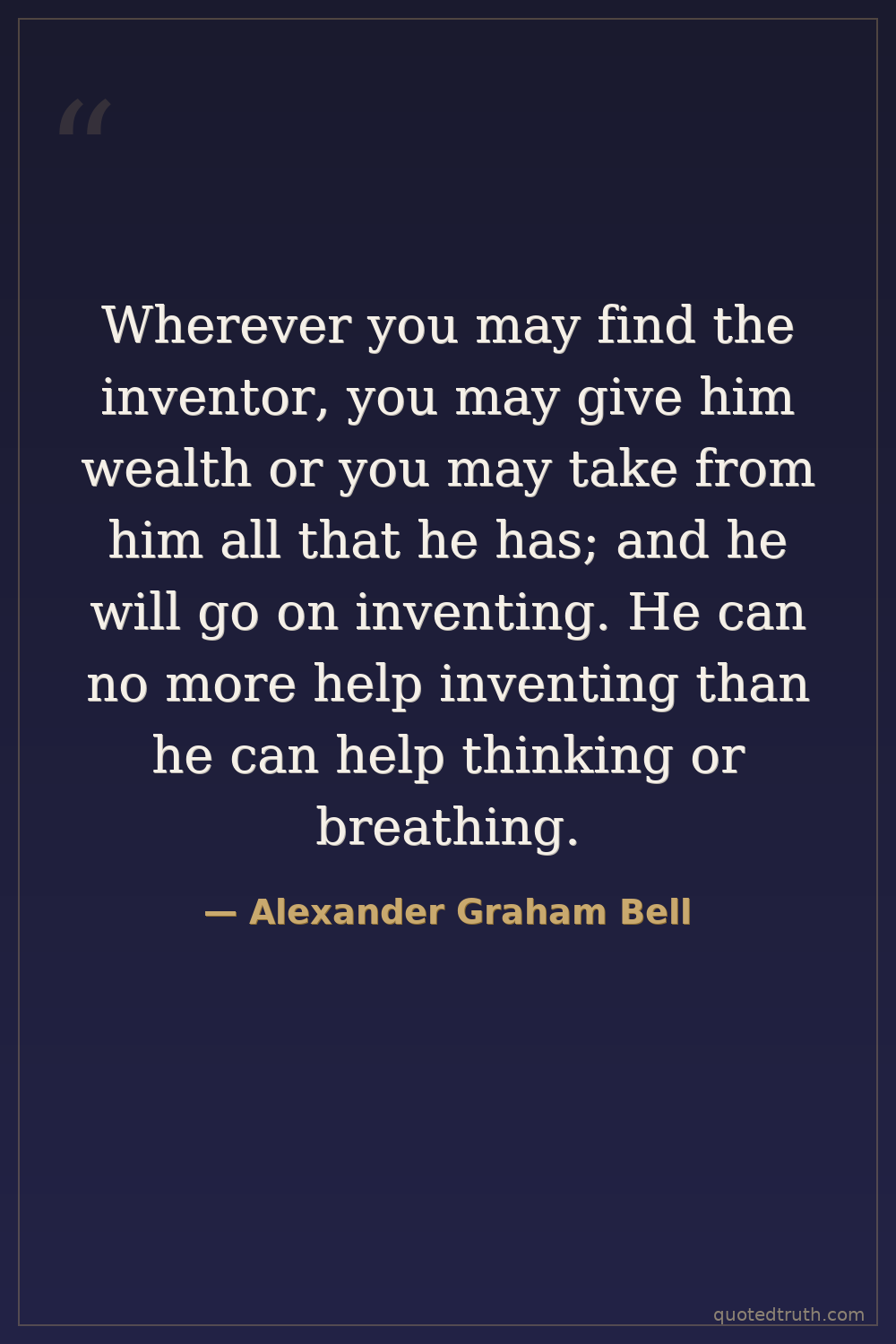
The quote asserts that true inventors are driven by an unstoppable internal compulsion — wealth cannot accelerate it, poverty cannot extinguish it. Inventing, for them, is as involuntary as breathing. The impulse to solve problems and create new things is hardwired into their character, not contingent on external reward or circumstance. It separates invention as a calling from invention as a career strategy.
Relevance to Alexander Graham Bell
Bell never stopped inventing after the telephone made him wealthy. He pursued the photophone (light-based communication, 1880), an audiometer, a metal detector used on President Garfield after his assassination attempt, hydrofoil boats, and early flight research. His mother and wife were both deaf, giving him a lifelong passion for communication science that transcended financial need. His Volta Laboratory continued experimentation long after he faced no economic pressure to innovate.
The era
Bell lived through the Gilded Age (1870s–1910s), when invention became industrialized and commercially lucrative. Patent wars — including Bell's own fierce battles with Elisha Gray over telephone priority — made invention appear purely profit-driven. Simultaneously, Edison built invention factories, commodifying creativity. Bell's statement pushes back against that narrative, asserting the inventor's inner drive predates and outlasts commercial systems — a significant claim when society debated whether science served capitalism or humanity.
AI-generated insights based on extensive research and information for context. Factual errors? Email [email protected].