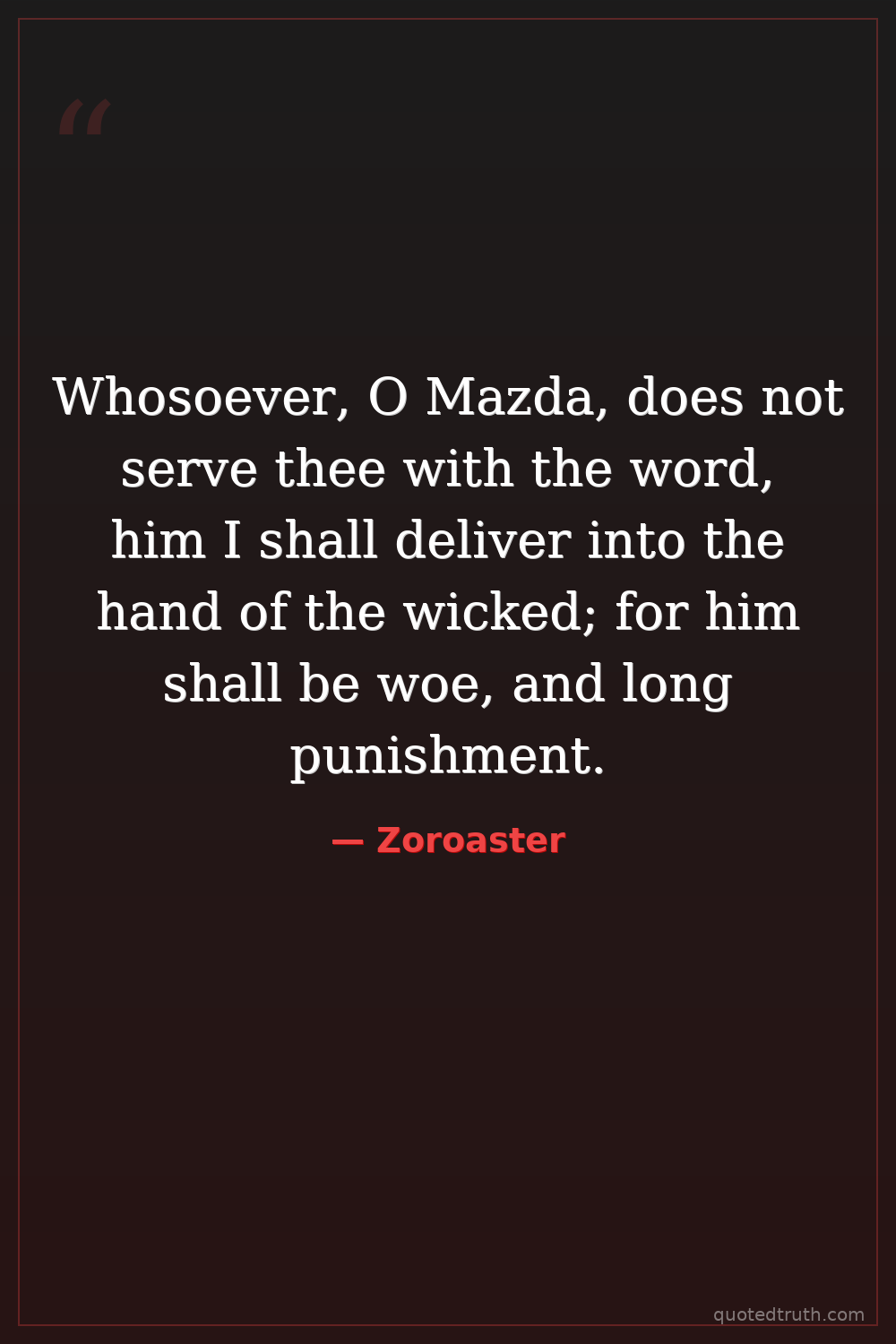
Zoroaster — "Whosoever, O Mazda, does not serve thee with the word, him I shall deliver into …"
Whosoever, O Mazda, does not serve thee with the word, him I shall deliver into the hand of the wicked; for him shall be woe, and long punishment.
Whosoever, O Mazda, does not serve thee with the word, him I shall deliver into the hand of the wicked; for him shall be woe, and long punishment.
Click any product to generate a realistic preview. Up to 3 at a time.
* Initial load can take up to 90 seconds — revising the preview in another color is nearly instant.
"The demonic powers or daævás are expressions or faces (čithr) of aká manah or 'beaten/anguished mind.'"
"The purpose of life is to strive for perfection and attain union with Ahura Mazda."
"A righteous government is of all the most to be wished for, Bearing of blessing and good fortune in the highest. Guided by the law of Truth, supported by dedication and zeal, It blossoms into the Best…"
"When, O Mazda, shall the dawn of the days of existence rise, when shall the world be restored to its purity?"
"Choose the truth. And if the truth is inconvenient, choose it anyway. But maybe grumble a little."
Iranian prophet who founded Zoroastrianism, the first major religion of cosmic dualism between good (Ahura Mazda) and evil (Angra Mainyu). Closely associated with The Buddha (near-contemporary Eastern moral-cosmological revolutionary). For an intellectual contrast, see Friedrich Nietzsche, German philosopher of 'beyond good and evil' — Nietzsche appropriated Zarathustra's name for Thus Spoke Zarathustra (1883) precisely to invert the original's moral cosmology — the historical Zoroaster founded the good-versus-evil framework Nietzsche's character announces the end of.
Found in 1 providers: grok
1 source checked
Anyone who refuses to honor the supreme god Mazda through prayer and speech will be abandoned to evil forces, suffering lasting torment. The message is stark: loyalty to the divine must be actively voiced, not merely felt. Silence or neglect counts as betrayal, and the consequence is separation from divine protection, leaving the unfaithful exposed to suffering that extends far beyond a single lifetime.
Zoroaster framed religion around the spoken word, composing the Gathas as hymns meant to be recited aloud to Ahura Mazda. As a prophet-priest rejecting the old polytheistic rites of ancient Iran, he demanded active verbal devotion over ritual sacrifice. This line reflects his dualistic worldview pitting truth (asha) against the lie (druj), and his conviction that failing to praise Mazda effectively enlisted one into the wicked camp.
Around 1200 BCE in Bronze Age Iran, tribal peoples worshipped many daevas through bloody animal sacrifices and intoxicating haoma rituals led by hereditary priests. Zoroaster preached against this establishment, facing persecution before winning King Vishtaspa's court. Literacy was minimal, so religion traveled through memorized oral poetry. Declaring allegiance aloud was the primary way to mark tribal and spiritual identity, making verbal worship a life-or-death commitment in a fractious society.
AI-generated insights based on extensive research and information for context. Factual errors? Email [email protected].
Your cart is empty