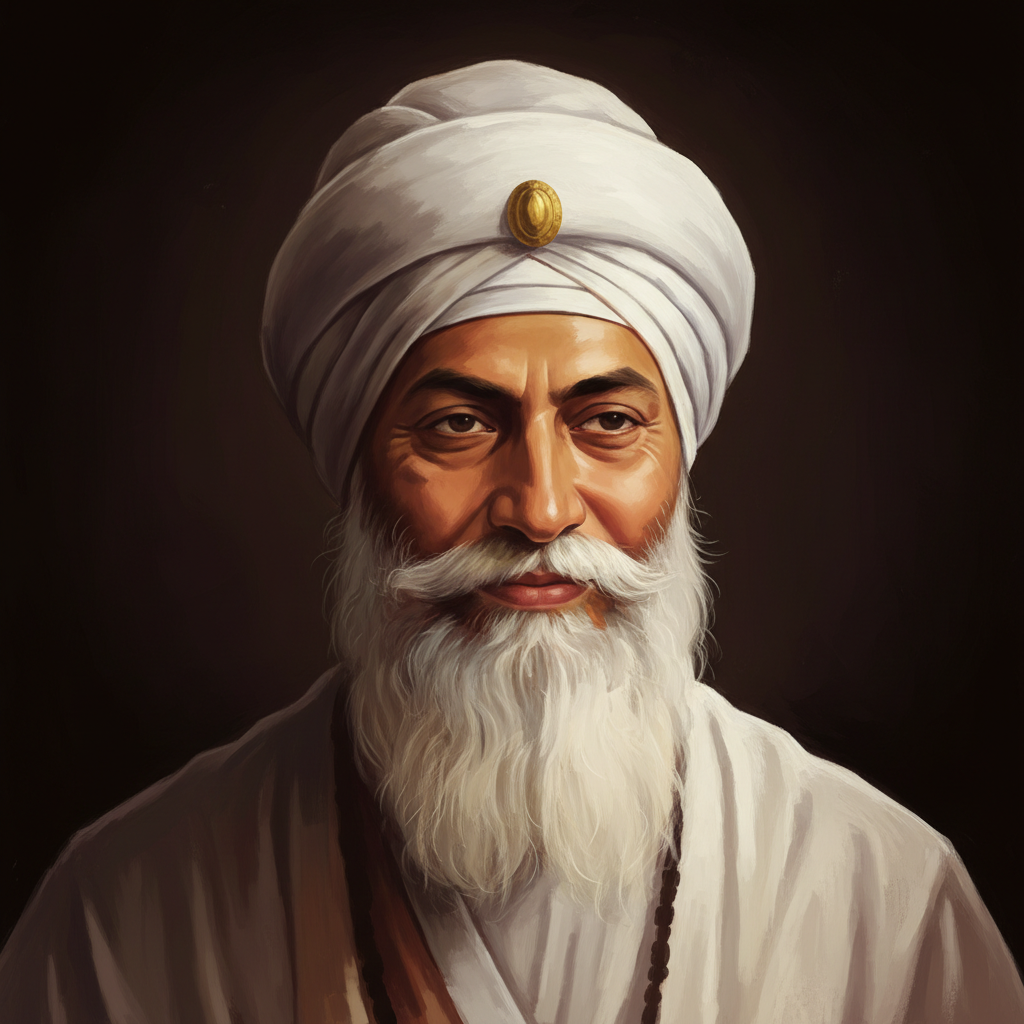
Guru Nanak — "Why do you not love the one who created you?"
Why do you not love the one who created you?
Why do you not love the one who created you?
Click any product to generate a realistic preview. Up to 3 at a time.
* Initial load can take up to 90 seconds — revising the preview in another color is nearly instant.
"Even kings and emperors have vast riches and still they are not content. Probably because they can't find matching socks."
"The greatest wealth is to be without desires."
"Those who have loved are those that have found God."
"Death would not be called bad, O people, if one knew how to truly die."
"Like the juggler, deceiving by his tricks, one is deluded by egotism, falsehood and illusion."
Founder of Sikhism and the first of the Ten Sikh Gurus, whose teachings of one universal God and rejection of caste shaped Punjab. Closely associated with Kabir (mystical poet whose verses appear in the Sikh Guru Granth Sahib). For an intellectual contrast, see Brahmanical orthodoxy, the Hindu caste-and-ritual establishment of his era — Sikhism was founded as a deliberate alternative to both Hindu ritual hierarchy and Islamic exclusivism — Nanak's universalism was a structural rejection of caste and priestly mediation.
Found in 1 providers: grok
1 source checked
The question asks why people ignore or fail to appreciate the source of their own existence. It challenges the reader to recognize that they owe their life, breath, and awareness to a creator, and wonders why that foundational relationship gets neglected in favor of lesser attachments. It reframes devotion not as a duty imposed from outside, but as the natural, grateful response any thinking person should have toward whoever brought them into being.
Guru Nanak founded Sikhism on the principle of Ik Onkar, one universal creator, and rejected empty ritual in favor of direct, loving devotion (bhakti) to that single God. A former accountant in Sultanpur who experienced a transformative vision in the Bein river, he spent his life traveling across South Asia and the Middle East urging people of every faith to remember the Creator through Naam Simran, sincere remembrance, rather than caste, pilgrimage, or outward religious performance.
Guru Nanak (1469-1539) preached in Punjab during the collapse of the Delhi Sultanate and the rise of the Mughal Empire under Babur, whose 1526 invasion he personally witnessed and lamented. Hindu-Muslim tensions, rigid Brahminical caste enforcement, and formalistic Islamic practice dominated religious life. By asking why people do not love their Creator, Nanak cut through sectarian boundaries and ritualism, offering a unifying devotional path during an era of political upheaval and communal division.
AI-generated insights based on extensive research and information for context. Factual errors? Email [email protected].
Your cart is empty