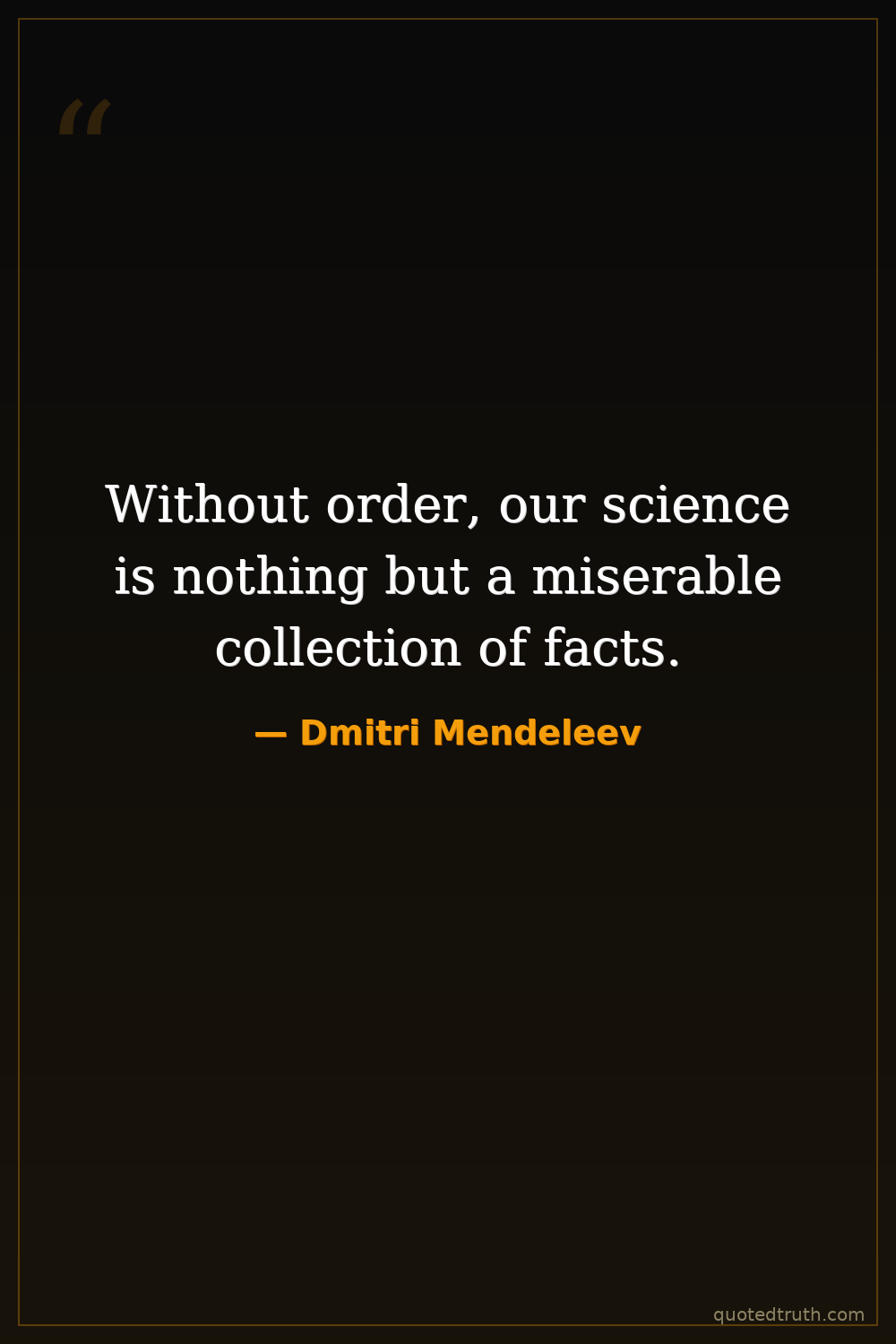
Dmitri Mendeleev — "Without order, our science is nothing but a miserable collection of facts."
Without order, our science is nothing but a miserable collection of facts.
Without order, our science is nothing but a miserable collection of facts.
Click any product to generate a realistic preview. Up to 3 at a time.
* Initial load can take up to 90 seconds — revising the preview in another color is nearly instant.
"The universe is a vast chemical laboratory."
"The chemical elements are not created, but are transformed."
"To conceive, understand, and grasp the whole symmetry of the scientific edifice, including its unfinished portions, is equivalent to tasting that enjoyment only conveyed by the highest forms of beauty…"
"I have achieved neither fame nor wealth, but I have learned to know the human heart."
"The chemical elements are the children of the sun."
Emphasizing the importance of organization and theory in science.
Date: Unknown, prior to 1907
ShockingFound in 1 providers: gemini
1 source checked
Knowledge without structure is useless. Facts piled up without classification or system give no understanding, no predictive power, and no way to see relationships. Real science requires organizing observations into patterns, categories, and laws that reveal how things connect. A random heap of data is not knowledge—only when arranged by principle does it become a tool for explaining the world and anticipating what has not yet been discovered.
Mendeleev built his career on exactly this principle. Facing 63 known elements with scattered, inconsistent properties, he arranged them by atomic weight and valence into the periodic table in 1869, leaving gaps he boldly predicted would be filled—gallium, scandium, and germanium proved him right. His insistence on order over accumulation transformed chemistry from cataloging substances into a predictive science rooted in underlying structure.
Nineteenth-century science was drowning in raw data. Chemists had isolated dozens of new elements, naturalists classified species, and physicists measured endlessly, but unifying frameworks lagged behind. Russia under the tsars was racing to modernize its industry and universities. Mendeleev wrote amid this tension between empirical abundance and theoretical poverty, championing systematization as Darwin did for biology and Maxwell for electromagnetism—an era demanding that mountains of observation yield coherent law.
AI-generated insights based on extensive research and information for context. Factual errors? Email [email protected].
Your cart is empty