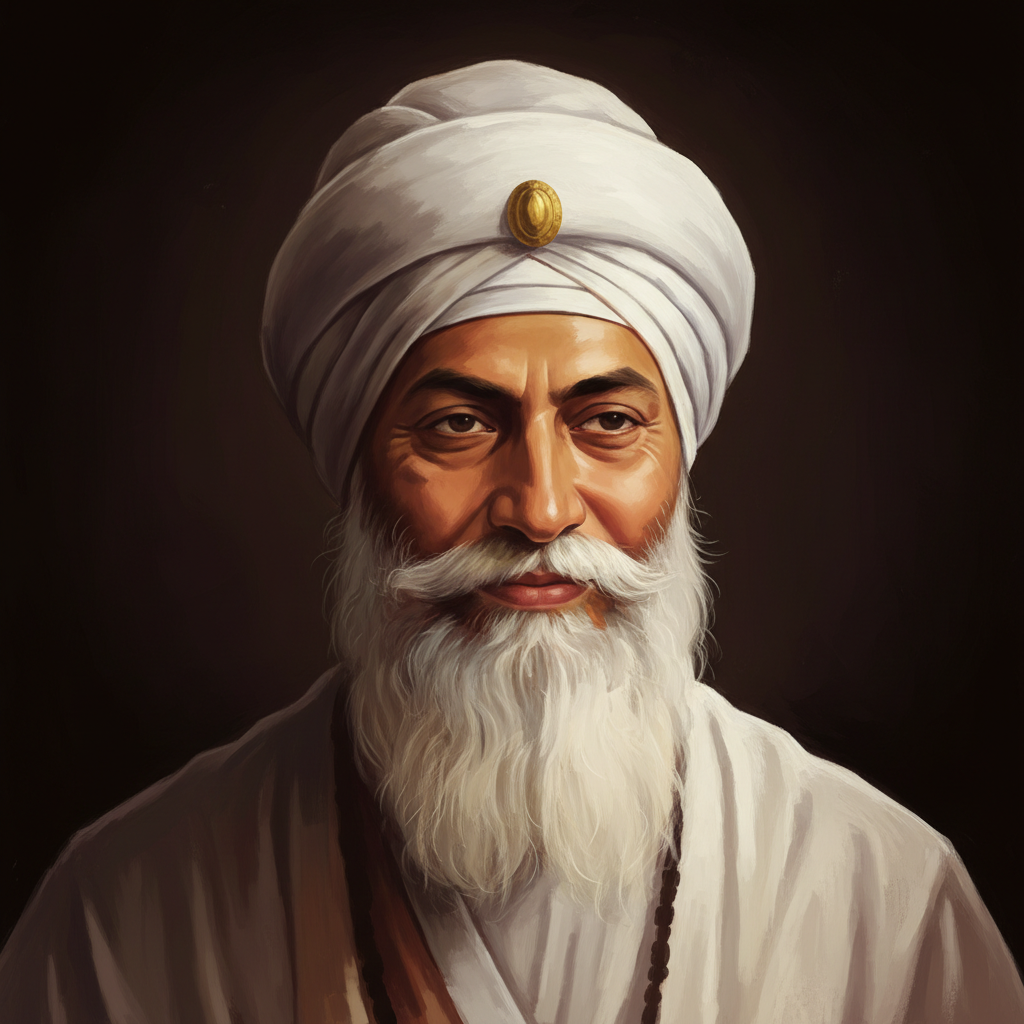
Guru Nanak — "Without the True Guru, none obtains salvation."
Without the True Guru, none obtains salvation.
Without the True Guru, none obtains salvation.
Click any product to generate a realistic preview. Up to 3 at a time.
* Initial load can take up to 90 seconds — revising the preview in another color is nearly instant.
"The nights are wasted sleeping, and the days are wasted eating; the human spends his life in vain."
"There is but One God. His Name is Truth. He is the Creator. He fears none. He is without enmity. He is timeless, unborn, self-existent. By the Guru's Grace, He is met."
"The world is burning in the fire of desire, greed, attachment, and ego."
"Recognize the whole human race as one. And then try to remember everyone's name."
"The highest religion is to rise to universal brotherhood; aye, to consider all creatures your equals."
Founder of Sikhism and the first of the Ten Sikh Gurus, whose teachings of one universal God and rejection of caste shaped Punjab. Closely associated with Kabir (mystical poet whose verses appear in the Sikh Guru Granth Sahib). For an intellectual contrast, see Brahmanical orthodoxy, the Hindu caste-and-ritual establishment of his era — Sikhism was founded as a deliberate alternative to both Hindu ritual hierarchy and Islamic exclusivism — Nanak's universalism was a structural rejection of caste and priestly mediation.
Found in 1 providers: gemini
1 source checked
Real spiritual liberation cannot come from rituals, priests, caste status, or scriptural memorization alone. A person needs an authentic teacher—one grounded in direct experience of the divine—to cut through ego, illusion, and inherited dogma. Without that genuine guidance, seekers stay trapped in surface religion, repeating forms without transformation. The saying insists that freedom is relational and transmitted, not self-manufactured, and that distinguishing a true guide from a false one is itself part of the path.
Guru Nanak founded Sikhism in 15th-16th century Punjab after a transformative mystical experience at the Bein river, emerging with the declaration that there is no Hindu, no Muslim—only one God. He rejected Brahminical priestcraft and empty ritual, traveling across South Asia and the Middle East teaching direct devotion. Establishing the line of Gurus, he embodied the very principle this saying names: a realized teacher transmitting liberation through lived example, hymn, and community rather than caste-gated ceremony.
Early 16th-century Punjab sat at a collision point between entrenched Hindu caste hierarchy, Islamic Mughal expansion under Babur, and the Bhakti and Sufi devotional movements pushing back against clerical gatekeeping. Ordinary people were taxed by Brahmin ritual fees and Muslim jizya alike, while saints like Kabir and Ravidas were declaring God accessible beyond temple and mosque. Nanak's insistence on a True Guru over inherited priesthood directly challenged both religious establishments and offered a unifying devotional path amid sectarian violence.
AI-generated insights based on extensive research and information for context. Factual errors? Email [email protected].
Your cart is empty