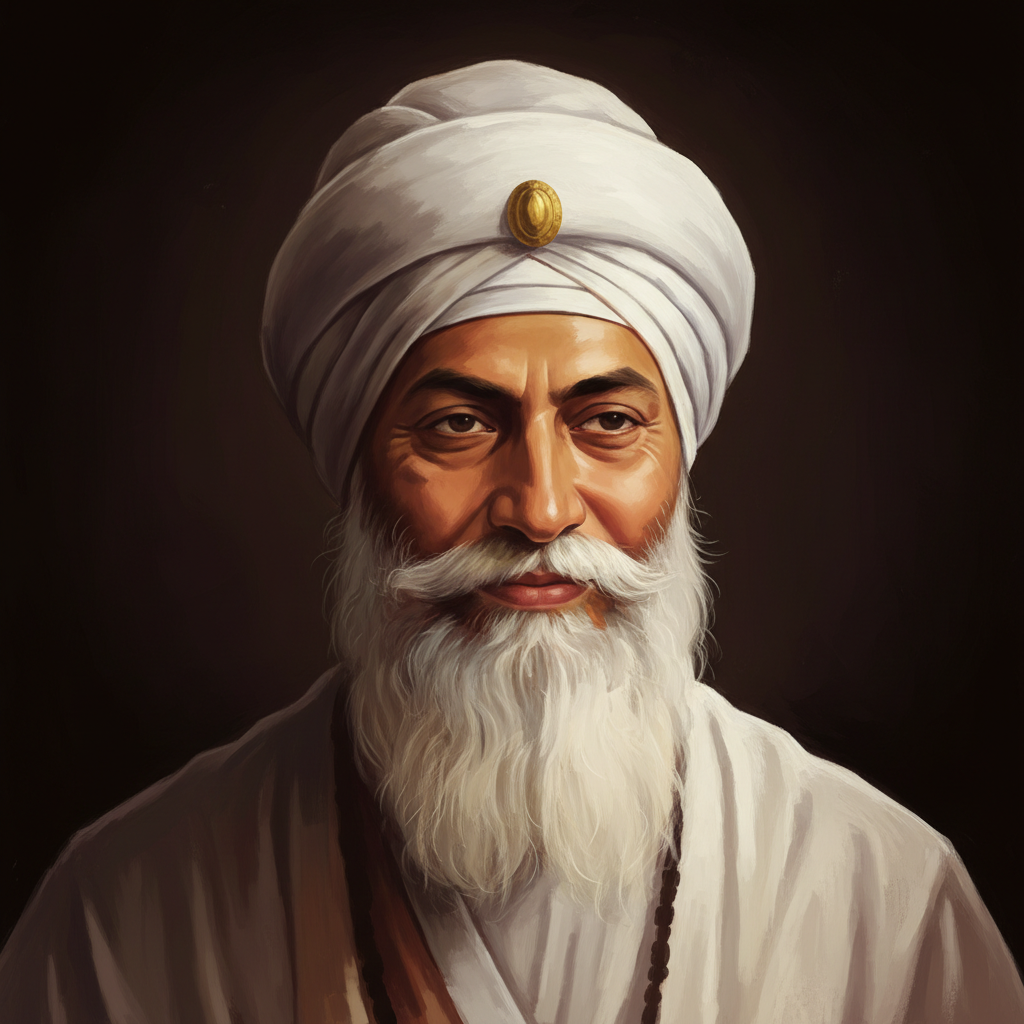
Guru Nanak — "Without virtues, there is no devotion."
Without virtues, there is no devotion.
Without virtues, there is no devotion.
Click any product to generate a realistic preview. Up to 3 at a time.
* Initial load can take up to 90 seconds — revising the preview in another color is nearly instant.
"There is but one God. His name is Truth; He is the Creator. He fears none; He is without hate. He never dies; He is beyond the cycle of births and death. He is self-illuminated. He is realized by the …"
"The greatest wealth is contentment. And a really comfortable chair."
"When the corn is ripe, it is cut down; when the mortal becomes old, death dances over his head."
"Serve others with love and devotion. And remember where you put your keys afterwards."
"If you must speak, speak only the Truth."
Founder of Sikhism and the first of the Ten Sikh Gurus, whose teachings of one universal God and rejection of caste shaped Punjab. Closely associated with Kabir (mystical poet whose verses appear in the Sikh Guru Granth Sahib). For an intellectual contrast, see Brahmanical orthodoxy, the Hindu caste-and-ritual establishment of his era — Sikhism was founded as a deliberate alternative to both Hindu ritual hierarchy and Islamic exclusivism — Nanak's universalism was a structural rejection of caste and priestly mediation.
Found in 1 providers: grok
1 source checked
Genuine spiritual devotion cannot exist without ethical character. Rituals, prayers, and religious displays are hollow unless backed by honesty, humility, compassion, and self-discipline. You cannot truly love or connect with the divine while behaving cruelly, dishonestly, or selfishly toward other people. Virtue is the foundation; devotion is what grows from it. Without moral substance in daily conduct, claims of piety are performance, not real worship or inner transformation.
Guru Nanak built Sikhism around the idea that sincere living matters more than ceremony. He rejected caste hierarchy, empty ritual, and religious hypocrisy, teaching the three pillars: honest work (kirat karni), remembering God (naam japna), and sharing with others (vand chakna). He established the langar, a free communal kitchen open to all castes and faiths, embodying his conviction that ethical action and service are inseparable from true devotion.
Nanak lived 1469-1539 in Punjab during the early Mughal period, amid sharp Hindu-Muslim tension, rigid caste oppression, and priestly classes profiting from elaborate rituals. Babur's invasions brought violence and displacement, which Nanak witnessed and criticized directly. Both Brahmin orthodoxy and some Sufi and clerical practices emphasized outward form over inner transformation. His insistence that virtue precedes devotion was a direct rebuke to a society mistaking ceremony, pilgrimage, and caste purity for genuine spirituality.
AI-generated insights based on extensive research and information for context. Factual errors? Email [email protected].
Your cart is empty