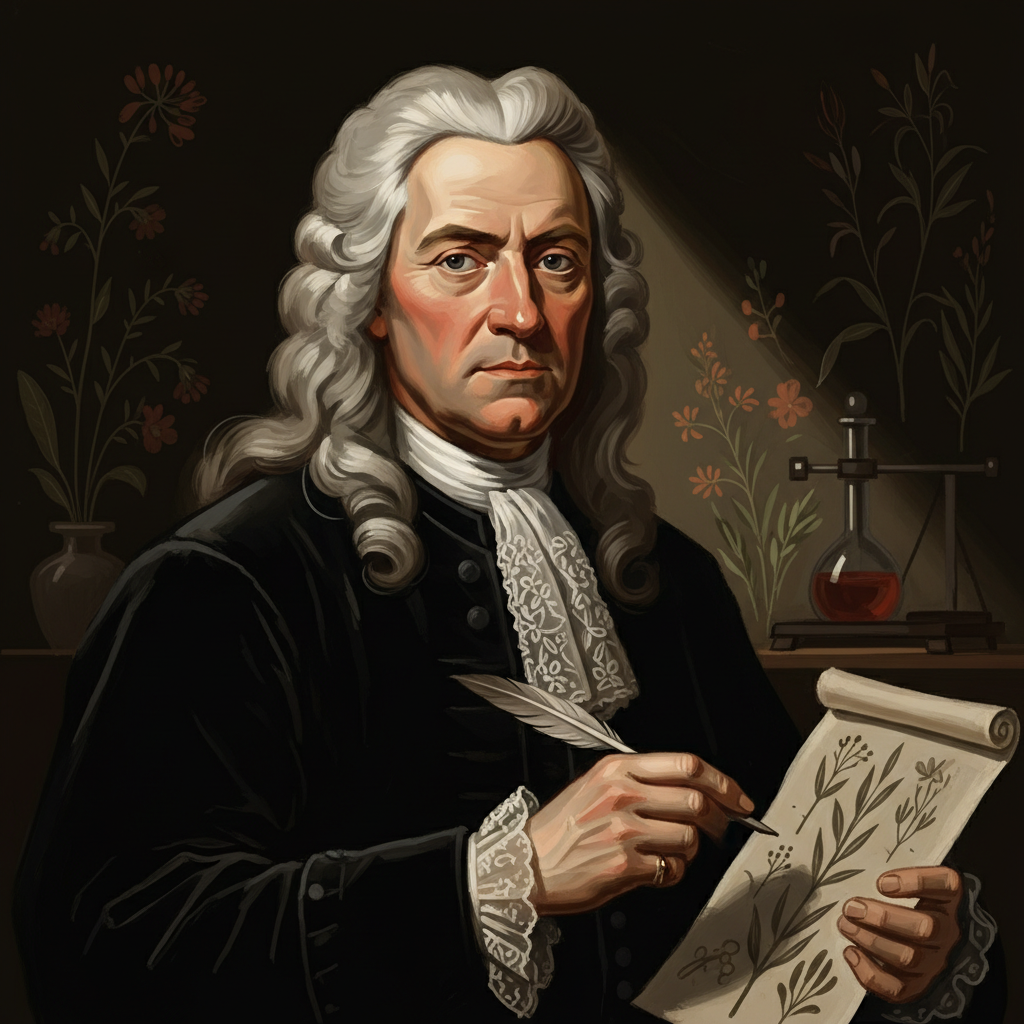
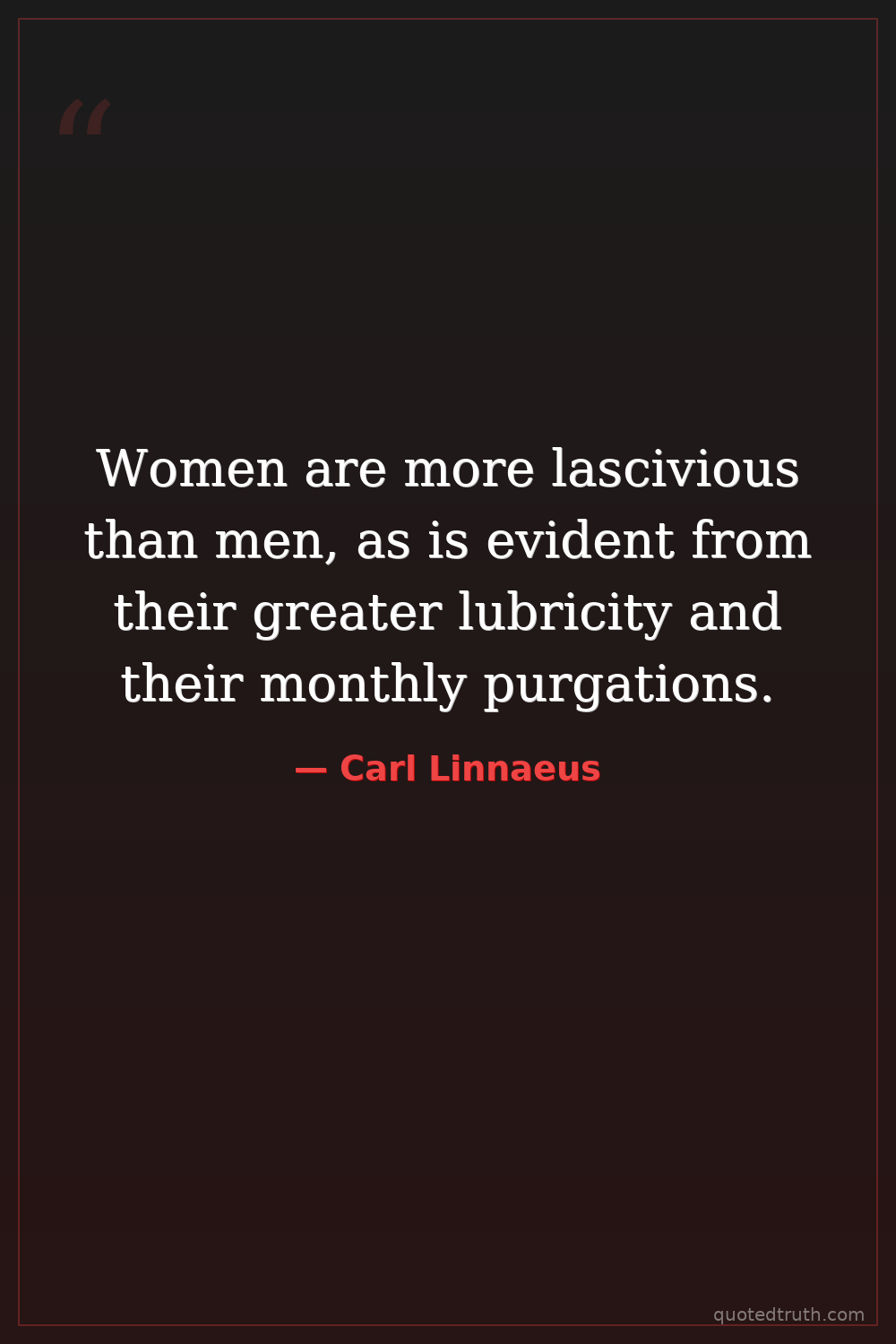
Carl Linnaeus — "Women are more lascivious than men, as is evident from their greater lubricity a…"
Women are more lascivious than men, as is evident from their greater lubricity and their monthly purgations.
Women are more lascivious than men, as is evident from their greater lubricity and their monthly purgations.
Click any product to generate a realistic preview. Up to 3 at a time.
* Initial load can take up to 90 seconds — revising the preview in another color is nearly instant.
"The natural system is the highest goal of botany."
"If a tree were to be a god, it would be a god of solitude."
"I have been as happy as a king, and happier."
"If a tree dies, plant another in its place."
"It is not God, but people themselves who shorten their lives by not keeping physically fit."
Swedish botanist and the father of modern taxonomy whose Systema Naturae (1735) introduced binomial nomenclature for naming all species. Closely associated with Joseph Banks (British naturalist who carried Linnaean classification on Cook's voyages). For an intellectual contrast, see Comte de Buffon, French naturalist and Histoire Naturelle author (1749-1788) — Buffon explicitly attacked Linnaean fixed-categories taxonomy as artificial and rejected the binomial system; his gradualist, environment-shaped natural history was the explicit alternative. Anticipates the fixed-species-vs-evolution debate Darwin would later resolve.
Found in 1 providers: deepseek
1 source checked
This quote claims women have stronger sexual desires than men, citing menstruation as biological proof of that excess. Linnaeus uses 'lubricity' to mean sexual looseness and treats monthly bleeding as evidence of bodily and moral surplus. In plain terms: he argues female biology reveals female lasciviousness. The reasoning collapses reproductive physiology into moral character, treating a normal bodily process as evidence of uncontrolled desire—an entirely unfounded but widely accepted 18th-century conflation.
Linnaeus built his botanical taxonomy around plant sexuality, classifying species by stamens and pistils—male and female reproductive organs. He extended that same systematic, naturalist eye to human biology, placing humans within the animal kingdom in Systema Naturae. This quote shows how his empirical framework absorbed and legitimized prevailing gender biases, treating cultural assumptions about female excess as observable biological fact. His credibility as a classifier gave such claims scientific authority they did not deserve.
In 18th-century Europe, humoral medicine still overlapped with emerging empirical science. Ancient Greek ideas that women were cold, wet, and prone to excess humor persisted in medical education. Menstruation was widely interpreted as the body purging dangerous surplus fluids, linking physiology to moral temperament. The Enlightenment demanded natural explanations for behavior, but gender hierarchies were deeply embedded in those frameworks. Religious tradition and classical authority both reinforced female subordination, and naturalists routinely encoded these prejudices as objective observation.
AI-generated insights based on extensive research and information for context. Factual errors? Email [email protected].
Your cart is empty