Carl Linnaeus — "The natural system is the highest goal of botany."
The natural system is the highest goal of botany.
The natural system is the highest goal of botany.
Click any product to generate a realistic preview. Up to 3 at a time.
* Initial load can take up to 90 seconds — revising the preview in another color is nearly instant.
"The names of plants are the foundation of botany."
"I have classified all plants and animals."
"The purpose of science is to know the works of God."
"There are no species in nature, only individuals."
"The Earth's Creation is the glory of God, as seen from the works of Nature by Man alone."
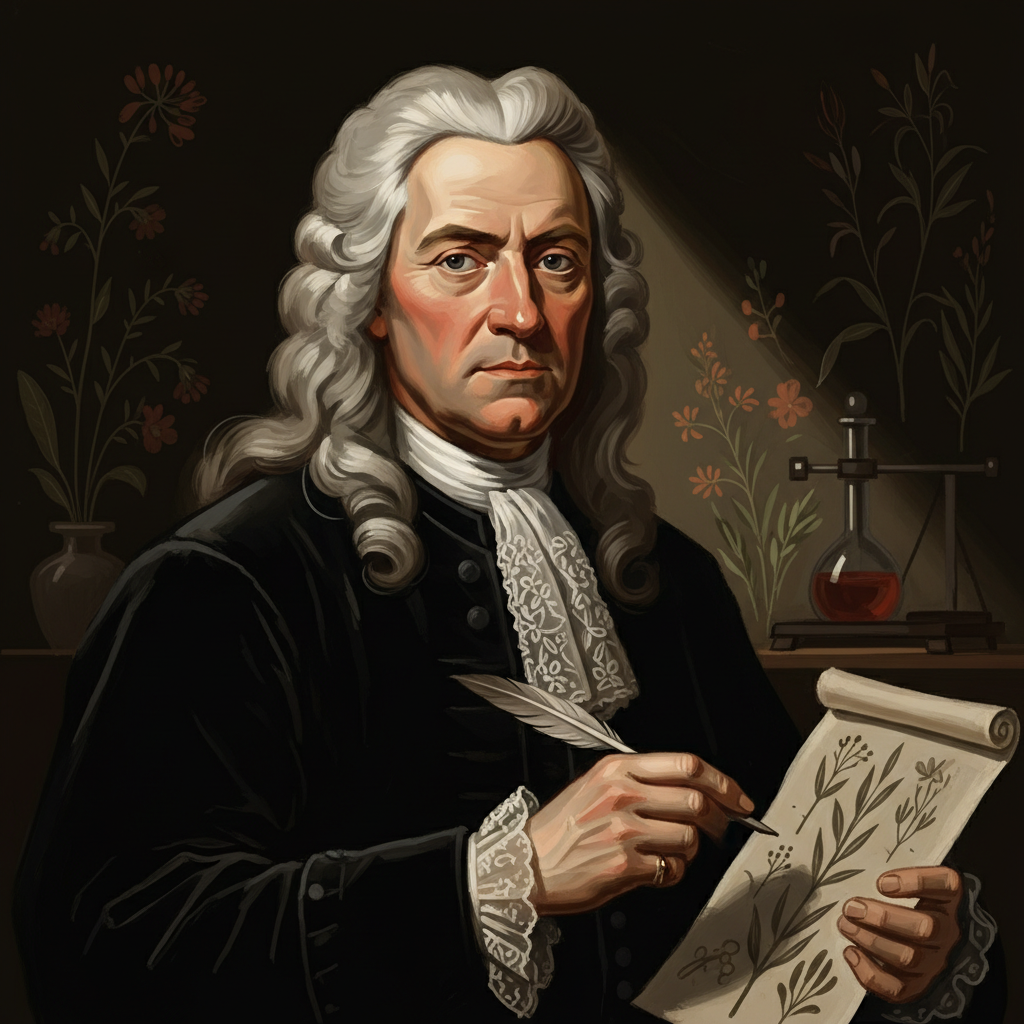
Swedish botanist and the father of modern taxonomy whose Systema Naturae (1735) introduced binomial nomenclature for naming all species. Closely associated with Joseph Banks (British naturalist who carried Linnaean classification on Cook's voyages). For an intellectual contrast, see Comte de Buffon, French naturalist and Histoire Naturelle author (1749-1788) — Buffon explicitly attacked Linnaean fixed-categories taxonomy as artificial and rejected the binomial system; his gradualist, environment-shaped natural history was the explicit alternative. Anticipates the fixed-species-vs-evolution debate Darwin would later resolve.
Stating his ambition for a classification based on natural affinities rather than artificial characteristics.
Date: c. 1750s
ShockingFound in 1 providers: grok
1 source checked
Science should organize living things into a coherent, logical framework based on their true relationships, not random or arbitrary groupings. The ultimate purpose of studying plants isn't merely cataloguing them for practical use but understanding the underlying order of nature itself—a system that reflects genuine structural and reproductive patterns shared across species.
Linnaeus spent his life constructing exactly this system. His Systema Naturae and Species Plantarum established binomial nomenclature and classified thousands of organisms by shared characteristics, particularly reproductive structures. He genuinely believed he was uncovering God's blueprint for creation, not inventing categories but discovering a divine order already embedded in nature's architecture.
In the 18th century, European naturalists were overwhelmed by specimens flooding in from global exploration and colonial expansion. Competing, incompatible classification schemes created chaos. Linnaeus worked during the Enlightenment, when reason and systematic method were transforming every discipline. His natural system offered science a universal language precisely when naturalists desperately needed one to make sense of an exploding catalogue of the world's biodiversity.
AI-generated insights based on extensive research and information for context. Factual errors? Email [email protected].
Your cart is empty