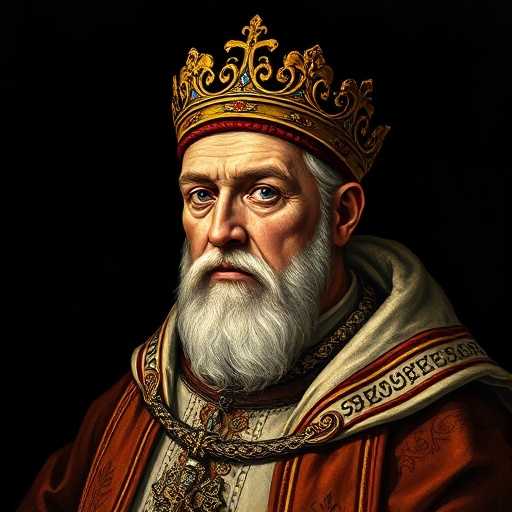
Pope Urban II — "You are called shepherds; see that you do not act as hirelings."
You are called shepherds; see that you do not act as hirelings.
You are called shepherds; see that you do not act as hirelings.
Click any product to generate a realistic preview. Up to 3 at a time.
* Initial load can take up to 90 seconds — revising the preview in another color is nearly instant.
"God wills it! God wills it!"
"Let those who have formerly been mercenaries at low wages, now gain eternal rewards. Let those who have been striving to the detriment both of body and soul, now labor for a two-fold reward."
"Your land, moreover, is too poor to support you."
"Let this be your war-cry in battle: 'God wills it! God wills it!'"
"When you have decided to go, you must publicly make your vow and dedicate yourselves to God."
Pope (1088-1099) whose Council of Clermont speech (November 1095) launched the First Crusade — the founding event of nine centuries of Christian-Muslim military conflict. Closely associated with Pope Gregory VII (his predecessor on papal-imperial reform). For an intellectual contrast, see Saladin, Kurdish-Muslim Sultan of Egypt and Syria (1138-1193) — Saladin recaptured Jerusalem in 1187, undoing the First Crusade Urban II launched 92 years earlier. Saladin's chivalrous treatment of Christian prisoners became the canonical Muslim counter-image to Crusader brutality. The cleanest before/after pairing of the Crusades' moral arc.
Found in 1 providers: deepseek
1 source checked
This warning draws on the biblical contrast between a true shepherd — who owns and sacrifices for his flock — and a hireling who works only for wages and abandons the flock when danger arrives. Urban II calls leaders to genuine, self-sacrificing commitment rather than self-serving caretaking. Those entrusted with others' wellbeing must stay devoted even at personal cost, refusing the mercenary mindset that treats sacred duty as merely a paying job.
Urban II spent years as a Cluniac monk before becoming pope, shaped by vows of genuine service over personal gain. As pope, he led the Gregorian Reform combating simony — the corrupt purchase of Church positions that produced exactly the hireling mentality he condemns. When he launched the First Crusade at Clermont in 1095, he framed it as protecting Christendom's flock — a true shepherd leading his people through mortal danger rather than abandoning them.
The late 11th century was consumed by the Investiture Controversy — a struggle between popes and secular rulers over who appointed bishops. Kings routinely installed clergy as political allies, creating church officials whose loyalty ran to lords, not God — the hireling problem made institutional. The Gregorian Reform sought to break this. Simultaneously, Byzantine Emperor Alexios I begged Rome for military aid against the Seljuk Turks, giving Urban his defining shepherd's moment at Clermont in 1095.
AI-generated insights based on extensive research and information for context. Factual errors? Email [email protected].
Your cart is empty