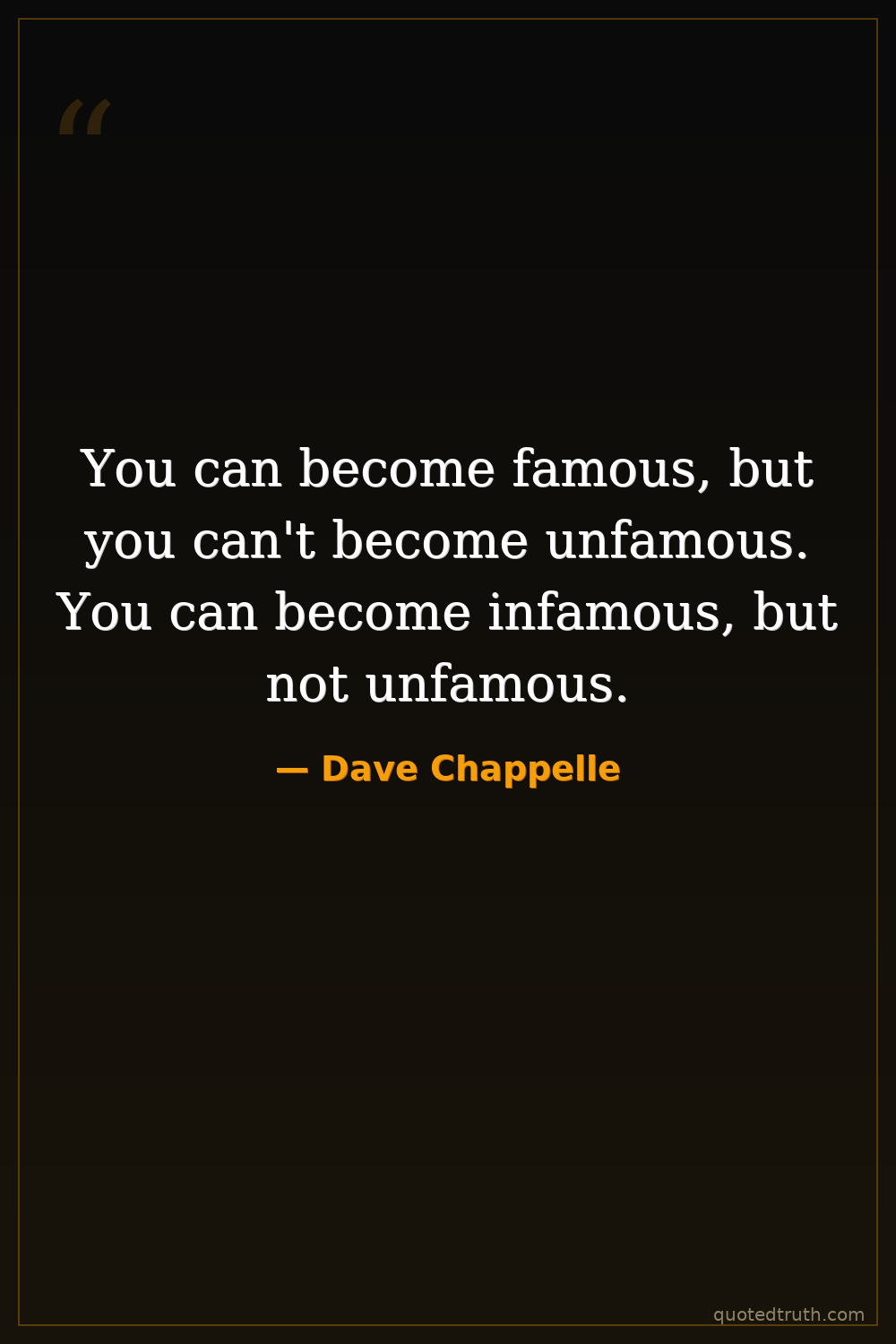
Dave Chappelle — "You can become famous, but you can't become unfamous. You can become infamous, b…"
You can become famous, but you can't become unfamous. You can become infamous, but not unfamous.
You can become famous, but you can't become unfamous. You can become infamous, but not unfamous.
Click any product to generate a realistic preview. Up to 3 at a time.
* Initial load can take up to 90 seconds — revising the preview in another color is nearly instant.
"I'm not smoking crack. I'm definitely stressed out."
"I would go to work on the show and I felt awful every day, that's not the way it was. I felt like some kind of prostitute or something. If I feel so bad, why keep on showing up to this place? I'm goin…"
"The only thing worse than a man who talks too much is a man who doesn't talk at all."
"Somebody broke into my house once, this is a good time to call the police, but mm mm, nope. The house was too nice. It was a real nice house, but they'd never believe i lived in it. They'd be like 'He…"
"The only way to get rid of a temptation is to yield to it."
American comedian whose Chappelle's Show (2003-2006) reshaped 21st-century comedy and whose 2010s-2020s Netflix specials triggered debates over comedy and offense. Closely associated with Richard Pryor (predecessor in race-and-language American stand-up) and Eddie Murphy (1980s SNL trailblazer). For an intellectual contrast, see Hannah Gadsby, Australian comedian and Nanette creator — Nanette (2018) explicitly attacks the stand-up tradition Chappelle works within and treats traditional punchline comedy as a structure of power. Nanette and Chappelle's Sticks & Stones are the two most-discussed comedy specials of the late-2010s, taking opposite positions on whether stand-up structurally enables or excuses harm.
Your cart is empty