What it means
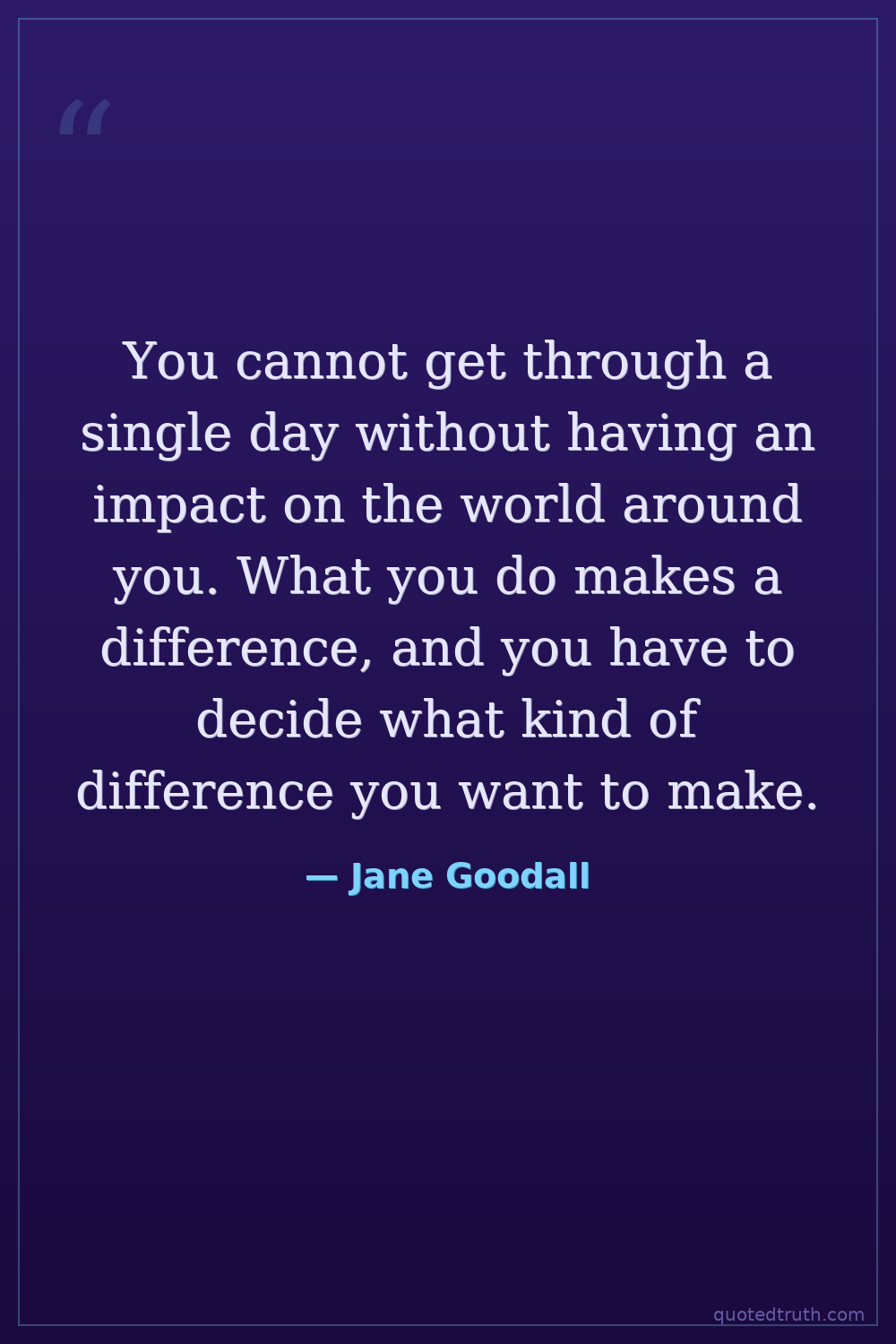
Every action you take, no matter how small, changes the world in some way. There is no neutral choice — inaction is itself a choice. The real question is whether your impact will be positive or negative, and that answer is yours to decide deliberately rather than by default.
Relevance to Jane Goodall
Goodall spent decades in Tanzanian forests proving that individual behavior shapes ecosystems. Her Gombe research showed how one chimpanzee's choices ripple through a community. After witnessing deforestation destroy habitats she loved, she shifted from scientist to activist, building the Roots and Shoots youth program on precisely this belief that personal agency drives conservation.
The era
Goodall rose to prominence during the 1960s environmental awakening, when DDT, industrial pollution, and mass deforestation forced societies to reckon with cumulative human impact. Earth Day launched in 1970, climate science was emerging, and the idea that ordinary individuals bore responsibility for ecological damage was radically new and politically charged.
AI-generated insights based on extensive research and information for context. Factual errors? Email [email protected].