What it means
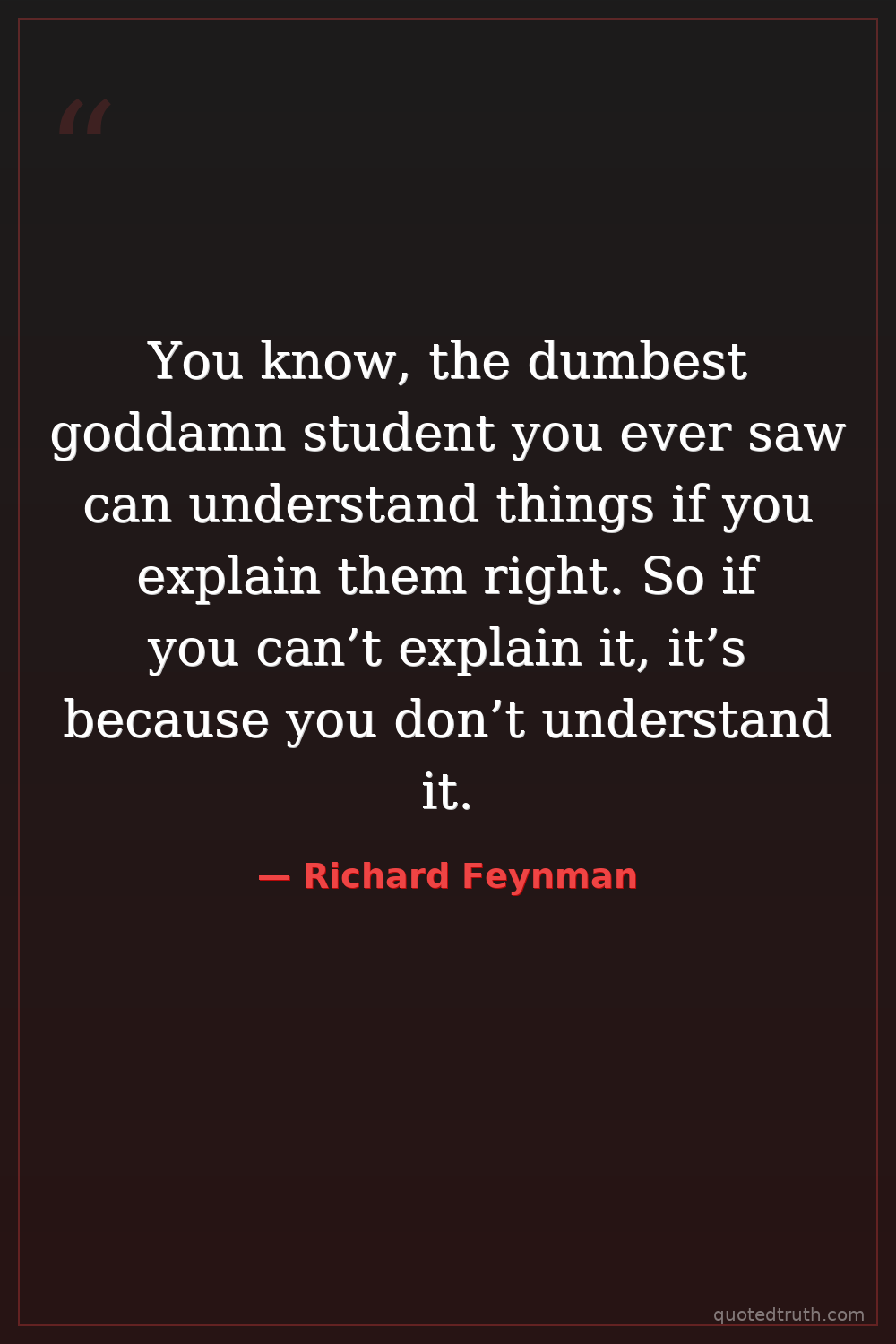
True understanding means you can explain a concept simply enough for anyone to follow. If an explanation fails, the problem is the explainer's incomplete grasp, not the listener's ability. Jargon and complexity often mask shallow comprehension. Real mastery lets you strip abstraction away and communicate the core idea directly. Teaching is the hardest test of what you actually know — and the most honest one.
Relevance to Richard Feynman
Feynman taught undergraduate physics at Caltech and is remembered as one of history's great science communicators. He developed what became the Feynman Technique: learn by explaining simply. His Nobel Prize-winning work in quantum electrodynamics — among the most abstract physics imaginable — he translated into accessible diagrams and plain lectures. His famous Caltech series proved that rigor and clarity aren't opposites; for Feynman, they were the same discipline.
The era
Feynman worked during postwar America, when physics sat at the center of Cold War competition and federal funding. Sputnik's 1957 launch triggered massive investment in science education, but academic culture still rewarded dense, jargon-heavy publication over clarity. Feynman challenged that norm at a moment when expert language increasingly separated specialists from the public, arguing that genuine expertise carried an obligation to communicate, not to obscure.
AI-generated insights based on extensive research and information for context. Factual errors? Email [email protected].