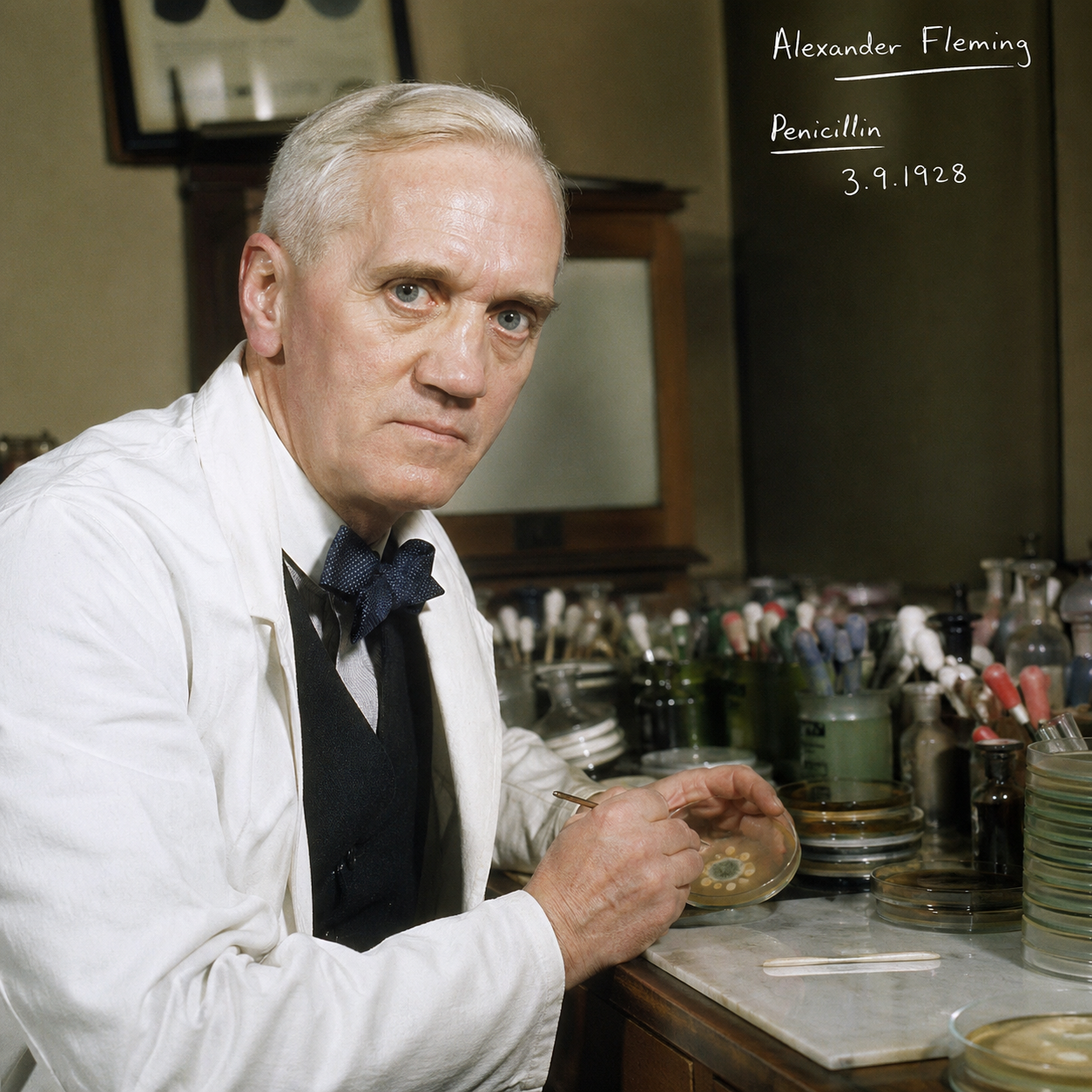
Alexander Fleming — "The thought that I might have discovered something which would be of value in tr…"
The thought that I might have discovered something which would be of value in treating disease was, of course, uppermost in my mind.
The thought that I might have discovered something which would be of value in treating disease was, of course, uppermost in my mind.
Click any product to generate a realistic preview. Up to 3 at a time.
* Initial load can take up to 90 seconds — revising the preview in another color is nearly instant.
"The greatest discovery of my life was not penicillin, but the fact that I was wrong about something."
"Penicillin cures, but wine makes people happy."
"The mould grew, and then I saw the clear space around it."
"I am not a very good speaker, but I hope my work speaks for itself."
"The discovery of penicillin was a series of small observations, not a single eureka moment."
Found in 1 providers: grok
1 source checked
From the moment Fleming noticed something unusual, his dominant thought was whether it could help sick people. He wasn't preoccupied with fame or abstract curiosity — his mind went immediately to practical medical value. This reflects a doctor's instinct: observations matter only insofar as they reduce human suffering. The statement captures the precise mental state of a scientist who measures every finding against its potential to treat disease.
Fleming served as a military physician in WWI, watching soldiers die not from wounds but from bacterial infections. This trauma defined his research priorities at St. Mary's Hospital, London. When he noticed Penicillium mold dissolving bacteria in 1928, his instinct was shaped by years of helplessness at the bedside — he thought in terms of treatment because medicine, not pure science, was always his frame of reference.
In 1928, bacterial infections were among the world's leading killers — sepsis, pneumonia, and wound infections killed millions annually. Antiseptics existed but destroyed human tissue alongside bacteria, making internal use impossible. Surgery carried enormous infection risk; a simple cut or tooth extraction could prove fatal. Fleming's insight emerged at the peak of this crisis, when medicine desperately needed an agent that could kill bacteria inside the body without harming the patient.
AI-generated insights based on extensive research and information for context. Factual errors? Email [email protected].
Your cart is empty