Alexander Fleming — "The story of penicillin is a lesson in serendipity and perseverance."
The story of penicillin is a lesson in serendipity and perseverance.
The story of penicillin is a lesson in serendipity and perseverance.
Click any product to generate a realistic preview. Up to 3 at a time.
* Initial load can take up to 90 seconds — revising the preview in another color is nearly instant.
"A good many people think that I deserve some credit for the discovery of penicillin. They are wrong. It was discovered by nature."
"One sometimes finds what one is not looking for."
"I can only warn. It is up to others to heed the warning."
"The laboratory worker who is not prepared to meet with occasional failures will never achieve success."
"The story of penicillin has been told so often that it is almost a cliché."
Found in 1 providers: grok
1 source checked
Great discoveries often combine accident with the wisdom to recognize its importance. Serendipity means stumbling onto something unexpected; perseverance means doing the hard follow-through work to realize its value. Together, the quote argues that breakthroughs rarely come from pure calculation alone — you need both the lucky moment and the grit to pursue what that moment reveals, even when the path forward is uncertain and long.
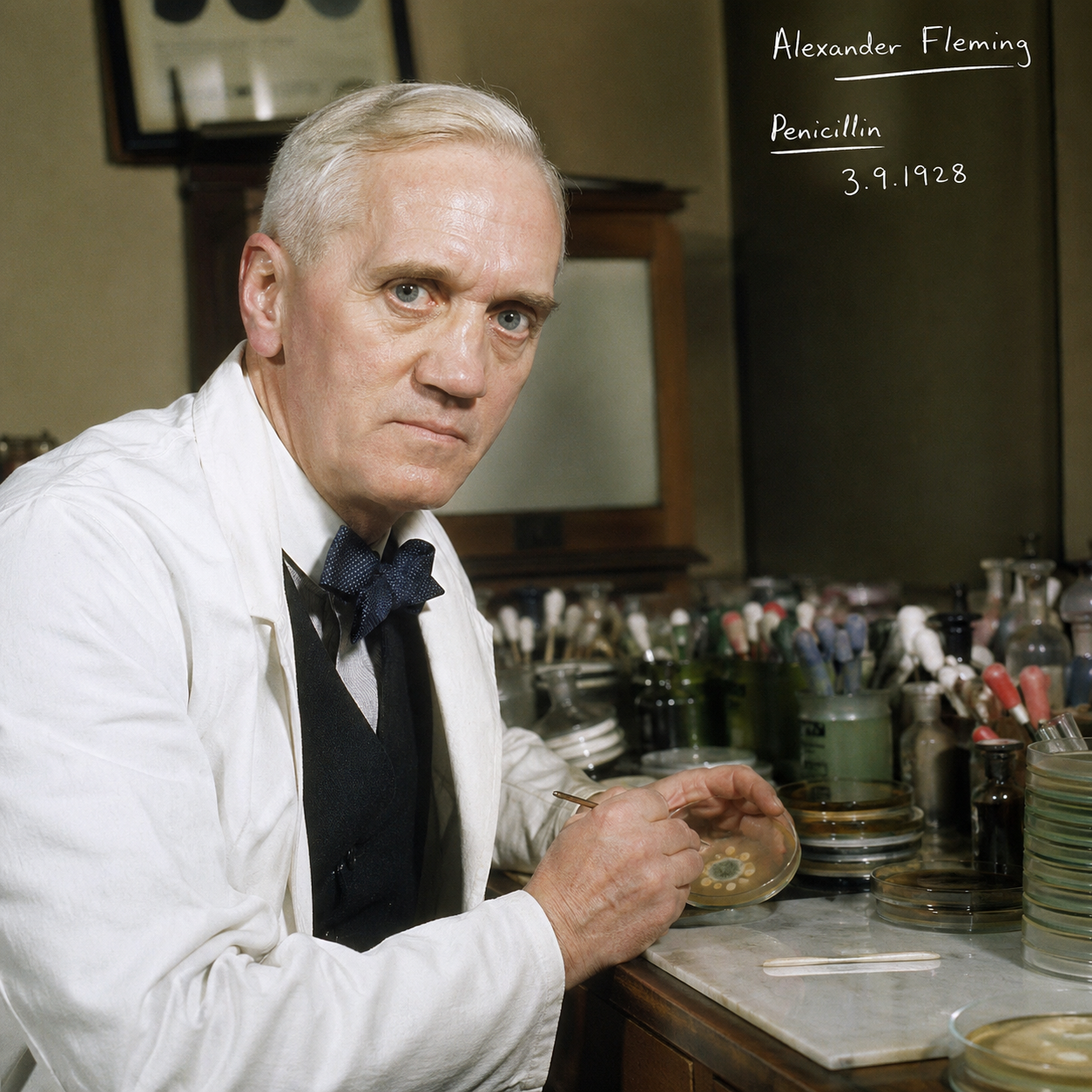
In 1928, Fleming returned from vacation to find mold contaminating his staph cultures — rather than discarding the plate, he noticed it was killing surrounding bacteria. That accidental observation was serendipity. The perseverance was his lifelong commitment to bacteriology since WWI, where he witnessed soldiers dying from infected wounds, driving his decades-long search for antibacterial agents before that fateful contaminated dish.
Fleming worked in an era before antibiotics, when bacterial infections — pneumonia, sepsis, infected wounds — killed millions. World War I demonstrated the lethal toll of untreated wounds. In the 1920s–30s, medicine lacked reliable cures for common infections; mortality from septicemia was near-certain. Penicillin's eventual development transformed modern medicine, making previously fatal conditions treatable and enabling surgeries that would have been impossible without reliable infection control.
AI-generated insights based on extensive research and information for context. Factual errors? Email [email protected].
Your cart is empty