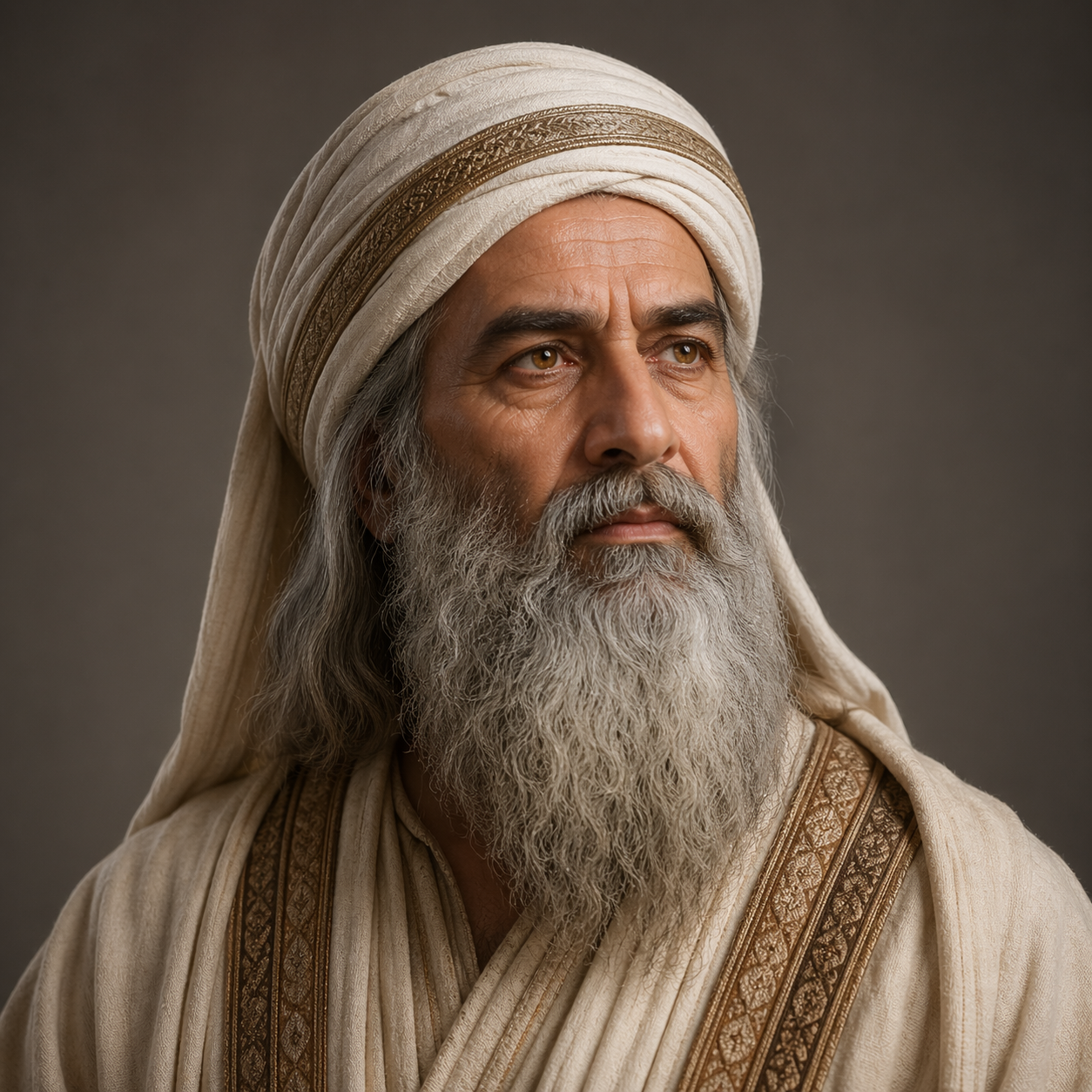
Zoroaster — "The poet of Thy praise, I call myself, O Mazda!"
The poet of Thy praise, I call myself, O Mazda!
The poet of Thy praise, I call myself, O Mazda!
Click any product to generate a realistic preview. Up to 3 at a time.
* Initial load can take up to 90 seconds — revising the preview in another color is nearly instant.
"The liar is the greatest enemy of mankind."
"Whosoever, O Mazda, does not serve thee with the word, him I shall deliver into the hand of the wicked; for him shall be woe, and long punishment."
"The light of truth shines brightly. Unless it's cloudy. Then it's more of a gentle glow."
"False gods bring destruction, but the Wise Lord brings salvation."
"With an open mind, seek and listen to all the highest ideals. Consider the most enlightened thoughts. Then choose your path, person by person, each for oneself."
Iranian prophet who founded Zoroastrianism, the first major religion of cosmic dualism between good (Ahura Mazda) and evil (Angra Mainyu). Closely associated with The Buddha (near-contemporary Eastern moral-cosmological revolutionary). For an intellectual contrast, see Friedrich Nietzsche, German philosopher of 'beyond good and evil' — Nietzsche appropriated Zarathustra's name for Thus Spoke Zarathustra (1883) precisely to invert the original's moral cosmology — the historical Zoroaster founded the good-versus-evil framework Nietzsche's character announces the end of.
Found in 1 providers: gemini
1 source checked
The speaker declares their identity and purpose as someone devoted to composing and singing praise to Mazda, the supreme wise god. It is a personal vow of vocation: 'I am the one who gives You voice.' Rather than claiming priesthood, power, or prophecy, the speaker defines themselves primarily as a poet-worshipper whose life's work is putting devotion into crafted, spoken words offered back to the divine.
Zoroaster composed the Gathas, seventeen hymns that form Zoroastrianism's oldest scripture, in an archaic Avestan poetic meter. He was a trained zaotar (priest-poet) by profession, not just a theologian. This line fits his self-identification throughout the Gathas, where he repeatedly addresses Ahura Mazda directly in first person as a singer-reformer, rejecting the older Iranian polytheistic ritual class in favor of a personal, lyric relationship with the one wise Lord.
Zoroaster lived in Bronze Age eastern Iran, roughly 1500–1000 BCE, among pastoral Indo-Iranian tribes whose religion centered on sacrificial rituals to many daevas performed by hereditary priestly singers. Oral poetry was the sole medium of sacred knowledge; hymns preserved cosmology, law, and theology before writing reached the steppe. Declaring oneself 'the poet of praise' to a single supreme god was a radical reform, elevating ethical monotheism and personal composition over inherited communal ritual.
AI-generated insights based on extensive research and information for context. Factual errors? Email [email protected].
Your cart is empty