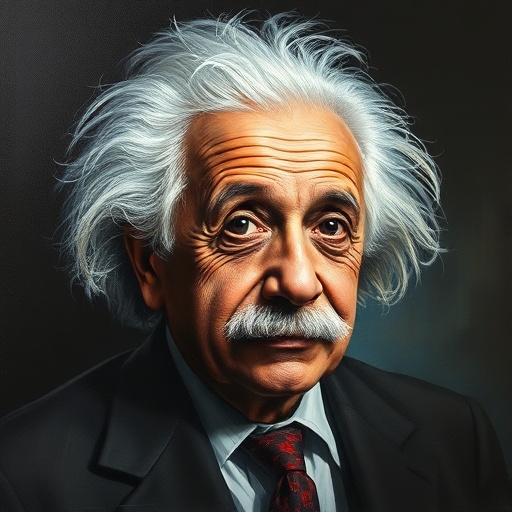
Albert Einstein — "Anyone who has never made a mistake has never tried anything new."
Anyone who has never made a mistake has never tried anything new.
Anyone who has never made a mistake has never tried anything new.
Click any product to generate a realistic preview. Up to 3 at a time.
* Initial load can take up to 90 seconds — revising the preview in another color is nearly instant.
"The human mind has first to construct forms, independently, before we can find them in things."
"The value of a man should be seen in what he gives and not in what he is able to receive."
"The Chinese don't sit on benches while eating but squat like Europeans do when they relieve themselves out in the leafy woods."
"Compound interest is the eighth wonder of the world. He who understands it, earns it... he who doesn't... pays it."
"Reading, after a certain age, diverts the mind too much from its creative pursuits. Any man who reads too much and uses his own brain too little falls into lazy habits of thinking."
Attributed, but specific source is elusive. Reflects his general philosophy.
Date: Uncertain
GeneralFound in 1 providers: grok
1 source checked
Mistakes are proof of attempting something beyond your comfort zone. If you never fail, you never ventured into unknown territory. Errors aren't signs of incompetence but evidence of genuine effort and experimentation. Progress requires risk, and risk guarantees occasional failure. The absence of mistakes signals stagnation, not mastery — real learning only happens when you push boundaries and sometimes stumble.
Einstein spent years developing the theory of relativity, facing skepticism and early professional rejection. He failed his ETH Zurich entrance exam and struggled to find academic work after graduating. His thought experiments repeatedly challenged accepted physics, often producing dead ends before breakthroughs. This quote reflects his personal philosophy that bold intellectual risk-taking — even when wrong — is the only path to revolutionary discovery.
Einstein lived through the early 20th century's explosion of scientific revolution — quantum mechanics, relativity, and atomic theory overturned centuries of Newtonian certainty. World War I and II demonstrated catastrophically what rigid, unchallenged assumptions could produce. Scientific institutions resisted radical new ideas. Against this backdrop, Einstein's embrace of trial and error challenged both academic conservatism and authoritarian certainty, championing intellectual courage in an era demanding conformity.
AI-generated insights based on extensive research and information for context. Factual errors? Email [email protected].
Your cart is empty