Zoroaster — "Hear with your ears the best things; behold with a clear vision the two choices,…"
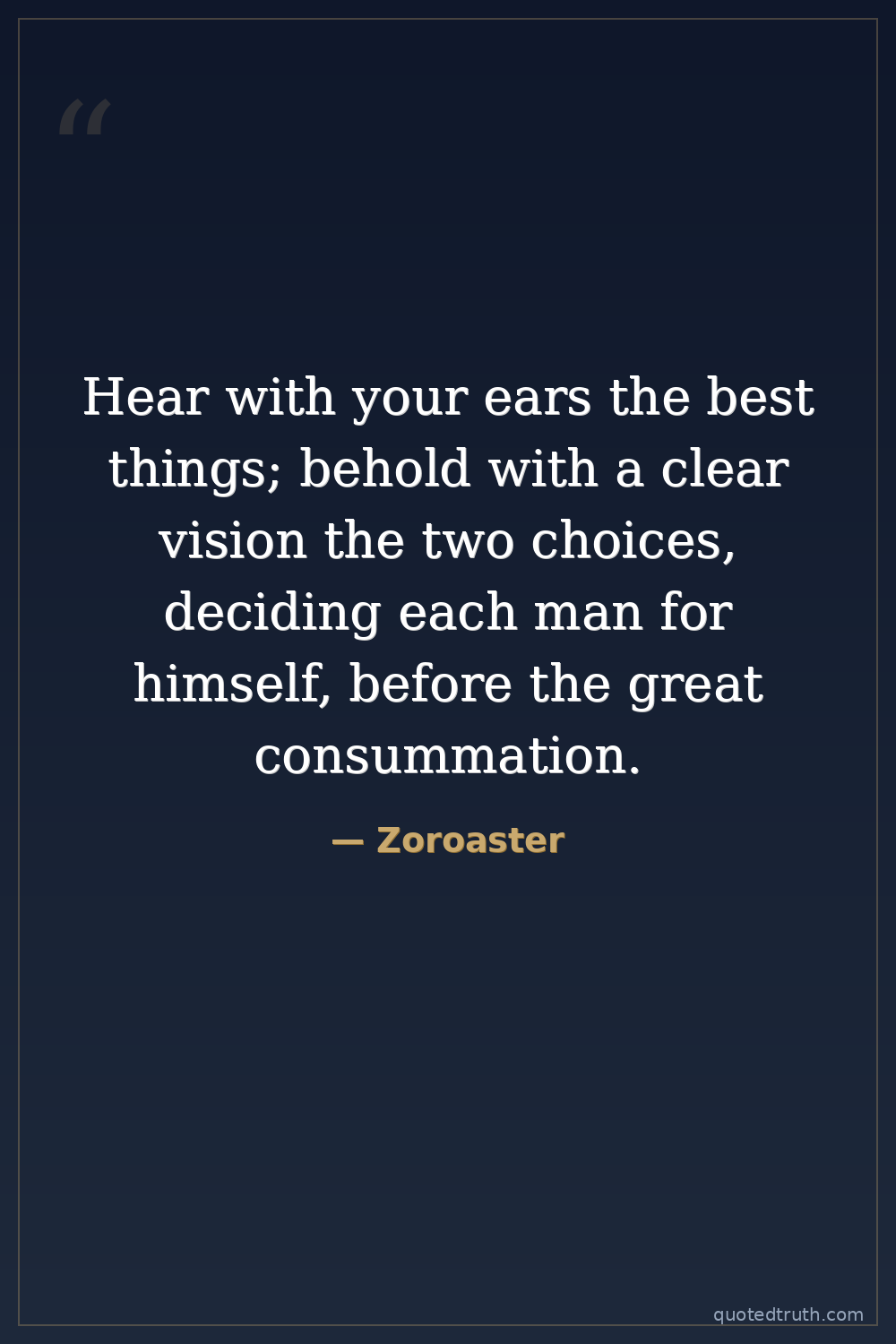
Hear with your ears the best things; behold with a clear vision the two choices, deciding each man for himself, before the great consummation.
Hear with your ears the best things; behold with a clear vision the two choices, deciding each man for himself, before the great consummation.
Click any product to generate a realistic preview. Up to 3 at a time.
* Initial load can take up to 90 seconds — revising the preview in another color is nearly instant.
"May your spirit be strong and your coffee be stronger."
"The deceitful shall be destroyed, but the righteous shall attain the best existence."
"Show me, O Mazda, through Good Mind, how to fulfill this teaching, for which I ask Thee, and through Thy Righteousness, to approach Thee, O Ahura, and to offer praise to Thee."
"Always meet petulance with gentleness and perverseness with kindness."
"Through Good Mind, Righteousness, and Devotion, Mazda Ahura will grant Immortality and Wholeness."
Iranian prophet who founded Zoroastrianism, the first major religion of cosmic dualism between good (Ahura Mazda) and evil (Angra Mainyu). Closely associated with The Buddha (near-contemporary Eastern moral-cosmological revolutionary). For an intellectual contrast, see Friedrich Nietzsche, German philosopher of 'beyond good and evil' — Nietzsche appropriated Zarathustra's name for Thus Spoke Zarathustra (1883) precisely to invert the original's moral cosmology — the historical Zoroaster founded the good-versus-evil framework Nietzsche's character announces the end of.
Found in 1 providers: gemini
1 source checked
Listen carefully to wisdom and look honestly at the two paths in front of you: good and evil, truth and lies. Do not let others decide for you. Every person must weigh the options themselves and make a personal choice about how to live, because a final reckoning is coming. Your decisions now shape who you become and what awaits you later, so think clearly while you still have time.
Zoroaster founded a religion built on the free moral choice between Asha (truth, order) and Druj (lie, chaos). As a priest-prophet who broke with the polytheistic Iranian tradition, he taught that salvation depends on individual conscience rather than ritual conformity. This saying distills his core doctrine: personal responsibility, dualism of good and evil, and an eschatological final judgment, all central pillars of the Gathas he composed.
Zoroaster lived in Bronze Age Iran, likely between 1500 and 1000 BCE, among pastoral Indo-Iranian tribes worshipping many gods through animal sacrifice and intoxicant rituals. Cattle raiding, tribal warfare, and priestly corruption were common. By urging each listener to choose personally between truth and deceit, Zoroaster challenged hereditary priestly authority and collective tribal morality, introducing an ethical monotheism radical for an age when religion meant inherited ceremony rather than inward conviction.
AI-generated insights based on extensive research and information for context. Factual errors? Email [email protected].
Your cart is empty