Charles Darwin — "I am a strong believer in the power of observation and the importance of collect…"
I am a strong believer in the power of observation and the importance of collecting facts.
I am a strong believer in the power of observation and the importance of collecting facts.
Click any product to generate a realistic preview. Up to 3 at a time.
* Initial load can take up to 90 seconds — revising the preview in another color is nearly instant.
"I own that I cannot see as plainly as others do, and as I should wish to do, evidence of design and beneficence on all sides of us. There seems to me too much misery in the world. I cannot persuade my…"
"I have tried lately to read Shakespeare, and found it so intolerably dull that it nauseated me."
"Man tends to increase at a greater rate than his means of subsistence."
"The more civilized so-called Caucasian races have beaten the Turkish hollow in the struggle for existence."
"The astonishment which I felt on first seeing a party of Fuegians on a wild and broken shore will never be forgotten by me, for the reflection at once rushed into my mind—such were our ancestors."
British naturalist whose On the Origin of Species (1859) established evolution by natural selection — the unifying theory of modern biology. Closely associated with Thomas Henry Huxley (his 'bulldog' public defender) and Alfred Russel Wallace (independent co-discoverer of natural selection). For an intellectual contrast, see William Paley, Anglican theologian and Natural Theology author (1743-1805) — Origin of Species is structurally a 400-page reply to Paley — Darwin admired Paley's watchmaker-argument as an undergraduate at Cambridge and then spent 20 years building the empirical machinery to displace him. The cleanest 'design argument vs natural selection' founding rebuttal in science.
The standard scholarly entry points to Charles Darwin's work: Janet Browne (Harvard, history of science) — Charles Darwin: Voyaging (1995) and The Power of Place (2002); Adrian Desmond (UCL, biographer) — Darwin: The Life of a Tormented Evolutionist (1991, with James Moore). These are the works graduate seminars cite when teaching Charles Darwin.
Found in 1 providers: grok
1 source checked
Careful observation and systematic fact-gathering are the bedrock of real understanding. Before drawing conclusions, you must look closely at the world and document what you actually find. Truth is built from accumulated evidence, not assumptions or inherited beliefs. This is the discipline of empiricism: trust what you can observe, record, and verify — and let the facts lead you to conclusions rather than forcing facts to fit a preconceived idea.
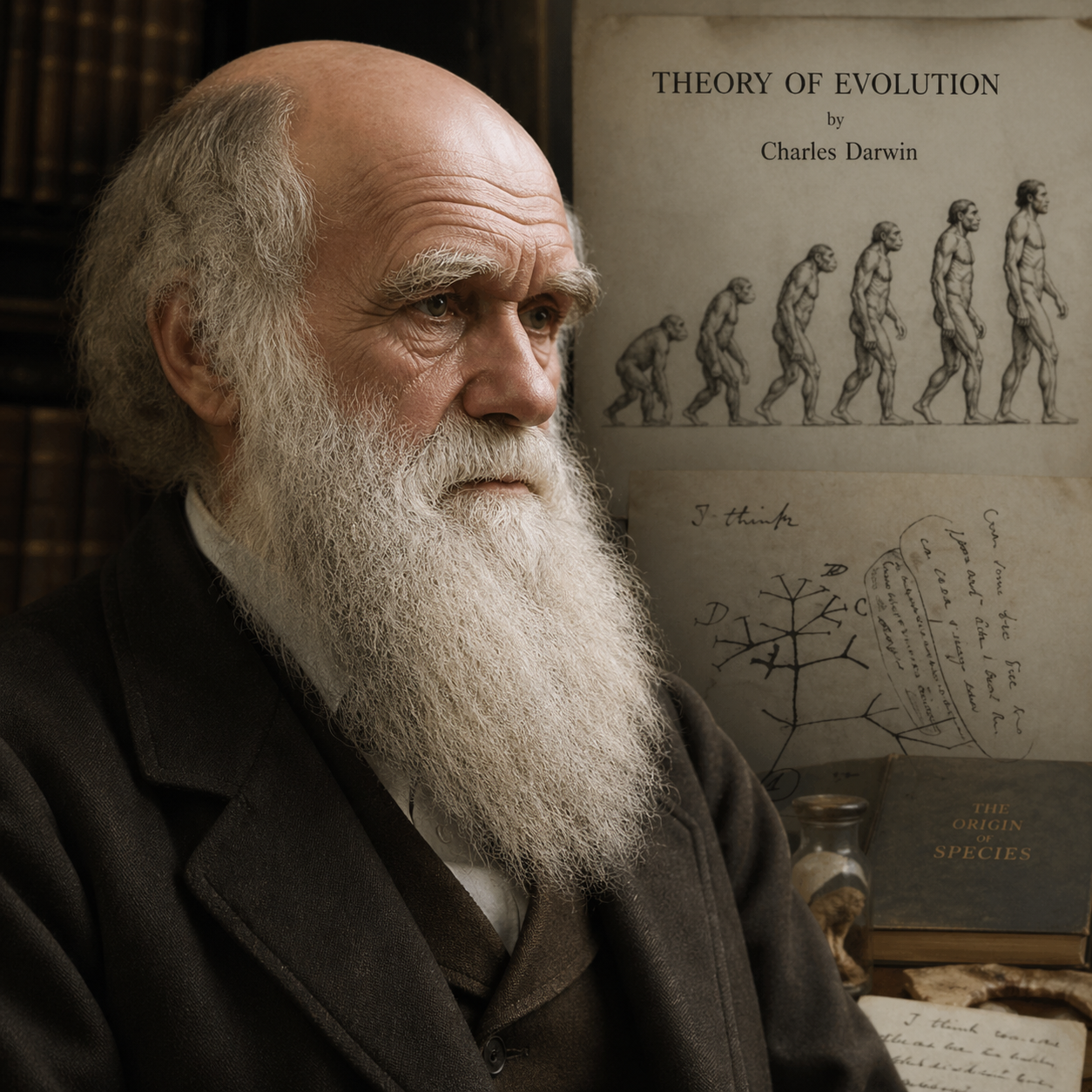
Darwin spent five years aboard HMS Beagle (1831–1836) cataloging thousands of specimens across South America and the Galápagos. He then spent over two decades accumulating further evidence before publishing On the Origin of Species in 1859. His notebooks are legendary for their obsessive detail. He knew a theory as radical as evolution by natural selection would only survive if built on an overwhelming, unassailable body of observed facts.
Darwin lived during the 19th century's great collision between religious authority and empirical science. Geology was overturning biblical timelines; Lyell's uniformitarianism showed Earth was ancient. Natural history institutions were formalizing scientific method. Observation-based science was asserting itself against speculation and scripture. In this climate, insisting on facts over faith was not merely a methodology — it was a philosophical stance that challenged centuries of received wisdom about nature and humanity's place in it.
AI-generated insights based on extensive research and information for context. Factual errors? Email [email protected].
Your cart is empty