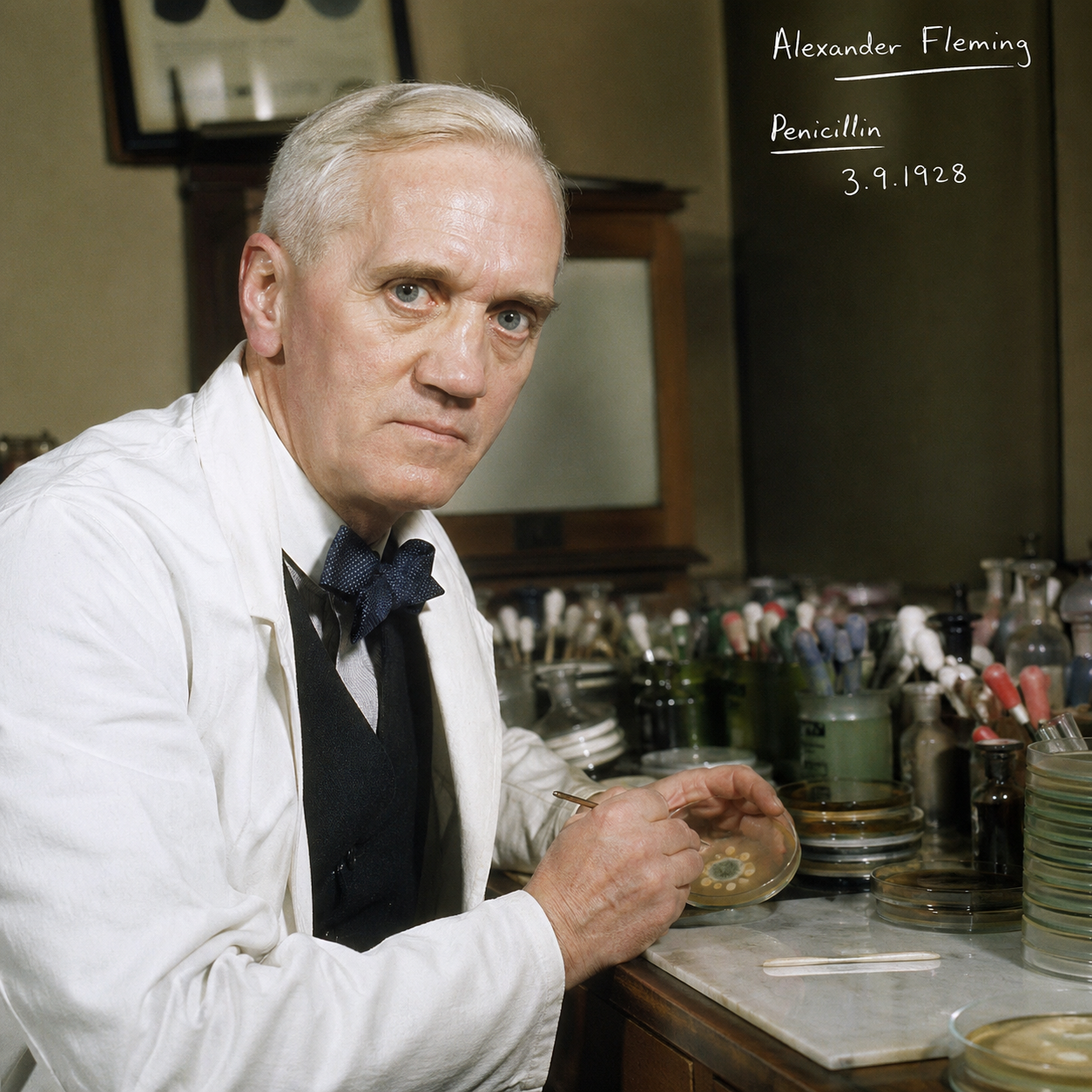
Alexander Fleming — "The discovery of penicillin was a series of lucky accidents."
The discovery of penicillin was a series of lucky accidents.
The discovery of penicillin was a series of lucky accidents.
Click any product to generate a realistic preview. Up to 3 at a time.
* Initial load can take up to 90 seconds — revising the preview in another color is nearly instant.
"The impact of penicillin on modern medicine is immeasurable."
"It has been said that I am a lucky man. I agree. I have been very lucky."
"I did not invent penicillin. Nature did that. I only discovered it by accident."
"I never thought of myself as a great man, just a man who made a great discovery."
"The world is full of interesting things. You just have to look for them."
Found in 1 providers: grok
1 source checked
Fleming is saying that a major scientific breakthrough didn't emerge from deliberate, controlled research — fortune played the decisive role. But luck alone isn't enough: you have to recognize unexpected results as meaningful rather than dismissing them as contamination. The quote reflects scientific humility, crediting serendipity rather than genius, while implicitly honoring the disciplined observation that turned a ruined experiment into medicine's most consequential discovery.
In 1928, Fleming returned from vacation to find a Penicillium mold had contaminated his Staphylococcus cultures — and noticed the surrounding bacteria had died. A less curious scientist would have discarded the plate. He had earlier made a similar serendipitous find with lysozyme in 1921. Fleming was famously modest, disliking self-promotion, and genuinely believed his success owed as much to chance and attentive observation as to planned brilliance.
Fleming worked in an era when bacterial infections — sepsis, tuberculosis, syphilis, pneumonia — were leading killers with almost no effective treatments. World War I had shown how wound infections killed more soldiers than combat injuries. Germ theory was established, but weaponizing biology against bacteria remained elusive. His 1928 discovery arrived at a moment when medicine desperately needed it, setting the stage for the antibiotic revolution that transformed 20th-century healthcare.
AI-generated insights based on extensive research and information for context. Factual errors? Email [email protected].
Your cart is empty